Open Badges 3.0 Standard
Open Badges 3.0: The global standard for verifiable digital credentials
POK - Proof of Knowledge is certified by 1EdTech to issue Open Badges 3.0 credentials — the global open standard for portable, secure, and interoperable verifiable digital credentials.Get started free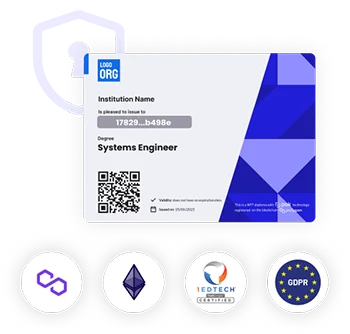
In summary
Open Badges 3.0 is the international standard for verifiable digital credentials, maintained by the 1EdTech Consortium and aligned with the W3C Verifiable Credentials Data Model. It enables institutions to issue tamper-proof, cryptographically signed credentials that anyone can verify independently. The standard was approved as final by 1EdTech in June 2024.
12 min read
Definition
What is Open Badges 3.0?
Open Badges 3.0 represent the most advanced evolution of the open standard for verifiable digital credentials. Developed and maintained by the 1EdTech Consortium (formerly IMS Global), Open Badges are a globally recognized format for issuing, sharing, and validating academic, professional, and online learning achievements.
This standard enables educational institutions, companies, governments, and communities to issue portable, secure, and interoperable digital credentials that users can store in their digital wallets and present in different contexts: from a LinkedIn profile to job applications or learning platforms.
This standard enables educational institutions, companies, governments, and communities to issue portable, secure, and interoperable digital credentials that users can store in their digital wallets and present in different contexts: from a LinkedIn profile to job applications or learning platforms.
What makes Open Badges 3.0 unique?
- Total interoperability: Based on 1EdTech guidelines and linked to technologies such as W3C Verifiable Credentials (VCs), badges can be used across multiple systems without being locked into a single platform.
- Verifiability: Each badge contains digitally signed metadata proving its authenticity, issuer, and achievement criteria.
- Global standardization: As an open standard, any institution can issue and any user can store and display their credentials without relying on a closed provider.
- Formal and informal recognition: Used not only for university degrees or corporate certifications but also for soft skills, microcredentials, and lifelong learning achievements.
The role of 1EdTech in Open Badges
1EdTech Consortium is the international organization leading the creation and evolution of this standard. Its mission is to ensure that digital learning ecosystems are open, accessible, and interoperable.
With Open Badges 3.0, 1EdTech ensures compatibility with other standards such as Comprehensive Learner Record (CLR) and W3C VCs, reinforcing the vision of a world where everyone can maintain a unique digital portfolio of academic and professional achievements, verifiable anywhere in the world.
With Open Badges 3.0, 1EdTech ensures compatibility with other standards such as Comprehensive Learner Record (CLR) and W3C VCs, reinforcing the vision of a world where everyone can maintain a unique digital portfolio of academic and professional achievements, verifiable anywhere in the world.
History & evolution
Open Badge 3.0 timeline: from Mozilla 1.0 to 1EdTech 3.0
Open Badge 3.0 is the result of more than a decade of standardization work. Key milestones:
- 2011 — Mozilla launches Open Badges 1.0 as an experimental framework for issuing digital achievements.
- 2016 — Open Badges 2.0 is published as the first widely adopted standard. Verification relies on metadata hosted on the issuer's server.
- 2017 — IMS Global (now 1EdTech) takes over stewardship of the standard from Mozilla.
- 2021 — Work begins on Open Badges 3.0 to align with the emerging W3C Verifiable Credentials Data Model.
- June 2024 — Open Badges 3.0 is officially approved as a final 1EdTech standard.
- 2025–2026 — Mass institutional adoption; major platforms (Accredible, Badgr/Canvas Credentials, Credly, POK and others) certify as 3.0 issuers. Migration from 2.0 to 3.0 accelerates.
Benefits of implementing Open Badges 3.0
- Greater trust and transparency in validating achievements.
- Facilitates employability and skills-based recruitment.
- Promotes lifelong learning through microcredentials.
- Boosts institutional SEO, as issuing organizations are positioned as leaders in verifiable digital credentials.
Comparison
Open Badge 3.0 vs Open Badge 2.0
Open Badge 3.0 is not a minor revision of 2.0 — it is a fundamental architectural shift toward decentralized, cryptographically verifiable credentials.
Aspect | Open Badge 2.0 (2016) | Open Badge 3.0 (2024) |
|---|---|---|
| Data format | JSON-LD with custom Open Badges schema | JSON-LD aligned with W3C Verifiable Credentials Data Model |
| Verification | Hosted JSON on issuer's server | Cryptographic proof (digital signatures, optional blockchain anchoring) |
| Independence from issuer | Limited — depends on issuer keeping URL live | Full — verifiable independently and indefinitely |
| Identifiers | URLs only | URLs and Decentralized Identifiers (DIDs) |
| Wallet integration | Limited | Native — compatible with the entire W3C VC ecosystem |
| Privacy controls | Basic | Advanced — selective disclosure of attributes |
| Revocation | Variable per platform | Standardized via W3C Status List |
| Migration path | N/A | Existing 2.0 credentials can be reissued in 3.0 format |
Technical anatomy
What's inside an Open Badge 3.0 credential
Every Open Badge 3.0 credential is a JSON-LD document with five essential components: a context that defines the vocabulary, the issuer's identity, the credential subject (the holder), the achievement being recognized, and a cryptographic proof that makes the credential verifiable independently.
The example below uses a real Open Badge 3.0 credential issued by POK to The World University. The complete, live, verifiable version is available at the link beneath the example.
Simplified example of an Open Badge 3.0 credential:
{
  "@context": [
    "https://www.w3.org/ns/credentials/v2",
    "https://purl.imsglobal.org/spec/ob/v3p0/context-3.0.3.json",
    "https://purl.imsglobal.org/spec/ob/v3p0/extensions.json"
  ],
  "id": "https://minter.pok.tech/certificate/5b7dd714-80e5-4c21-8beb-13130c3d0478",
  "type": ["VerifiableCredential", "OpenBadgeCredential"],
  "name": "Frontend Developer",
  "issuer": {
    "id": "did:key:z6MkjMuP7neY5xnb5wRgxgTSVayoV7uZiNmpsZq9jrKQchDn",
    "type": ["Profile"],
    "name": "The World University",
    "url": "https://mint.pok.tech/organization/0xae416b08dbd216c93048c252eb4e15c27f1c4aee"
  },
  "validFrom": "2025-07-01T00:00:00Z",
  "awardedDate": "2025-07-01T00:00:00Z",
  "credentialSubject": {
    "type": ["AchievementSubject"],
    "identifier": [{
      "type": "IdentityObject",
      "hashed": true,
      "identityHash": "sha256$350958bd...",
      "identityType": "emailAddress"
    }],
    "achievement": {
      "id": "https://minter.pok.tech/certificate/5b7dd714-.../achievement",
      "type": ["Achievement"],
      "name": "Frontend Developer",
      "description": "Comprehensive training in user interface design and development using HTML, CSS, JavaScript, React, and Angular...",
      "criteria": {
        "narrative": "Complete 300+ hours of work-study, maintain a 6.0/10 GPA, pass a final project, participate in 3 collaborative projects..."
      }
    }
  },
  "credentialSchema": [{
    "id": "https://purl.imsglobal.org/spec/ob/v3p0/schema/json/ob_v3p0_achievementcredential_schema.json",
    "type": "1EdTechJsonSchemaValidator2019"
  }],
  "proof": [{
    "type": "DataIntegrityProof",
    "cryptosuite": "eddsa-rdfc-2022",
    "proofPurpose": "assertionMethod",
    "verificationMethod": "did:key:z6MkjMuP7neY5xnb5wRgxgTSVayoV7uZiNmpsZq9jrKQchDn#z6MkjMuP...",
    "created": "2025-08-07T17:53:46Z",
    "proofValue": "z3gNfhXu8KyvQm4EM9uipcQpQtuVSx1jX7WSHLVkJ..."
  }]
}
→ See the live, verifiable credential
Verification flow
How is an Open Badge 3.0 credential verified?
Verifying an Open Badge 3.0 credential is a fully offline operation — no contact with the original issuer is required. The flow has four standard steps:
- Fetch the credential: obtain the credential as a JSON-LD document (from a URL, a wallet, a PDF, or a QR code).
- Resolve the issuer's identifier: take the issuer's DID or URL and retrieve the public key associated with it.
- Verify the cryptographic signature: use the issuer's public key to confirm that the credential has not been altered since it was signed.
- Check revocation status: query the W3C Status List referenced in the credential to confirm the credential is still active.
With POK's paid plans, a fifth optional step registers the credential on public blockchain, as a hash on Ethereum (Blockchain Verify) or as an NFT on Polygon or LACNet (NFT Ownership), so the proof remains verifiable even if the issuer's infrastructure changes or shuts down.
Related standards
Open Badge 3.0 vs W3C Verifiable Credentials vs ELM
These three standards are often confused. The reality is they are layered, not competing.
- W3C Verifiable Credentials (VC) — the foundational data model for any verifiable claim about any subject (employment, identity, education, healthcare). Maintained by the World Wide Web Consortium.
- Open Badges 3.0 — an Open Badge is a specific type of W3C VC. Maintained by 1EdTech. Specifies the achievement structure: name, criteria, evidence, image, alignment to skill frameworks.
- European Learning Model (ELM / Europass) — the European Union's framework for credential exchange across European education systems. Aligned with W3C VC. Adds fields like NQF level, ECTS credits, and language proficiency descriptors.
Bottom line: W3C VC is the foundation. Open Badges 3.0 specializes it for education and skills. ELM specializes it for European academic interoperability. An Open Badge 3.0 credential is also a valid W3C VC and can be made ELM-compatible by adding ELM-specific fields.
Adoption
Who is adopting Open Badge 3.0?
As of 2026, Open Badges 3.0 is the de facto standard for verifiable digital credentials in education and corporate training:
- 1EdTech Consortium: 600+ members including universities, governments, EdTech vendors, and assessment providers.
- Certified platforms: official issuers can be verified at the 1EdTech certifications directory. Major certified platforms include Accredible, Badgr (now Canvas Credentials), Credly, and POK; the full, up-to-date list of issuers is published in the directory linked above.
- Wallet ecosystem: Open Badge 3.0 credentials can be stored in any W3C Verifiable Credentials-compatible wallet, as well as in vendor wallets including the POK Credential Holder. Export to Google Wallet and Apple Wallet is supported by platforms that provide white-label integrations.
- Geography: institutional adoption across North America, Latin America, Europe, and Asia-Pacific.
Open Badges 3.0 at POK - Proof of Knowledge
Open Badges 3.0 at POK
At POK - Proof of Knowledge, we believe the value of a digital credential goes far beyond a simple file or image. That is why we adopted the Open Badges 3.0 (OB3.0) standard from 1EdTech, an organization we are proud to be partners with. This ensures that every certificate, diploma, or badge issued through our platform is secure, verifiable, portable, and interoperable, with international recognition.
By integrating OB3.0 with our blockchain and IPFS technologies, we make digital credentials:
This means that universities, companies, NGOs, and educational entities issuing credentials through POK are not only recognizing skills and achievements but also providing their learners and collaborators with credentials that meet the most advanced international standards.
In other words, at POK - Proof of Knowledge we don’t just issue digital credentials—we issue Open Badges 3.0 powered by blockchain, ready for the present and the future of learning and work.
By integrating OB3.0 with our blockchain and IPFS technologies, we make digital credentials:
- Immutable: blockchain ensures that each record is sealed and cannot be altered.
- Portable: users can take their credentials to any compatible digital wallet, without being tied to a single system.
- Interoperable: following the 1EdTech standard, badges issued by POK can be recognized across multiple educational and professional platforms worldwide.
- Verifiable: anyone can instantly and transparently validate the authenticity of a credential.
This means that universities, companies, NGOs, and educational entities issuing credentials through POK are not only recognizing skills and achievements but also providing their learners and collaborators with credentials that meet the most advanced international standards.
In other words, at POK - Proof of Knowledge we don’t just issue digital credentials—we issue Open Badges 3.0 powered by blockchain, ready for the present and the future of learning and work.
Migration
How to migrate from Open Badge 2.0 to 3.0
Institutions with existing Open Badge 2.0 credentials don't need to invalidate them. There are three practical migration approaches:
- Continue 2.0 in parallel — 2.0 credentials remain valid as long as the issuing platform keeps its servers online. Suitable as a short-term path.
- Reissue under 3.0 — most certified platforms (including POK) can reissue 2.0 credentials in the new 3.0 format for the same holders, with a new cryptographic proof.
- Hybrid approach — new credentials go out as 3.0 from a cut-off date, while legacy 2.0 credentials remain as-is. The most common path for large institutions with historical archives.
Key institutional consideration: 2.0 credentials depend on the issuer's hosting infrastructure to remain verifiable. 3.0 credentials are cryptographically verifiable without contacting the issuer — and with POK, they are additionally anchored on public blockchain for permanent independent verification.
Compatibility
Wallets, LMS, and platforms that support Open Badge 3.0
The Open Badge 3.0 ecosystem extends well beyond issuance — it includes wallets, learning management systems, and enterprise integrations:
- Wallets: Apple Wallet (via vendor integrations), Google Wallet (via vendor integrations), POK Credential Holder, and any W3C Verifiable Credentials-compatible wallet.
- LMS: Moodle, Canvas (Instructure), D2L Brightspace, Blackboard, via LTI 1.3 and REST APIs.
- CRM: Salesforce, HubSpot.
- HR systems: most enterprise HR platforms can integrate via REST API or webhooks.
- Automation: Zapier and webhook-based pipelines for instant issuance on milestone completion.
Glossary
Open Badge 3.0 key terms
Essential vocabulary for working with Open Badge 3.0:
- Issuer
- The institution or platform that creates and digitally signs the credential.
- Holder
- The individual who earns and possesses the credential — typically managed through a digital wallet.
- Verifier
- Any party that needs to confirm the authenticity of a credential (employer, registrar, government agency).
- Verifiable Credential (VC)
- A digitally signed claim that can be verified independently using cryptography.
- Decentralized Identifier (DID)
- A globally unique identifier that is not controlled by any central authority — used for issuers and holders.
- Proof
- The cryptographic signature or blockchain anchor that makes the credential tamper-evident and verifiable.
- JSON-LD
- The data format used by Open Badge 3.0 — JSON with linked-data semantics.
- Status List
- A W3C standard mechanism to mark credentials as revoked without altering the original document.
- Selective disclosure
- The holder's ability to share only specific attributes of a credential, preserving privacy.
- Achievement
- The skill, course, or competency that the credential represents.
For institutions
Open Badge 3.0 implementation checklist
Before adopting an Open Badge 3.0 platform, evaluation teams should validate these criteria:
- Official 1EdTech certification: is the platform listed in the 1EdTech certifications directory as a certified Open Badges 3.0 Issuer?
- Verification independence: will credentials remain verifiable if the platform shuts down or contracts end?
- W3C VC alignment: does the implementation use the full W3C Verifiable Credentials Data Model?
- DID support: does the platform support decentralized identifiers for issuers and holders?
- Revocation strategy: how are revoked credentials handled — via W3C Status List?
- Migration path: can existing Open Badge 2.0 credentials be reissued in 3.0 format?
- Privacy controls: does the platform support selective disclosure of attributes?
- Wallet portability: can holders move credentials to other compatible wallets without losing verifiability?
- Security certifications: does the provider hold ISO 27001, SOC 2, and 1EdTech TrustEd Apps data privacy certifications?
Resources
Authoritative resources on Open Badge 3.0
Primary sources for technical specifications and certifications:
- 1EdTech Open Badges 3.0 Specification — the official standard document.
- W3C Verifiable Credentials Data Model 2.0 — the foundational standard.
- 1EdTech Certifications Directory — official list of certified platforms.
Frequently asked questions
Open Badges is the leading open standard for digital credentials and badges — originally developed by the Mozilla Foundation in 2011 and now managed by 1EdTech (formerly IMS Global).
It defines how digital credentials should be structured, issued, and verified to ensure:
POK is 1EdTech certified for its Open Badges 3.0 implementation — one of the few digital credential platforms globally to achieve this certification.
It defines how digital credentials should be structured, issued, and verified to ensure:
- Interoperability — badges work across different platforms, LMS systems, and professional networks
- Portability — recipients can share and use their badges anywhere without platform dependency
- Verifiability — any third party can confirm the authenticity of a badge instantly
POK is 1EdTech certified for its Open Badges 3.0 implementation — one of the few digital credential platforms globally to achieve this certification.
Open Badges 2.0 was the reference standard for digital credentials for years, allowing inclusion of basic metadata about the issuer, recipient, and achievement.
Open Badges 3.0, supported by POK, advances this significantly:
Open Badges 3.0, supported by POK, advances this significantly:
- Integrates natively with the W3C Verifiable Credentials (VC) model — enabling cryptographic verification of credential authenticity
- Improves interoperability with professional networks, LMS systems, and government platforms
- Supports enriched metadata including competency framework alignments, detailed criteria, and supporting evidence
- Compatible with the European Learning Model (ELM) for cross-border recognition
POK is 1EdTech certified for data privacy — one of the few digital credential platforms globally to hold this certification.
1EdTech (formerly IMS Global) is the international standards body that manages Open Badges 3.0, the European Learning Model (ELM), and the TrustEd Credentials Framework. Platforms with 1EdTech certification meet independently verified standards for data privacy, interoperability, and credential portability.
POK also holds ISO 27001 and SOC 2 certifications, making it the only digital credential platform combining 1EdTech certification, NFT blockchain credentials, and a 100% free unlimited plan — trusted by 1,100+ institutions across 19 countries.
1EdTech (formerly IMS Global) is the international standards body that manages Open Badges 3.0, the European Learning Model (ELM), and the TrustEd Credentials Framework. Platforms with 1EdTech certification meet independently verified standards for data privacy, interoperability, and credential portability.
POK also holds ISO 27001 and SOC 2 certifications, making it the only digital credential platform combining 1EdTech certification, NFT blockchain credentials, and a 100% free unlimited plan — trusted by 1,100+ institutions across 19 countries.
POK is aligned with the most relevant global standards for digital credentials:
- Open Badges 3.0 — the most widely adopted open standard for digital badges and microcredentials, managed by 1EdTech
- W3C Verifiable Credentials — the internationally recognized data model for verifiable digital credentials, ensuring interoperability across platforms and systems
- European Learning Model (ELM/Europass) — the European framework ensuring interoperability in education and employment, enabling credential recognition across Europe
- 1EdTech TrustEd Credentials Framework — independently verified standards for data privacy, interoperability, and credential portability
Yes. POK is fully compatible with Europass — the European initiative that facilitates the presentation and verification of skills and qualifications internationally.
Credentials issued with POK can be directly integrated into the Europass profile of the holder, alongside other academic and professional documents. This is enabled through POK's compliance with the European Learning Model (ELM) — the technical framework underpinning Europass interoperability.
This compatibility is essential for:
Credentials issued with POK can be directly integrated into the Europass profile of the holder, alongside other academic and professional documents. This is enabled through POK's compliance with the European Learning Model (ELM) — the technical framework underpinning Europass interoperability.
This compatibility is essential for:
- Students and professionals seeking opportunities across Europe
- Universities with international students or European institutional partnerships
- Organizations issuing credentials that need to be recognized by employers, universities, and authorities across multiple countries
A digital badge is a visual and verifiable representation of a specific achievement, skill, or experience — typically used for microcredentials, course completions, and competency recognitions.
Unlike traditional certificates, digital badges include embedded metadata that describes:
POK issues digital badges compliant with Open Badges 3.0 — the latest version integrating W3C Verifiable Credentials for enhanced cryptographic verification and global portability.
Unlike traditional certificates, digital badges include embedded metadata that describes:
- Who issued the badge and their credentials
- What the badge validates — criteria, competencies, or learning outcomes
- When it was earned and whether it has an expiration date
- Evidence supporting the achievement
POK issues digital badges compliant with Open Badges 3.0 — the latest version integrating W3C Verifiable Credentials for enhanced cryptographic verification and global portability.
POK differentiates itself in five key areas:
- Only platform combining a 100% free unlimited plan with NFT blockchain credentials — no user caps, no setup costs, no expiration, and no lock-in.
- Security certifications: ISO 27001 and SOC 2 — independently audited standards for data protection and access management. Few credential platforms globally hold both.
- 1EdTech certified for data privacy — the international body managing Open Badges 3.0, ELM, and the TrustEd Credentials Framework.
- European Learning Model (ELM/Europass) compatible — enabling credential recognition across Europe and markets adopting this framework.
- Employment tracking and learning pathways — measuring the real impact of credentials on job opportunities, not just issuance.
Open Badge 3.0 is not directly backwards-compatible with 2.0, because it uses a different data model (aligned with W3C Verifiable Credentials) and different verification mechanisms (cryptographic proofs instead of hosted JSON). However, most certified platforms — including POK — can reissue existing 2.0 credentials in 3.0 format for the same holders, preserving the institutional record without invalidating prior achievements.
No. Open Badge 3.0 only requires a cryptographic proof — typically a digital signature using the issuer's private key. Blockchain anchoring is optional. POK offers both: a free unlimited Web2 plan using digital signatures, and paid plans that register each credential on public blockchain, as a hash on Ethereum (Blockchain Verify) or as an NFT on Polygon or LACNet (NFT Ownership), for credentials that need permanent, intermediary-free verification.
Yes. Open Badge 3.0 uses the W3C Status List standard for revocation. The issuer maintains a status list referenced in the credential; when a credential is revoked, the corresponding entry in the list is updated. Verifiers check this list during verification. The original credential document is never altered.
The POK Credential Holder natively supports Open Badge 3.0. POK also enables white-label export to Google Wallet and Apple Wallet on every plan, including the free one, so recipients can store credentials in their phone's native wallet with the institution's branding. Any W3C Verifiable Credentials-compatible wallet can also store and present Open Badge 3.0 credentials.
A PDF certificate can be edited, photoshopped, or fabricated — verification requires manually contacting the issuer. An Open Badge 3.0 credential is cryptographically signed: any change to the document invalidates the signature. Anyone can verify it in seconds without contacting the issuer. With POK's paid plans, credentials are additionally anchored on public blockchain for permanent verification.
1EdTech Consortium (formerly IMS Global), a non-profit organization with 600+ members including universities, governments, technology platforms, and education providers. The standard is open, public, and developed collaboratively with the community. Version 3.0 was approved as final in June 2024.
Yes. Open Badge 3.0 is an open standard with no commercial restrictions. Any organization can issue, hold, verify, or process Open Badge 3.0 credentials. To advertise as an officially certified issuer or platform, the organization must complete the 1EdTech certification process — listed publicly at the 1EdTech certifications directory.
Yes. POK has been a certified 1EdTech Open Badges 3.0 Issuer since 2025. POK is also certified under the 1EdTech TrustEd Apps data privacy program. Both certifications can be verified at the public 1EdTech certifications directory.
Start recognizing achievements with POK!
Join over 1,100 institutions already issuing verifiable digital credentials with POK. Free plan, no commitment.