Everything you need to issue, verify and scale digital credentials
POK - Proof of Knowledge is a global platform for issuing verifiable digital credentials, microcredentials and NFT certificates on blockchain — used by over 1,100 universities, companies, and governments in 19 countries. Certified by 1EdTech, ISO 27001 and SOC 2, compatible with Open Badges 3.0 and ELM/Europass.Credentials issued
Active institutions
Countries
HolonIQ EdTech LA
The new POK
Three products, one system
Issue verifiable credentials, understand the skills they prove, and connect them to education and work. Each product works on its own; together they form a single system.
Learn anywhere. Prove everything. Understand your skills. Connect them to education and work.
POK Platform
All features in one platform
Employability Tracking
Measure the real impact of your programs with real-time LinkedIn data.
100% White Label
Issue credentials with your own domain, logo and colors — no POK branding.
Marketing & AdTech
Turn every credential into a viral organic marketing campaign.
Advanced Digital Signature
Legally backed credentials with immutable blockchain registration.
Branded Wallet App
Mobile app for students to store and share their credentials.
Learning Paths
Connect microcredentials into structured, certified learning journeys.
POK + IEE Equivalency
International academic recognition for credentials issued with POK.
Native Integrations
Moodle, Canvas, Blackboard, D2L Brightspace, Sana, REST API and more.
Bulk Issuance
Issue thousands of credentials in seconds via CSV upload or API.
Public Verification
Anyone can check a credential in seconds, with no accounts and no phone calls.
Template Designer
Visual editor with per-recipient attributes, signatures and paper formats.
Email Campaigns
Expiry warnings and share reminders, sent from your own address.
Credential Lookup
A search over the credentials you issued, on your site or your POK page.
POK Platform
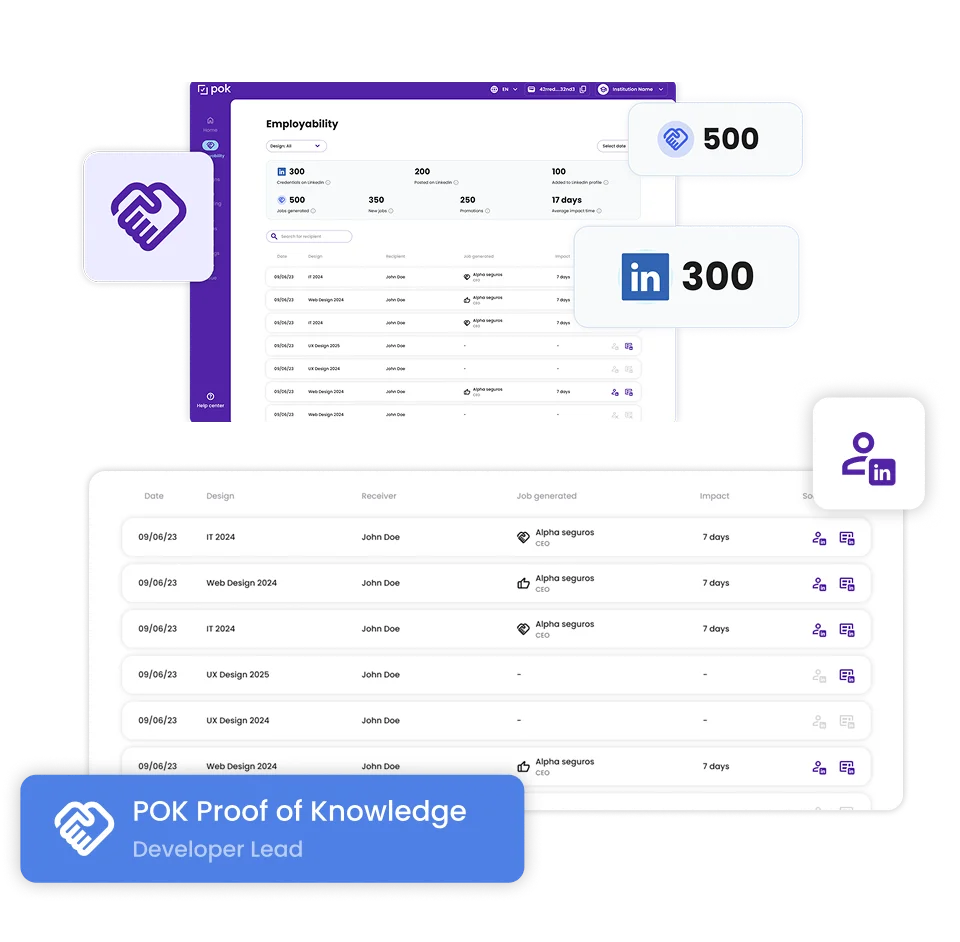
LinkedIn Employability Tracking: Measure the Real Impact of Your Credentials
POK enables universities and companies to precisely and continuously understand the real impact of their training on the professional careers of their students and employees. Through real-time data linked to LinkedIn, institutions can analyze each student's individual progress, calculate cohort growth percentages, and adjust their educational programs based on concrete evidence.
POK's employability tracking also keeps the post-certification connection with graduates active, strengthening institutional engagement and program reputation in the job market.
With POK, you not only issue verifiable NFT digital credentials but transform the way you measure, communicate, and multiply the value of your training.
POK Platform
100% White-label digital credentials platform with full customization
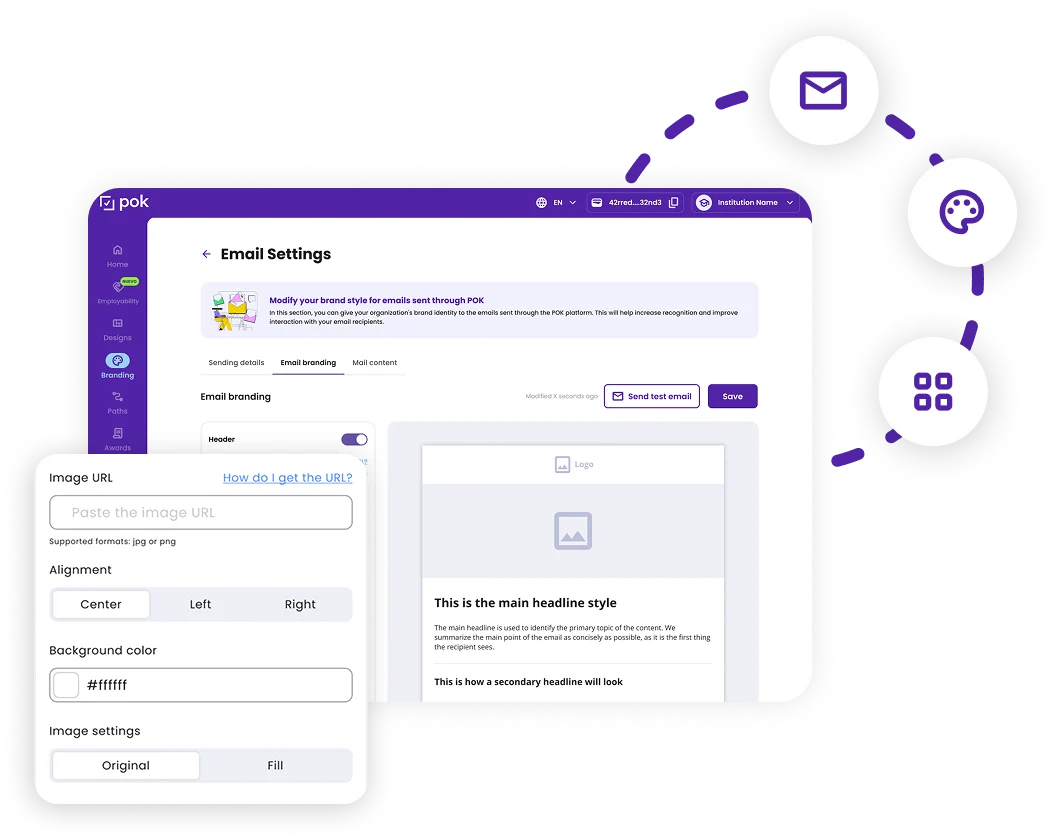
With POK, your institution maintains its identity in every detail:
POK offers comprehensive white-label customization for the entire credential issuance and reception experience: custom domain, email branding, sending from your own SMTP domain, fully customizable credential display pages with banners, brand colors and multimedia content, export to Google Wallet and Apple Wallet with white-label, and a recipient wallet compatible with Open Badges 3.0 and ELM/Europass.
Every touchpoint with the student or employee reflects the institutional identity — not the platform’s.
POK is the only NFT digital credential platform that combines true white-label with the flexibility to customize and control every touchpoint with your students or employees.
POK Platform
Marketing and AdTech: Turn Every Credential into a Growth Tool
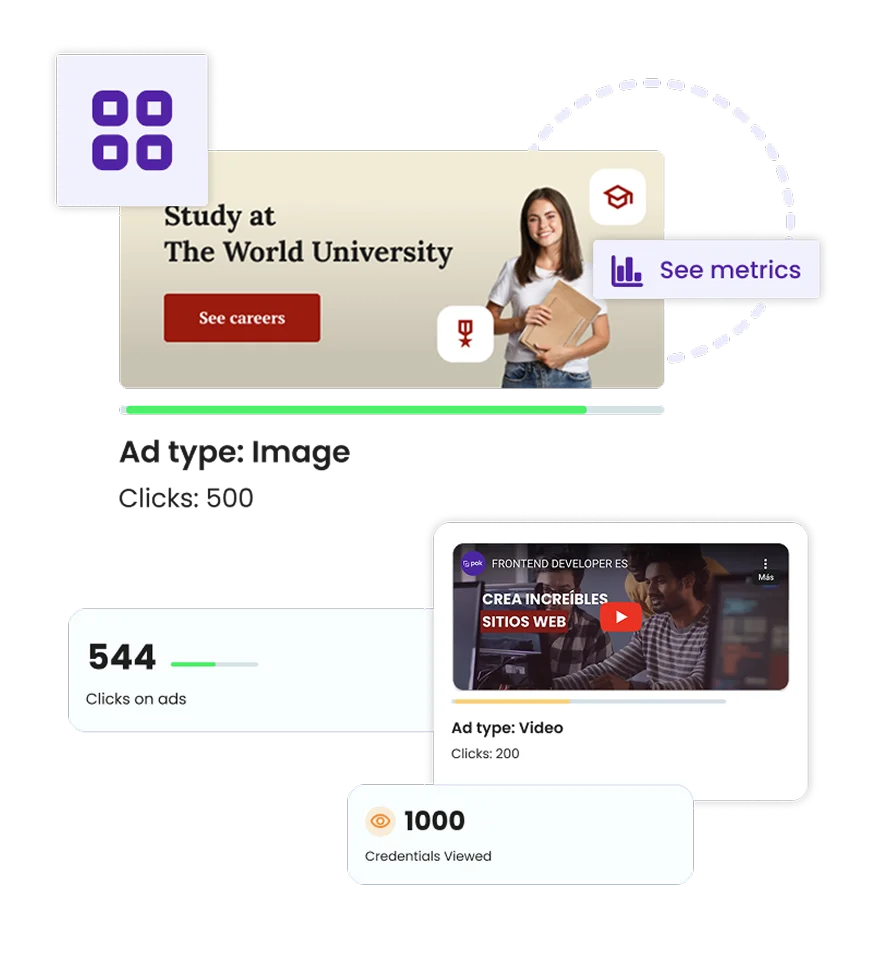
With POK, every NFT digital credential you issue not only certifies achievements: it multiplies your brand’s reach and turns your students into ambassadors spreading your message to thousands or even millions on networks like LinkedIn.
POK integrates marketing and advertising features directly into the credential experience. Institutions can configure customizable banners with images, text, video, and links that appear on each credential's display page, track clicks and conversions through Google Ads integration, identify new prospects from interactions with shared credentials, and measure the real ROI of each certification program.
When a student shares their credential on LinkedIn, the institutional logo, message, and values travel with it — generating organic exposure and qualified leads at no additional cost.
POK is the only white-label, NFT, and LATAM leader platform combining secure credential issuance with a measurable and scalable marketing ecosystem. Turn every certification into a living campaign that boosts your reputation, employability, and revenue.
POK Platform
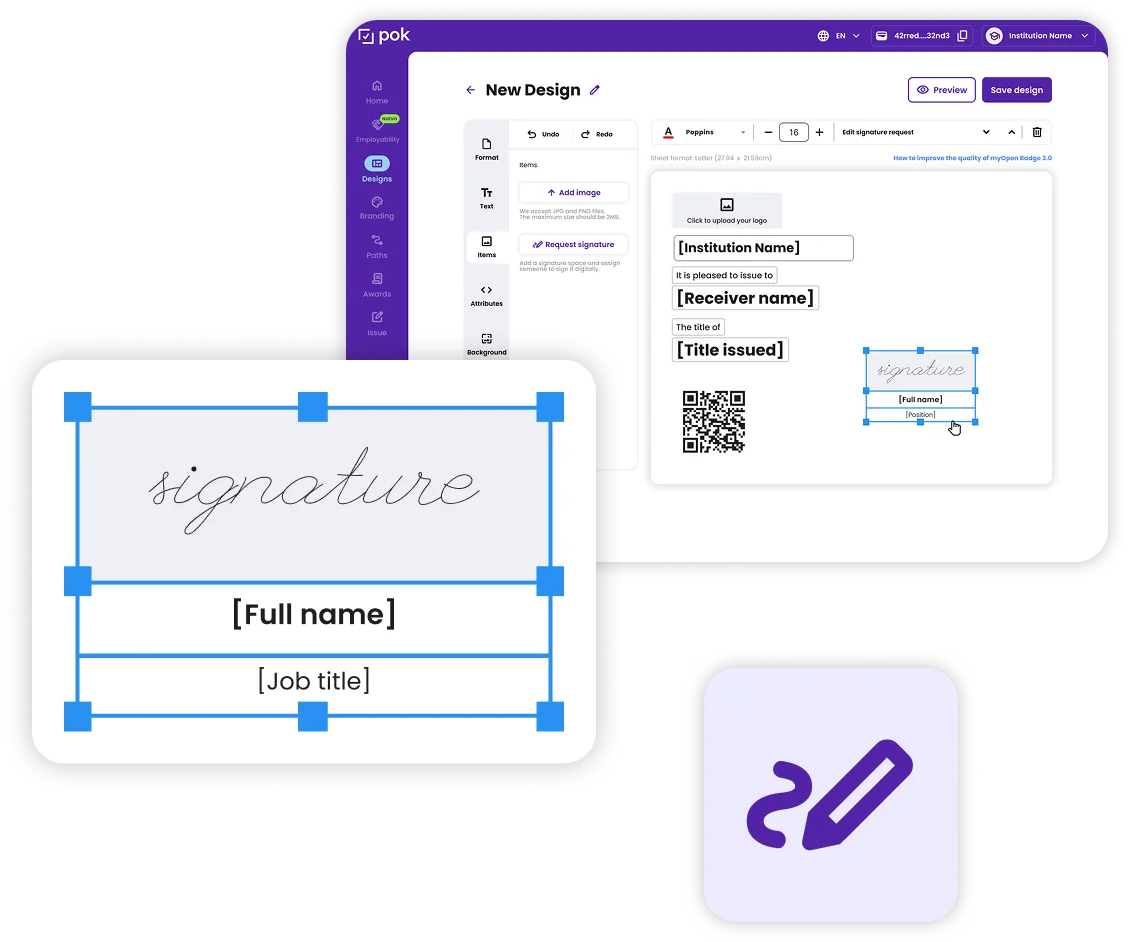
Advanced digital signature on your credentials: authenticity with legal backing
POK allows including advanced digital signature on each credential, validated by an authorized person before issuance. An authorized signer approves each credential before publication, linking the signature to the blockchain to ensure traceability and document integrity.
This functionality is comparable to leading solutions like DocuSign or Adobe Sign, integrated directly into the credential issuance workflow and compatible with internationally recognized digital signature standards.
POK combines the most reliable digital signature technology with the power of NFT credentials on blockchain, so every certificate you issue is unique, verifiable, and legally backed.
POK Platform
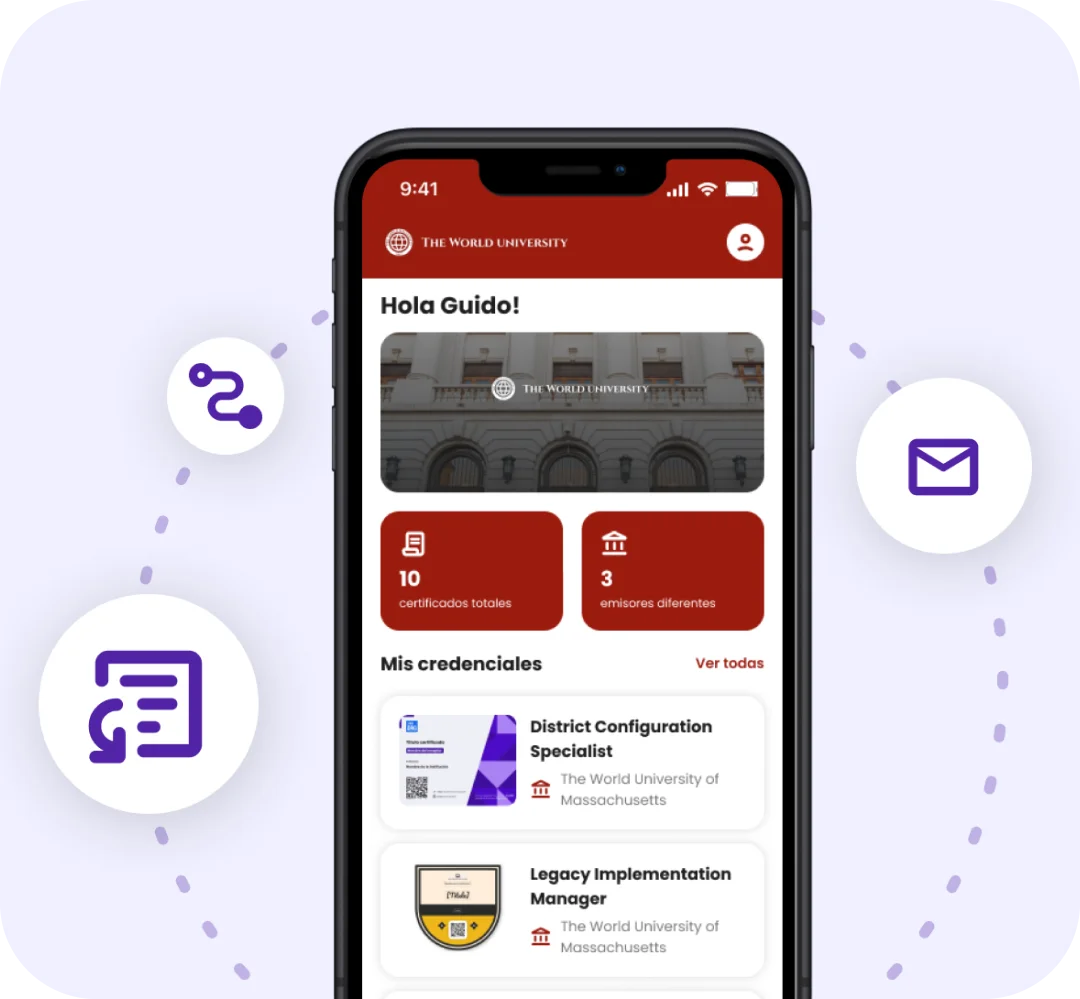
Credential Wallet with Custom Branding: Compatible with Open Badges 3.0
POK enables institutions to offer students and graduates a digital credential wallet with the institution’s brand — designed to securely store, organize, and share credentials in a verifiable way. The wallet stores NFT credentials issued by POK on public blockchain and also accepts credentials from any platform compatible with Open Badges 3.0, including Credly, Accredible, and Canvas Credentials.
This allows users to manage all their digital credentials in one place, with the visual identity of the issuing institution.
Unlike other platforms that just use blockchain as a marketing resource, POK issues real NFT credentials, with traceability, interoperability, and permanent value for the holder. With POK Wallet App your institution delivers not just a certificate, but a digital asset with identity, value, and global portability.
POK Platform
Learning Paths with POK: Connect Microcredentials and Boost Professional Development
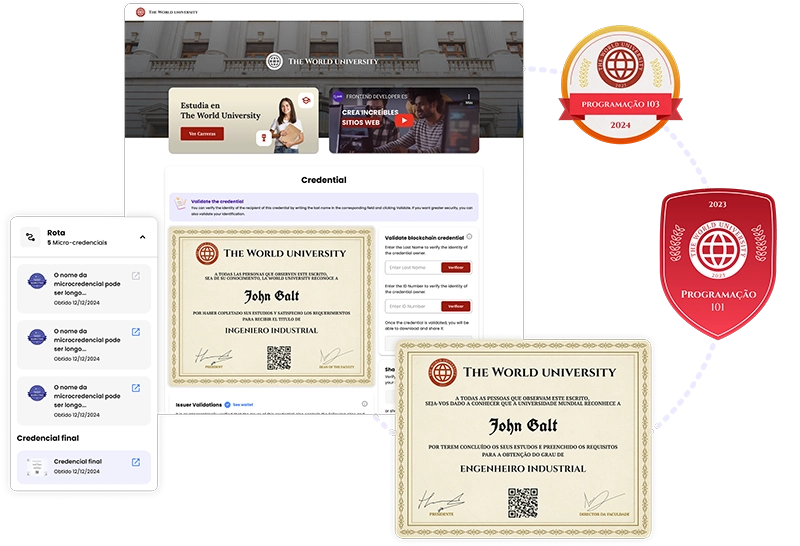
POK enables universities and companies to design structured learning paths that connect microcredentials and digital certificates in a coherent educational journey. Each milestone is validated with a verifiable digital microcredential issued on public blockchain, and upon completing all modules, the student receives a final credential recognizing the full set of acquired skills.
What is a Learning Path?
A Learning Path is a structured training journey composed of different courses, workshops, or learning experiences. Each milestone is validated with a verifiable digital microcredential, and upon completing all modules, the student receives a final credential recognizing the full set of acquired skills.
Why implement Learning Paths with POK?
POK’s learning paths integrate natively with Moodle, Open edX, D2L Brightspace, and Blackboard, are compatible with Open Badges 3.0, and allow full customization with institutional branding. Each microcredential and the final credential are recorded on public blockchain, ensuring authenticity and permanent ownership. Institutions can monitor each student’s progress with real-time metrics and communicate the impact of their programs with verifiable data.
With POK, your Learning Paths are not just a training journey but a certified, measurable, and high-impact experience that boosts your institution’s reputation and your students’ professional future.
POK Platform
POK + IEE Equivalency: Global Academic Recognition
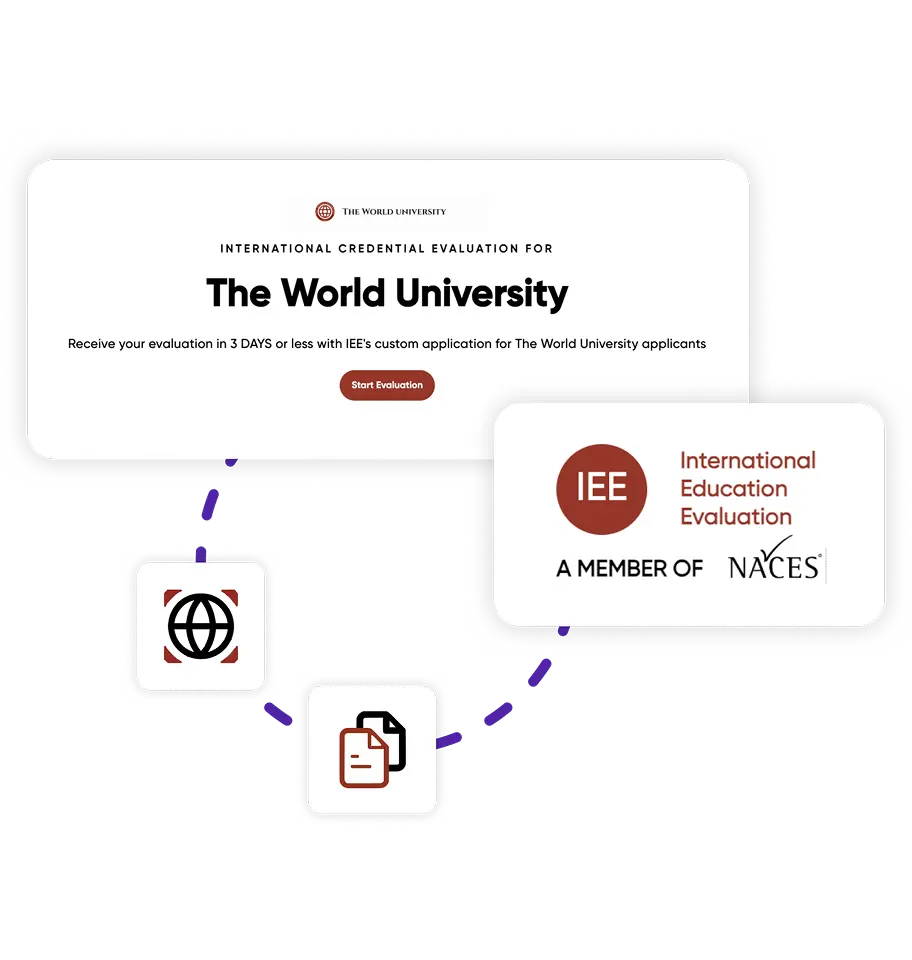
POK integrates with IEE Equivalency (International Education Evaluations), an official NACES member, to connect blockchain-based digital credentials with official academic evaluations recognized in the United States. Universities can issue digital credentials with POK while their students directly request U.S. academic equivalency evaluations through IEE.
This integration turns a digital credential into globally recognized academic value — from the blockchain to U.S. institutional verification, with authenticity, transparency, and global mobility for every student.
With POK + IEE Equivalency, institutions open the path to turning academic achievements into globally validated credentials.
POK Platform
Public verification, without calling the institution
Every credential issued with POK has a unique link and a QR code that open its public verification page: issuer, holder, date, skills and real-time status.
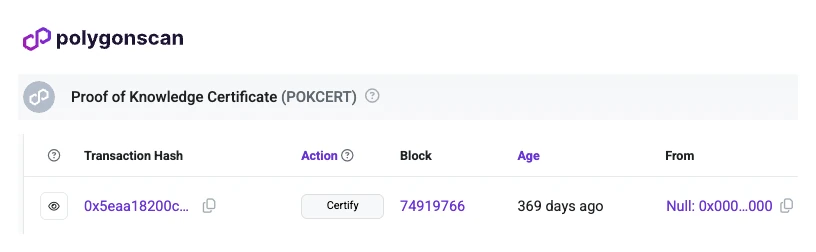
With Blockchain Verify or with NFT credentials, the record can also be checked independently on public blockchains, so the validity of a degree never depends on POK staying in business. See how verification works.
POK Platform
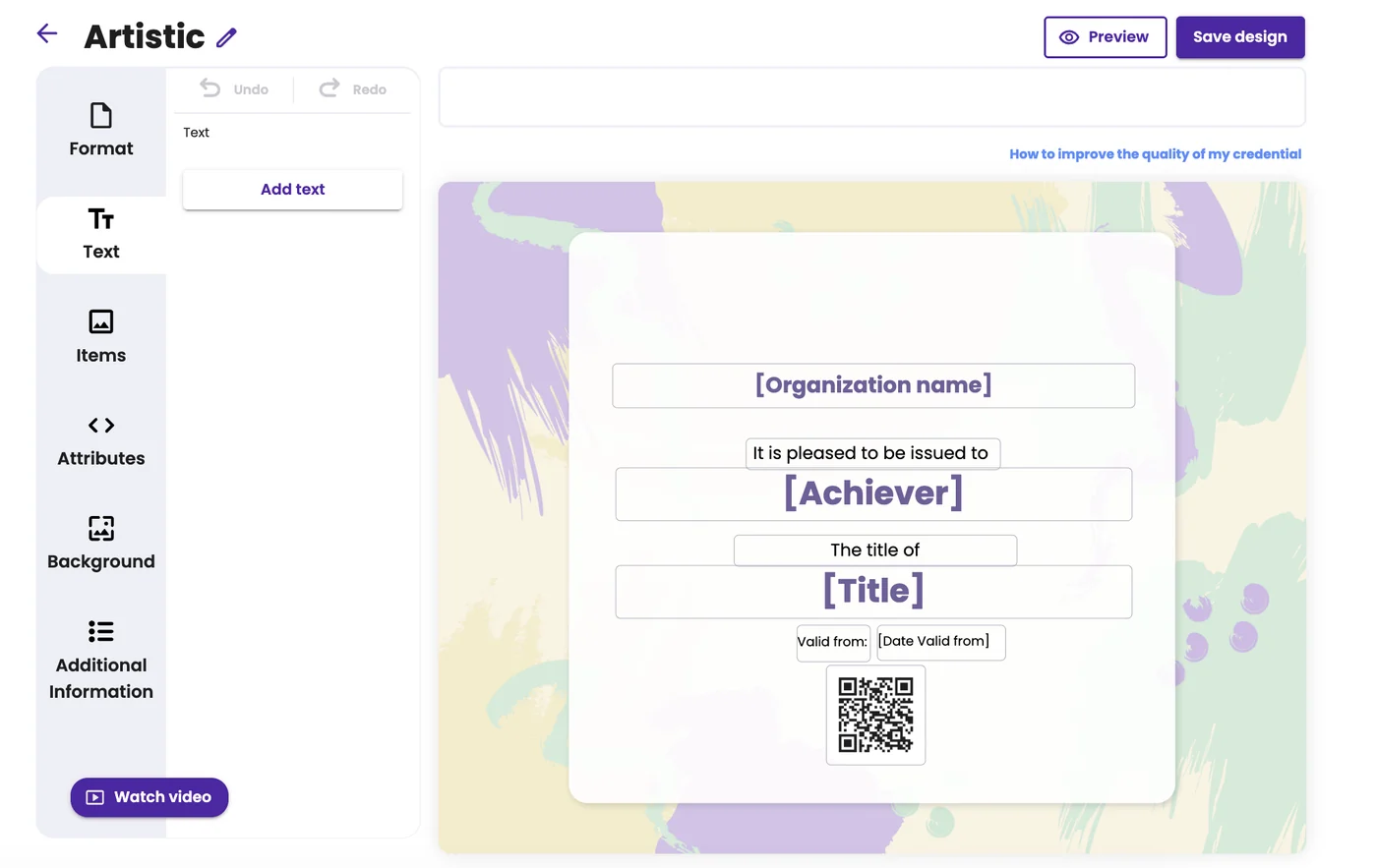
Design the template once, issue thousands of credentials
A visual editor where you set background, logo, typefaces, signatures and the fields that change on every credential. At issuing time, POK fills in each recipient's data over that design.
It covers custom attributes, information that varies per person, a dynamic image through the API, paper formats and a preview before issuing. See the template designer.
POK Platform
POK Integrations: Moodle, Canvas, Blackboard, API and more
POK integrates natively with the leading learning management systems and corporate platforms: Moodle, Blackboard, D2L Brightspace, Open edX, Canvas and Sana. LTI integrations allow credentials to be issued automatically upon course completion, with no manual intervention and no additional integration costs.
For institutions with specific needs, POK offers a documented API that fully automates the credential issuance, query and revocation workflow. POK's API-first architecture ensures that any institutional system can connect with minimal development resources and without dependency on specialized technical teams.
POK Platform
Bulk Digital Credential Issuance: Simple, Fast and Unlimited
POK allows institutions to issue digital credentials in bulk to hundreds or thousands of recipients in a single process, with no user limit and no additional cost on the free plan. Institutions can upload recipient data via an Excel or CSV file, configure the credential design with their institutional branding and issue in seconds — with no technical team and no complex setup.
For more advanced workflows, POK offers automated issuance via API and automatic issuance integrated with LMS via LTI, allowing credentials to be issued directly upon course or program completion without manual intervention. Institutions can also schedule credential issuance in advance, setting the exact delivery date and time.
POK Platform
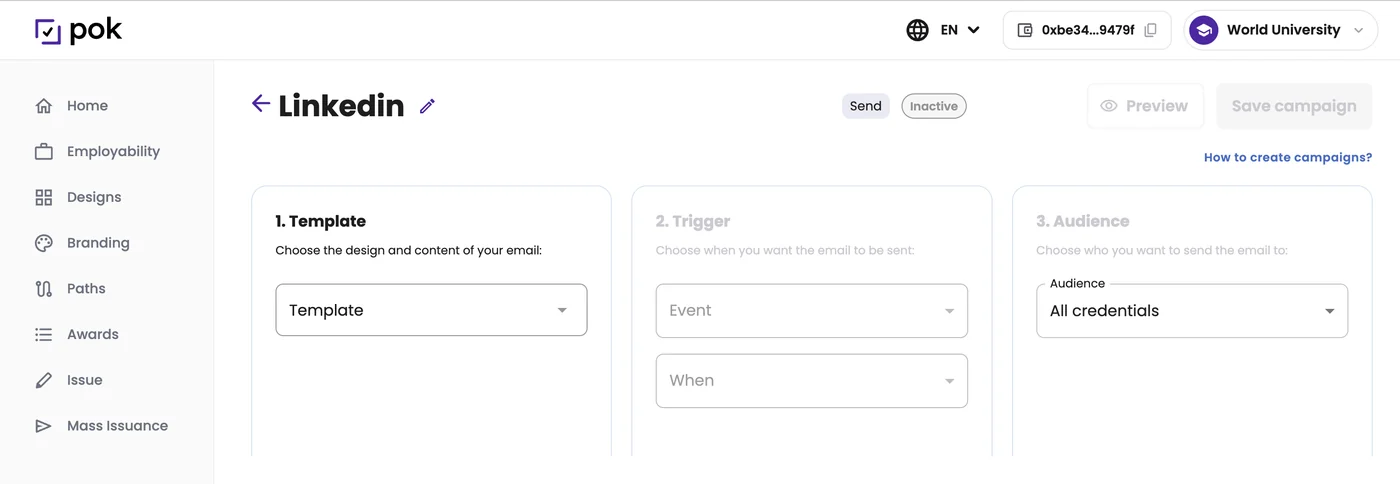
Expiry flagged in time, and credentials that actually get shared
Campaigns that fire when a credential is sent, accepted or about to expire, with the audience filtered by state, credential type or whether it was already shared on LinkedIn.
They go out from your own address and with your template, and switch on when you decide. The acceptance reminder already runs by itself: this is for everything that comes after. See email campaigns.
POK Platform
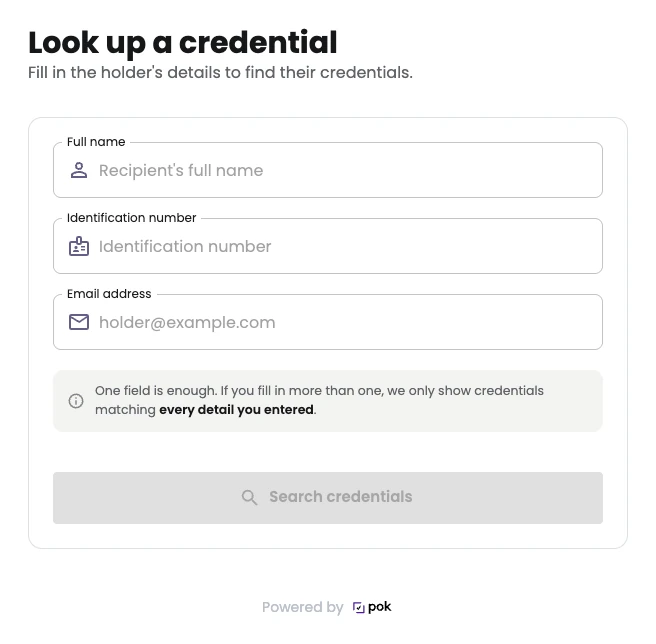
Credential lookup: your own degree search
Publish a search over the credentials your institution issued, so anyone can confirm a degree without writing to your registrar's office. People search by first and last name, ID number or email, depending on what you enable, and every result shows the credential's real status.
It goes as a section of your organization page on POK, as an iframe on your own site, or both at once. How the credential lookup works.
Frequently asked questions
Free Web2 version:
- 100% free with no user caps, no setup costs, and no expiration
- Credentials are verified via a unique link or QR code on the POK verification portal
- Fully customizable design with institution branding
- Compatible with Open Badges 3.0, W3C Verifiable Credentials, and ELM
- Each credential is registered as a unique Non-Fungible Token on Polygon and LacNet — public blockchains
- Decentralized cryptographic verification — verifiable by anyone, independently, without POK as intermediary
- Permanent traceability showing when and by whom the credential was issued
- Recipient owns the credential in their digital wallet, shareable on professional networks
- Credentials remain verifiable even if POK ceases to operate
Some platforms claim to use blockchain but actually only generate a cryptographic hash — an alphanumeric fingerprint — and store it on a private server or permissioned network. This is fundamentally different from registering credentials on a public blockchain:
- A hash alone does not contain the credential or its metadata — only a string that represents it
- If the server hosting the information disappears or is manipulated, verification breaks entirely
- A private or permissioned blockchain depends on a central administrator, reducing decentralization and resistance to manipulation
Public blockchain (e.g., Polygon, Ethereum):
- Open network where anyone can read and verify records independently
- Data distributed across thousands of nodes — maximum resistance to manipulation
- Credential verification does not depend on any single organization remaining operational
- Managed by an organization or consortium controlling who can access and record information
- Faster and cheaper to operate, but depends on a central administrator
- If the administrator disappears or restricts access, credential verification may be compromised
- Open Badges 3.0 — the most widely adopted open standard for digital badges and microcredentials, managed by 1EdTech
- W3C Verifiable Credentials — the internationally recognized data model for verifiable digital credentials, ensuring interoperability across platforms and systems
- European Learning Model (ELM/Europass) — the European framework ensuring interoperability in education and employment, enabling credential recognition across Europe
- 1EdTech TrustEd Credentials Framework — independently verified standards for data privacy, interoperability, and credential portability
Education (LMS):
- Moodle, Canvas, Blackboard, Brightspace (D2L) and Open edX register over LTI 1.3 from the integrations panel. Canvas also accepts an API key.
- Sana delivers its results over xAPI.
- Any other system comes in through the custom integration, with an LTI URL or an API key.
- A CRM connects through the REST API or the custom integration, like any other in-house system.
- Google Ads integration for remarketing campaigns based on credential engagement.
The result is issuance on autopilot: a student passes a course and the credential goes out on its own, with no human intervention.
Open Badges 3.0, supported by POK, advances this significantly:
- Integrates natively with the W3C Verifiable Credentials (VC) model — enabling cryptographic verification of credential authenticity
- Improves interoperability with professional networks, LMS systems, and government platforms
- Supports enriched metadata including competency framework alignments, detailed criteria, and supporting evidence
- Compatible with the European Learning Model (ELM) for cross-border recognition
Credentials issued with POK can be directly integrated into the Europass profile of the holder, alongside other academic and professional documents. This is enabled through POK's compliance with the European Learning Model (ELM) — the technical framework underpinning Europass interoperability.
This compatibility is essential for:
- Students and professionals seeking opportunities across Europe
- Universities with international students or European institutional partnerships
- Organizations issuing credentials that need to be recognized by employers, universities, and authorities across multiple countries
Start recognizing achievements with POK!
Join over 1,100 institutions already issuing verifiable digital credentials with POK. Free plan, no commitment.