POK Platform
Measure your graduates’ employability and career mobility with real-time data
POK measures what happened to your graduates after they received the credential: how many posted it on their professional profile, how many landed a new job, how many were promoted in the one they already had, and how many days passed on average before that change.
Measuring employability usually means calling graduates who never pick up and publishing a report built on half the answers. Here the figure updates on its own and rests on something checkable: the holder shared their digital credential and their professional profile changed afterwards.
The Employability section is a premium feature and is enabled through your account executive.
Measuring employability usually means calling graduates who never pick up and publishing a report built on half the answers. Here the figure updates on its own and rests on something checkable: the holder shared their digital credential and their professional profile changed afterwards.
The Employability section is a premium feature and is enabled through your account executive.
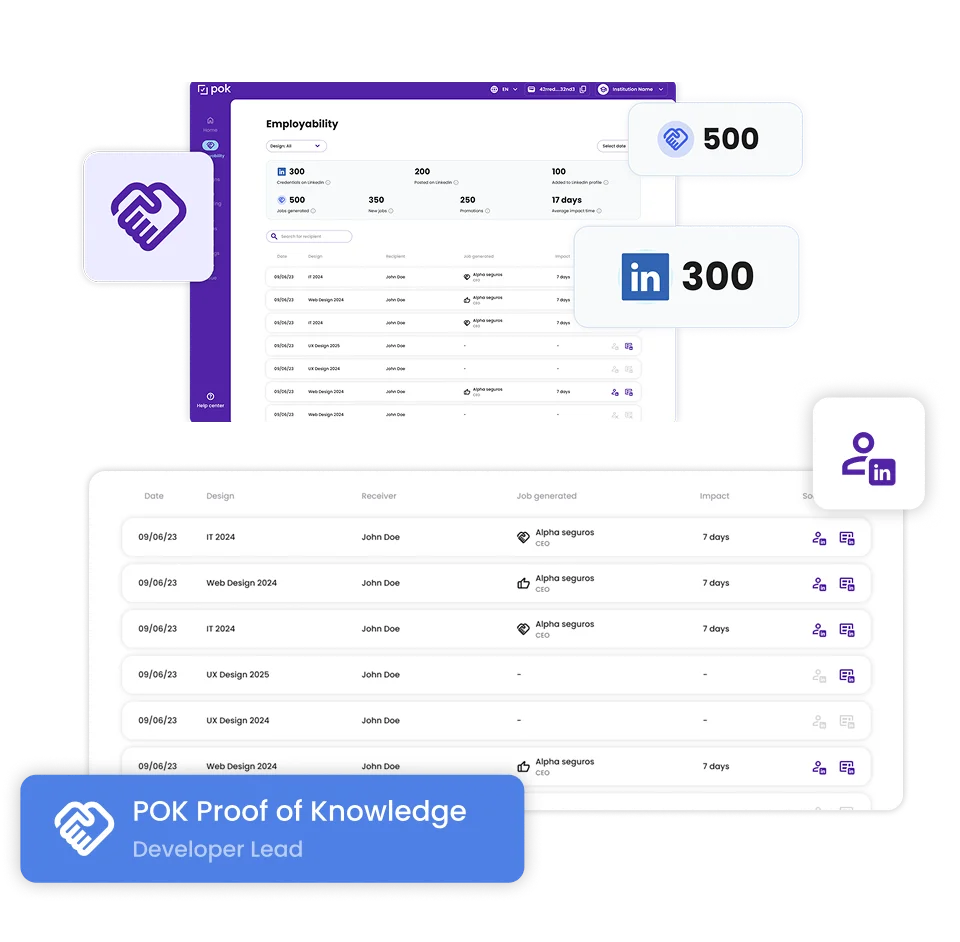
What it actually measures
- Credentials published: how many were shared as a LinkedIn post and how many were added to the holder’s profile as a license or certification. Two separate numbers, because they are two different gestures.
- Jobs generated: holders who landed a new job, plus those promoted in their current one. Each with its own metric.
- Average time to impact: how many days passed, on average, between the credential and that job change or promotion.
- Person-level detail: a table with previous experience, the job generated, the impact and the link to the profile or the post.
- Filters: by credential design, by year and by title.
What to do with those numbers
- An argument with evidence behind it: saying how many graduates in a cohort changed jobs, and in how many days, lands differently than asserting that your programs are well regarded. It is the same figure admissions and marketing can both use.
- Which programs move the needle: filtering by design and by year lets you compare cohorts against each other, which is what tells you where to invest and what to revisit.
- The link survives graduation: a shared credential keeps the holder close to the institution exactly when contact is usually lost.
- No surveys: the figure does not depend on anyone filling in a form, so it neither decays over time nor skews toward the people who reply.
- Exportable, with masked names: the table downloads to CSV so you can cross it with what you already have, and holder names come out abbreviated.
Show what happened after the diploma
Employability stops being a perception you have to defend in a meeting and becomes a set of numbers you can filter, export and compare across cohorts.
With one limit worth stating plainly: you only see what holders post on their professional profile. Whoever does not post their credential is not in the count.
With one limit worth stating plainly: you only see what holders post on their professional profile. Whoever does not post their credential is not in the count.
Frequently asked questions
POK applies a comprehensive privacy-by-design approach across all platform layers:
- Personal data is protected on encrypted servers and only shown if the user actively shares the credential
- Complies with GDPR, Argentina's Law 25.326, Brazil's LGPD, and equivalent regional data protection regulations
- Credentials are not forced to be public — control is always in the user's hands
- Recipients can choose which credentials to display, share each credential with a unique link, and revoke access at any time
- POK does not sell, rent, or share issuer or recipient information with third parties for commercial purposes
Yes. POK is trusted by 1,100+ institutions across 19 countries, has issued over 1.5 million credentials, and has been recognized as a Top 100 Latin America EdTech by HolonIQ in 2024, 2025 and 2026.
POK is 1EdTech certified, holds ISO 27001 and SOC 2 security certifications, and is compatible with the European Learning Model (ELM/Europass) — enabling credential recognition across Europe, Latin America, North America, and markets adopting open credential standards globally.
POK is also rated among the highest on G2, Capterra, and SourceForge globally, reflecting consistent institutional trust across regions. POK was named SourceForge Top Performer Fall 2026.
POK is 1EdTech certified, holds ISO 27001 and SOC 2 security certifications, and is compatible with the European Learning Model (ELM/Europass) — enabling credential recognition across Europe, Latin America, North America, and markets adopting open credential standards globally.
POK is also rated among the highest on G2, Capterra, and SourceForge globally, reflecting consistent institutional trust across regions. POK was named SourceForge Top Performer Fall 2026.
POK is aligned with the most relevant global standards for digital credentials:
- Open Badges 3.0 — the most widely adopted open standard for digital badges and microcredentials, managed by 1EdTech
- W3C Verifiable Credentials — the internationally recognized data model for verifiable digital credentials, ensuring interoperability across platforms and systems
- European Learning Model (ELM/Europass) — the European framework ensuring interoperability in education and employment, enabling credential recognition across Europe
- 1EdTech TrustEd Credentials Framework — independently verified standards for data privacy, interoperability, and credential portability
Start recognizing achievements with POK!
Join over 1,100 institutions already issuing verifiable digital credentials with POK. Free plan, no commitment.