POK Platform
Integrations with LMS, CRM and academic systems to issue digital credentials without manual work
POK connects today with six platforms: Moodle, Canvas, Blackboard, D2L Brightspace and Open edX over LTI 1.3, and Sana over xAPI. Canvas also accepts an API key. For any other system there is a custom integration by LTI URL or API key, plus a REST API with webhooks for everything that does not go through those. A CRM of your own comes in the same way, through the REST API or the custom integration.
Without an integration, issuing means exporting the student list from the LMS, checking it, uploading it somewhere else and correcting it again. With the integration in place, the digital credential goes out on its own when the student finishes the course: nobody opens a spreadsheet and nobody retypes an email address.
Without an integration, issuing means exporting the student list from the LMS, checking it, uploading it somewhere else and correcting it again. With the integration in place, the digital credential goes out on its own when the student finishes the course: nobody opens a spreadsheet and nobody retypes an email address.
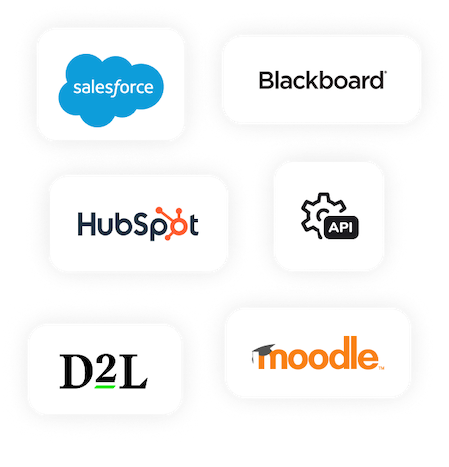
How POK connects to your LMS
- Six platforms with a guided setup: Moodle, Canvas, Blackboard, D2L Brightspace and Open edX register over LTI 1.3 from the integrations panel, and Sana delivers its results over xAPI. Canvas adds an API key as a second route.
- Any other system: the custom integration accepts an LTI URL or an API key, so an in-house campus or a bespoke build comes in the same way.
- Issuance on completion: when the student finishes the course, their credential or microcredential is generated and sent with no one stepping in.
- Minimum grade rule: you can make issuance conditional on a grade, for example that the student passes with more than 80%. POK reads the score from the LMS grades service, and if the platform does not expose one, the credential is delivered anyway.
- The plan does not change the integration: the same connection issues on the free Web2 plan, on Blockchain Verify and on the NFT packs. What changes is where the record lives, not how the data arrives.
What your institution gains by connecting the LMS
- The spreadsheet goes away: the graduate list is never exported or re-uploaded, so duplicates, mistyped addresses and batches that have to be reissued disappear with it.
- Delivery stops depending on volume: a cohort of fifty and one of fifty thousand follow the same path, with no extra operating hours.
- Students get it when they finish: no weeks between the end of the course and the credential, which is exactly when the graduate still has a reason to share it.
- One source for the data: the name, the course and the date come from the LMS, not from a copy someone maintains on the side.
- What you issue can be verified from outside: whoever receives the credential checks it without having to call the institution.
Connect your LMS and let the credential go out on its own
An integration is set up once and then left alone. From that point on, issuing stops being an end-of-term task and becomes a consequence of the student having finished.
If your system is not on the list, the custom integration by LTI URL or API key covers the rest.
If your system is not on the list, the custom integration by LTI URL or API key covers the rest.
Frequently asked questions
POK connects with the tools you already use, so issuance does not depend on someone assembling a list.
Education (LMS):
The result is issuance on autopilot: a student passes a course and the credential goes out on its own, with no human intervention.
Education (LMS):
- Moodle, Canvas, Blackboard, Brightspace (D2L) and Open edX register over LTI 1.3 from the integrations panel. Canvas also accepts an API key.
- Sana delivers its results over xAPI.
- Any other system comes in through the custom integration, with an LTI URL or an API key.
- A CRM connects through the REST API or the custom integration, like any other in-house system.
- Google Ads integration for remarketing campaigns based on credential engagement.
The result is issuance on autopilot: a student passes a course and the credential goes out on its own, with no human intervention.
POK differentiates itself in five key areas:
- Only platform combining a 100% free unlimited plan with NFT blockchain credentials — no user caps, no setup costs, no expiration, and no lock-in.
- Security certifications: ISO 27001 and SOC 2 — independently audited standards for data protection and access management. Few credential platforms globally hold both.
- 1EdTech certified for data privacy — the international body managing Open Badges 3.0, ELM, and the TrustEd Credentials Framework.
- European Learning Model (ELM/Europass) compatible — enabling credential recognition across Europe and markets adopting this framework.
- Employment tracking and learning pathways — measuring the real impact of credentials on job opportunities, not just issuance.
POK is architected specifically to ensure credential permanence independent of platform survival:
With NFT Ownership, the credential belongs to the recipient permanently — not to the platform.
- NFT Ownership credentials are registered on Polygon or LACNet and remain verifiable through any blockchain explorer even if POK ceases to operate. With Blockchain Verify, the recipient keeps a Blockcerts file whose proof can be checked against the root anchored on Ethereum
- Credentials are built on open standards (Open Badges 3.0, W3C Verifiable Credentials) — ensuring portability and verifiability across any compatible system
- In the unlikely event of blockchain deprecation, POK can migrate credentials to another network while maintaining full traceability and metadata
With NFT Ownership, the credential belongs to the recipient permanently — not to the platform.
Start recognizing achievements with POK!
Join over 1,100 institutions already issuing verifiable digital credentials with POK. Free plan, no commitment.