POK and the future of digital credentials: trust, purpose and real impact
POK leads secure and global digital credentials. Learn how to choose trusted solutions for long-term academic and professional mobility.By POK Team
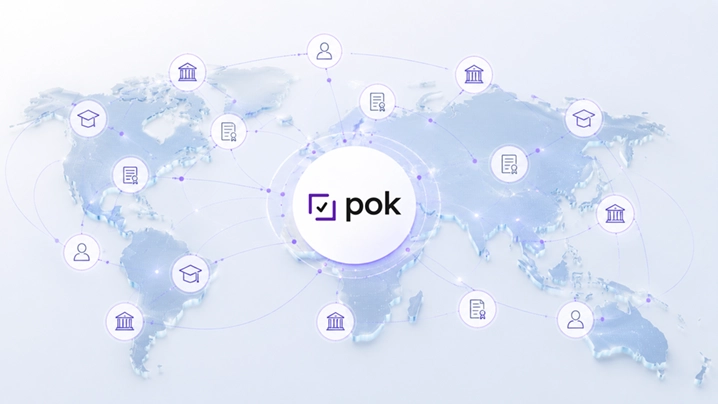
POK leads secure and global digital credentials. Learn how to choose trusted solutions for long-term academic and professional mobility.
Direct answer: POK - Proof of Knowledge builds digital credential infrastructure focused on one purpose: generating employability and social mobility through education. By combining NFT technology, ISO 27001 security, and open standards like Open Badge 3.0, POK helps universities issue credentials that remain verifiable, portable, and trustworthy — permanently.
The Purpose of POK and the Invisible Risks of Choosing the Wrong Digital Credential Platform
For years, digital credentials were seen as nothing more than a nice-looking certificate to share on LinkedIn. An elegant file, an attractive design, a link. But the reality runs much deeper. Digital credentials represent academic identity, employment opportunity, international mobility, and, above all, social advancement.
The education and work markets are transforming at record speed. Understanding what lies behind a digital credential — and what risks exist when choosing the wrong platform — has become essential for universities, governments, companies and students. And that's where POK comes in.
A Clear Purpose: Employability and Social Mobility
At POK, every technological decision, every feature, every standard adopted responds to one central purpose: To generate employability and social mobility through education.
This is not an aspirational phrase. It is the engine behind everything POK does.
It means:
- seeking to improve the real employability of millions of people
- driving social, economic and labor mobility
- helping institutions innovate and adapt to what's coming
- promoting upskilling and reskilling as real pathways for growth
- ensuring that every student can say: "I know this — and here is the verifiable evidence."
That simple access to concrete evidence — owned by the student, verifiable in seconds from any country — can be the difference between getting a job, earning a promotion, securing an international opportunity… or losing it.
The Metaphor That Best Explains POK's Vision
POK uses an idea that has become part of its identity:
"We manufacture screws for the machines of the future."
Universities are the true factories of talent: they train professionals, researchers, entrepreneurs, citizens. They build strong, dynamic nations with present and future.
But many of these factories still operate with "machines" designed for a world that no longer exists.
The NFT credentials POK builds are screws designed for the machines of the future: for modern learning models, for skills architectures, for microcredential ecosystems, and for a global and demanding labor market.
POK's role is not to replace universities. POK's role is to help them build their new machines.
Credentials That Truly Work: More Than a PDF or a Pretty Design
A digital credential is not:
- a PDF,
- an image for social media,
- an attractive design,
- nor a link to download a file.
A digital credential is critical infrastructure.
It must be:
- verifiable
- immutable
- private
- international
- interoperable
- resistant to tampering and time
And these properties can only be achieved with real NFTs, purpose-driven blockchain, external audits, and global standards such as:
- OpenBadge 3.0
- European Learning Model (ELM)
- GDPR
- ISO 27001
Anything less than that is marketing.
The Risk of Choosing the Wrong Platform
A worrying trend has emerged: institutions choosing platforms without truly knowing what they're purchasing. The problem is not the platform. The problem is the impact on students.
Below are the six most critical risks in the ecosystem today:
1) Security and Data Breaches
Universities hand over extremely sensitive information: names, documents, academic records, evidence, skills, educational identity.
If a platform does not have:
- external audits,
- penetration tests,
- ISO 27001,
- GDPR compliance,
- real NFT technology,
then the institution is exposed. A breach not only destroys credentials — it destroys reputation.
2) False Claims of Standards Compliance
Many platforms claim to be "OpenBadge 3.0" or "ELM", but declaring it is easy. Complying with it is complex.
Compliance requires:
- technical validation,
- auditing,
- proven interoperability.
If a platform cannot demonstrate it, it does not comply.
3) Lack of GDPR Compliance
If a credential does not meet GDPR requirements, the student is excluded from the international academic and labor mobility ecosystem. Without knowing it, the institution harms those it aims to help.
4) Features That Look Good But Don't Work
Many platforms claim to offer "the same as POK".
The way to uncover the truth is simple:
- usability,
- speed,
- automation,
- security,
- scalability.
Real technology vs simulation.
5) Lack of Integration With the Institutional Ecosystem
A credentialing platform cannot operate in isolation. It must integrate natively with:
- LMS (Moodle, Canvas, Classroom, Blackboard…)
- CRM (HubSpot, Salesforce, Banner…)
- LTI (Learning Tools Interoperability)
Without these integrations, everything becomes manual, slow, error-prone and not scalable.
6) Credentials That Do Not Validate (the Most Serious Risk)
Imagine this:
A student graduates. Applies for a job or scholarship in Europe or the United States. Submits their credential. The credential does not validate.
Who looks bad? The university. Who pays the price? The student.
This risk is real. And it is likely the most severe of all.
POK's Vision: A Global Knowledge Network
At POK, the vision is a future where:
- universities issue real credentials,
- students store them in their wallets,
- employers validate them in seconds,
- and the labor market becomes fairer, more efficient and more human.
This is not science fiction. It's happening now.
POK works alongside:
- UNESCO
- OEI
- OneTec
- Europass
- University associations across the region
And has been recognized by HolonIQ in 2024 and 2025 as one of the most innovative EdTech companies in Latin America.
Conclusion: The Credentials Are Not Ours — They Belong to the Students
Digital credentials are a person's story. They are identity. Evidence. A gateway to new opportunities.
This is why POK commits to real standards, robust technology and an unwavering purpose: to use digital credentials to generate social mobility.
Because ultimately, the question is not which platform an institution chooses. The real question is:
What future are we giving our students?
Frequently Asked Questions
What makes POK different from other digital credential platforms?
POK combines NFT-based blockchain credentials, ISO 27001:2022 security certification, Open Badge 3.0 compliance verified by 1EdTech, and a $0 setup fee model. Unlike platforms that store credentials in centralized databases, on its paid plans POK anchors each credential on blockchain — meaning verification remains permanent even if the institutional contract ends.
What happens to issued credentials if an institution stops using POK?
Credentials issued on POK's paid plans remain permanently verifiable because they are anchored on-chain, independent of the platform. Centralized providers cannot make this guarantee — if the provider closes or the contract ends, verification links typically stop working.
Does POK comply with GDPR and international data protection standards?
Yes. POK holds ISO/IEC 27001:2022 certification and operates in compliance with GDPR requirements. The platform's architecture includes data minimization, encryption in transit and at rest, and formal incident response processes — all independently audited.
How can an institution verify POK's international standards compliance?
POK's Open Badge 3.0 certification can be verified through the 1EdTech certification registry. ISO 27001 certification can be verified at trust.pok.tech. Both are externally audited credentials, not self-declarations.
What is the risk of choosing a credential platform that claims Open Badge compliance but hasn't been certified?
The risk is direct: students may share credentials that employers and academic institutions cannot verify in international systems. Compliance requires technical validation, not just a checkbox. POK's 1EdTech certification guarantees that its credentials are readable by digital wallets, LMS systems, and employment platforms worldwide.
Start recognizing achievements with POK!
Join over 1,100 institutions already issuing verifiable digital credentials with POK. Free plan, no commitment.