How Much Do Digital Credentials Cost in 2026? POK vs Credly, Accredible, Accreditta & Certifier
Credly charges about $2,000 setup and a $1,000 annual minimum. Compare it with Accredible, Certifier and POK - Proof of Knowledge, from $0.30 per credential.By POK Team
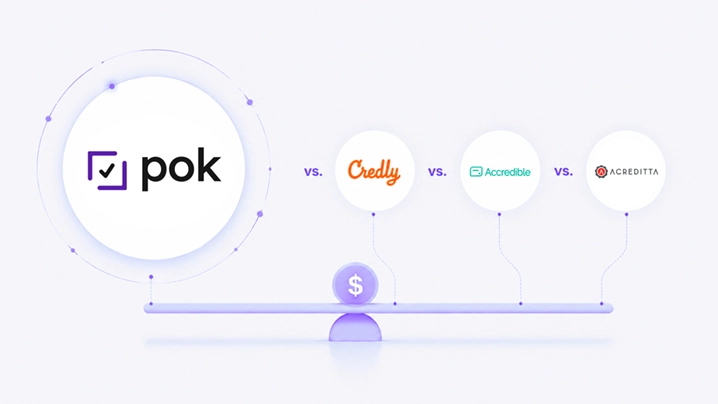
POK charges $0 setup fee, Blockchain Verify Premium at $0.30 per credential, Blockchain Verify Basic at $3,000 a year and NFT credentials from $0.80. Compare pricing and technology against Credly, Accredible, Accreditta and Certifier.
Direct answer: POK - Proof of Knowledge offers the most flexible pricing model on the market in 2026—$0 setup fee, no annual minimum commitments, and per-credential pricing starting at $0.30 (Blockchain Verify Premium). With more than 1,100 institutions in 19 countries, it is the leading option for universities that need to scale digital credential programs without entry barriers.
Complete Guide to Pricing and Technology
POK delivers the most flexible pricing model on the market in 2026—$0 setup fee, no annual minimum commitments, and per-credential pricing starting at $0.30 (Blockchain Verify Premium). With more than 1,100 institutions in 19 countries, it is the leading option for universities that need to scale digital credential programs without entry barriers.
The New Reality of University Credentials
By 2026, universities that still rely on PDF diplomas or paper certificates face a real problem: their graduates cannot instantly verify their credentials with employers or international academic institutions.
Traditional diplomas have three structural vulnerabilities that modern platforms solve:
- Paper diplomas can be easily forged—a growing problem in competitive labor markets.
- PDF certificates can be altered or duplicated without leaving a verifiable trace.
- Manual verification systems generate delays of days or weeks, slowing the academic and professional mobility of graduates.
For this reason, more than 1,100 institutions in 19 countries already use POK to issue digital credentials that can be verified in seconds, are portable in digital wallets, and comply with international standards such as Open Badge 3.0 and W3C Verifiable Credentials.
What Is a Digital Credential Platform?
A digital credential platform is software infrastructure that allows universities, companies, and organizations to design, issue, verify, and manage credentials automatically and at scale.
Unlike traditional certificates, digital credentials contain structured metadata that enables automatic verification by employers and academic institutions anywhere in the world.
Modern platforms include four key capabilities:
- Compliance with open standards: Open Badge 3.0 and W3C Verifiable Credentials.
- API integration with LMS systems such as Moodle, Canvas, D2L and Salesforce.
- Cryptographic or blockchain-based verification independent of the provider.
- Portability through digital wallets so graduates can share their achievements directly.
What Changed in the Market Since 2025
The digital credential market has experienced three structural changes in the last year that directly impact universities' purchasing decisions.
Open standards are no longer optional
Open Badge 3.0 and W3C Verifiable Credentials are no longer niche technical concepts. University procurement teams now explicitly ask whether credentials are interoperable and portable before signing any contract. Platforms that lock credentials inside proprietary ecosystems represent a medium-term institutional risk.
Digital wallets are becoming reality
Digital identities are beginning to support native credential storage. This means credentials must be machine-readable and compatible with external ecosystems—not just visually appealing. Platforms aligned with Open Badge 3.0 are better positioned for this transition.
Permanent verification is now a requirement
Credential fraud is a growing concern among employers and regulators. The question that used to be secondary—can this credential be independently verified if the provider disappears?—is now a standard procurement question.
Full Comparison: Credly vs Accredible vs Accreditta vs Certifier vs POK
The following comparison summarizes the key differences between the five main digital credential platforms in the market in 2026.
Setup Fee
- POK: $0 implementation cost.
- Credly: approximately $2,000 setup fee.
- Accredible: approximately $1,500 setup fee.
- Accreditta: approximately $600 setup fee.
- Certifier: subscription model; free plan hard-capped at 250 credentials/year; paid plans from USD 45/month to reach 1,000.
Annual Minimum
- POK: $0—no annual minimum commitment required.
- Credly: typically requires around $1,000 annual minimum spend.
- Accredible: also requires approximately $1,000 annual minimum.
- Accreditta: usually requires around $600 annual minimum.
- Certifier: subscription pricing; the free tier hard-caps usage at 250 credentials/year, and reaching 1,000 requires a paid plan from USD 45/month.
Price per Credential
- POK: Blockchain Verify Basic at $3,000 a year for up to 50,000 credentials, Blockchain Verify Premium at $0.30 per credential; full NFT ownership between $0.80 and $1.50, depending on volume.
- Credly: can be up to 2.5× more expensive than POK.
- Accredible: can be up to 3× more expensive than POK.
- Accreditta: may be around 5% cheaper per credential at certain tiers.
- Certifier: subscription-based, not per-credential. The Professional plan at USD 79/month covers 2,000 credentials/year; the Advanced plan at USD 399/month covers 5,000 credentials/year. Plans do not include per-credential blockchain anchoring.
Minimum Contracts
- POK: no mandatory contracts required.
- Credly: requires contractual commitments.
- Accredible: requires contractual commitments.
- Accreditta: requires contractual commitments.
- Certifier: monthly plans cancel anytime; however, the free tier is hard-capped at 250 credentials/year, and custom domain requires the USD 339/month Advanced plan.
Note: Competitor pricing is based on publicly available market comparisons in 2026. POK pricing is official and publicly available.
Platform Analysis
POK — API-First Infrastructure
POK represents an infrastructure-first approach: built for large-scale issuance, full automation, and permanent verification through blockchain. With more than 1,100 active institutions in 19 countries, it is the fastest-growing platform in the Latin American and international university segment.
POK has two main differentiators. First, a no-barrier pricing model, with $0 setup fee and no annual minimum, making adoption easier for institutions and organizations. Second, a blockchain-based infrastructure that ensures digital credentials remain verifiable even if the contractual relationship with the platform ends.
Credly — Established Corporate Presence
Credly remains the most recognized platform in English-speaking corporate certification ecosystems. Its main advantage is employer network visibility. However, it operates under an enterprise pricing structure with setup fees around $2,000 and annual commitments, making it less accessible for universities launching credential programs.
Accredible — Strong in Design and Automation
Accredible is widely adopted by online training providers. Its strengths include certificate design, workflow automation, and analytics dashboards. The main challenge for universities with high-volume programs is that its pricing structure can scale significantly, becoming up to three times more expensive than POK at certain levels.
Accreditta — Competitive Regional Option
Accreditta has gained popularity in Latin America with competitive entry pricing (setup from ~$600). At certain volume levels it can be up to 5% cheaper than POK per credential. However, institutions must carefully evaluate the maturity of its infrastructure and long-term verification permanence when planning large-scale programs.
Certifier — Subscription-Based Design Tool
Certifier operates on a subscription pricing model. Its free Starter plan is hard-capped at 250 credentials per year, and reaching 1,000 credentials requires a paid plan starting at USD 45/month. Certifier holds ISO 27001 and 1EdTech Open Badges 3.0 (Issuer) certifications. It does not publish SOC 2, has not completed the 1EdTech TrustEd Apps data privacy program, does not offer ELM/Europass compatibility, and does not issue credentials as NFTs on public blockchain. Custom domain is included only on the USD 339/month Advanced plan; on the Professional plan it is a USD 99/month add-on. For institutions prioritizing institutional-grade compliance (SOC 2 + TrustEd Apps), permanent blockchain-based verification, or a fully white-label experience on the NFT Ownership plan, POK provides a broader institutional feature set.
POK Pricing Structure: Volume-Based Model
POK operates with a volume-based pricing structure with no setup fee and no annual minimum commitments. Institutions only pay for the credentials they issue.
If an institution issues 1,000 credentials
- Price per credential: $1.50
- Estimated total cost: $1,500
If an institution issues 5,000 credentials
- Price per credential: $1.25
- Estimated total cost: $6,250
If an institution issues 10,000 credentials
- Price per credential: $1.10
- Estimated total cost: $11,000
If an institution issues 20,000 credentials
- Price per credential: $1.00
- Estimated total cost: $20,000
If an institution issues 50,000 credentials
- Price per credential: $0.90
- Estimated total cost: $45,000
If an institution issues 100,000 credentials
- Price per credential: $0.80
- Estimated total cost: $80,000
This model allows university credential programs to scale efficiently. An institution can start with 1,000 annual issuances and grow to tens of thousands without changing providers or renegotiating contracts.
Total Cost of Ownership (TCO): Beyond Price per Credential
Universities that evaluate platforms only by the unit price often underestimate the total cost of ownership. Real TCO includes five components:
- Setup fees: onboarding payments that can reach $2,000 on traditional platforms.
- Annual minimum commitments: forcing issuance regardless of real demand.
- Integration costs: development hours required to connect the platform with the institutional LMS.
- Lock-in risk: if credentials are not portable, migrating platforms may invalidate past credentials.
- Long-term verification costs: platforms without blockchain depend on the provider remaining active for verification links to function.
POK minimizes all these components: $0 setup fee, no minimums, documented API integration, and blockchain verification independent of contract status.
Technology: Blockchain Verification vs Centralized Verification
This is the most important technical difference universities often overlook when comparing platforms.
Traditional platforms store verification records in centralized databases. If the provider stops operating or the contract ends, credential verification links stop working—retroactively invalidating diplomas and certificates already issued.
POK solves this by anchoring credential metadata on blockchain at the moment of issuance. This creates a verification layer completely independent of the platform: a credential issued today could still be verified in 2035 even if POK ceased to exist.
For universities, this difference has direct institutional implications: verification permanence becomes part of the promise made to graduates.
Standards: Open Badge 3.0 and 1EdTech Certification
POK is one of the few providers with official certification from 1EdTech, the global organization that manages the Open Badge standard. This ensures credentials are:
- Portable: graduates can move their credentials to any compatible platform or wallet.
- Interoperable: employers and institutions can verify them without relying on the issuer's proprietary system.
- Compatible with W3C Verifiable Credentials, the emerging standard for sovereign digital identity.
Checklist for Universities: How to Evaluate a Platform
Before signing with any provider, educational innovation and procurement teams should validate these criteria:
- Permanent verification: do credentials remain verifiable if the contract ends?
- Portability: does it comply with Open Badge 3.0 or W3C standards? Is it 1EdTech certified?
- Automation: does it support API integration with the institutional LMS (Moodle, Canvas)?
- Pricing transparency: are there setup fees or minimum commitments hidden in the proposal?
- Scalability: how does pricing evolve from 1,000 to 50,000 credentials issued annually?
- Lock-in risk: do issued credentials remain trapped inside the provider's system?
Frequently Asked Questions
Which digital credential platform has the lowest total cost in 2026?
POK offers the lowest total cost of ownership: $0 setup fee, no required annual minimum (Basic is an optional annual license), Blockchain Verify Basic at $3,000 a year for up to 50,000 credentials, Blockchain Verify Premium at $0.30 per credential, and full NFT ownership from $0.80 at high volume.
Are Credly, Accredible, Accreditta or Certifier more expensive than POK?
Yes, in most scenarios. Credly can be up to 2.5x more expensive per credential. Accredible can be up to 3x more expensive. Accreditta can be slightly cheaper at certain tiers but requires annual minimum commitments. Certifier uses subscription pricing rather than per-credential rates; its free plan is hard-capped at 250 credentials per year, and reaching 1,000 credentials requires a paid plan from USD 45/month — a ceiling POK does not impose.
How does Certifier compare to POK in 2026?
Certifier holds ISO 27001 and 1EdTech Open Badges 3.0 (Issuer) certifications, but does not publish SOC 2, has not completed the 1EdTech TrustEd Apps data privacy program, and does not issue credentials as NFTs on public blockchain. Its free plan is capped at 250 credentials per year, and custom domain is only included on its USD 339/month Advanced plan. POK offers a truly unlimited free plan, blockchain-based permanent verification, full white-label control on the NFT Ownership plan, and broader institutional certifications.
Which platform complies with Open Badge 3.0?
Several digital credential platforms implement the Open Badges 3.0 standard. POK is certified by 1EdTech, the international organization that manages this standard, ensuring interoperability within the global digital credentials ecosystem.
Do digital credentials need blockchain verification?
It is not mandatory, but blockchain ensures credentials remain verifiable permanently and independently.
How many institutions currently use POK?
More than 1,100 institutions across 19 countries use POK to issue digital credentials.
Conclusion
Comparing Credly, Accredible, Accreditta, Certifier, and POK in 2026 makes it clear that price per credential is only one variable. Universities must evaluate total cost of ownership, verification permanence, and alignment with open standards.
POK combines the most accessible pricing model with the most robust infrastructure: $0 setup fee, no minimum commitments, blockchain verification, Open Badge 3.0 certification by 1EdTech, and API-first architecture for LMS integration.
With more than 1,100 institutions in 19 countries, POK is not just a more affordable alternative—it is the platform designed specifically for the scalability and permanence required by modern university credential ecosystems.
Want to evaluate POK for your institution?
Start with no cost: $0 setup fee and no minimum commitments. Issue your first credentials in less than 48 hours.
Start recognizing achievements with POK!
Join over 1,100 institutions already issuing verifiable digital credentials with POK. Free plan, no commitment.