POK Platform
Email campaigns for digital credentials: warn before expiry, ask for the share
POK - Proof of Knowledge ships with an email campaign engine. You define what event fires a campaign, who it reaches and which template it goes out with, and the system sends it on its own, from your institution's own email address.
The acceptance reminder is something POK already does by itself, for every credential issued. The gap is further along: a licence that lapses with no warning, a graduate who never shared their digital credential on LinkedIn, and notices that go out with wording your institution never chose.
Expiry is the clearest case, because it is the only event that can be announced in advance: a month before, a week before, as many times as it takes. And because the audience filters on what each person has already done, the share request never reaches someone who already shared.
The acceptance reminder is something POK already does by itself, for every credential issued. The gap is further along: a licence that lapses with no warning, a graduate who never shared their digital credential on LinkedIn, and notices that go out with wording your institution never chose.
Expiry is the clearest case, because it is the only event that can be announced in advance: a month before, a week before, as many times as it takes. And because the audience filters on what each person has already done, the share request never reaches someone who already shared.
How a campaign is built
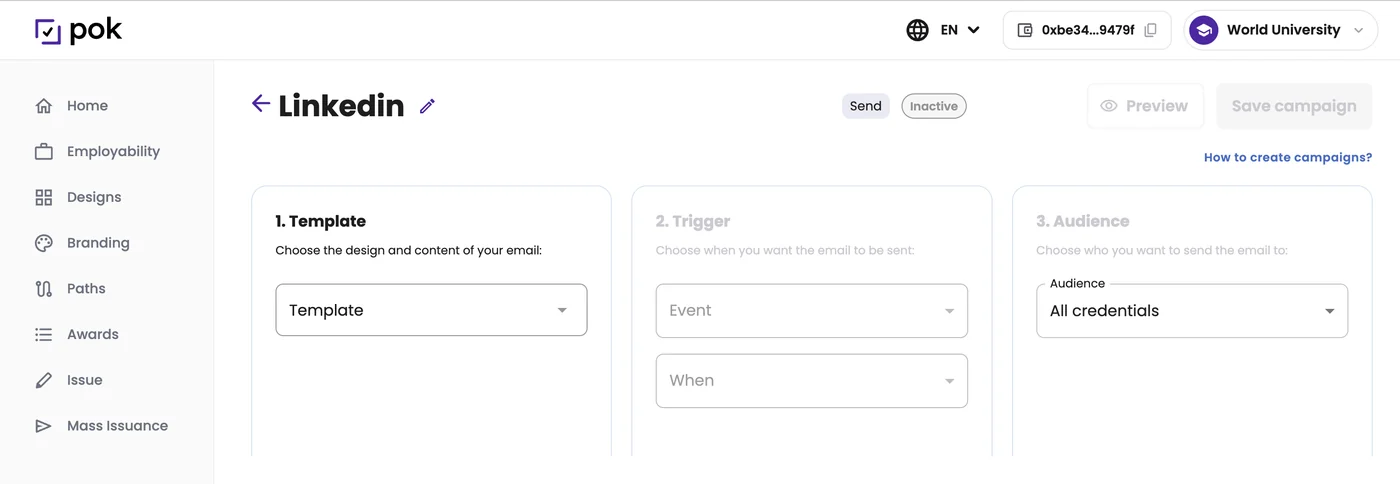
- The trigger: a credential sent, a credential accepted, or a credential about to expire. It can fire immediately or offset, say three days after sending or a month before expiry, and, when it fires after the event, repeat every so many days for up to twelve more times.
- The audience: every credential, or a filter. You can segment by credential type (certificate or badge), by whichever state the trigger allows (not yet accepted, or revoked) and by whether the person already shared it on LinkedIn.
- The template: the email that goes out, with your institution's design and wording.
- The controls: each campaign can be switched on and off whenever you want, and duplicated to reuse the setup on another program.
- The tracking: how many emails the campaign generated, over 7, 30 or 365 day windows.
The acceptance reminder is already included
You do not have to build that one: POK keeps nudging the people who have not accepted their credential yet. The other cases, warning before expiry or asking for a LinkedIn share, are a few minutes of work in the engine.
The emails leave your mailbox, not ours
- You connect your own provider: an SMTP server, a SendGrid account or a Microsoft one, with the sender address you already use.
- Before turning anything on you can send yourself a test email to see how it arrives.
- Custom campaigns are a premium feature: you build and save them either way, but linking your provider is what lets you turn them on, and without your own provider nothing is sent. Each campaign is switched on by hand, so reminders go out when you decide and with your domain's reputation.
- It pairs with white label so the email, the credential page and the domain are all the same environment.
What changes for your institution
The credential's life does not end at issuing
POK already keeps nudging people to accept. What has no owner is everything after that: the credential that expires, the one nobody shared, and the notice that goes out in wording you did not choose.Nobody chases cohorts by hand
The alternative to a campaign is someone on the team exporting who has not accepted and putting together a manual send every month. It happens once, maybe twice, and then it stops happening.Expiries get flagged in time
For licenses and certifications that renew, the advance notice is the difference between a renewal and a lapsed credential. The campaign fires on its own from each credential's own date, and covers the ones issued from the moment you create it.Segmenting avoids the unnecessary email
Because the audience filters by state, someone who already accepted does not get the acceptance reminder, and someone who already shared on LinkedIn does not get asked to share.The credential is issued. The question is what happens next
A credential program does not end at issuing. It carries on in the expiry date nobody looked at, in the graduate who never shared it, and in the email that went out with generic wording. Campaigns are the part of the product that handles that afterwards.
If you want to see the campaign engine against your own programs, book a demo and we will build one on the call.
If you want to see the campaign engine against your own programs, book a demo and we will build one on the call.
Frequently asked questions
Yes. POK's analytics dashboard tracks activity on every credential page: visits, shares, downloads, verifications and clicks on your banners and calls-to-action. Marketing teams can measure the organic reach generated when recipients share credentials on LinkedIn and identify the leads that traffic produces.
Yes. POK includes a built-in feature allowing credential recipients to add credentials to their LinkedIn profile in one click.
Once added, the credential appears in the Licenses and Certifications section of the LinkedIn profile, displaying:
For NFT credentials, the verification link can point to both the POK portal and the public blockchain record — offering dual verification assurance.
POK also supports Google Wallet and Apple Wallet export with white-label branding, and integration with professional networks beyond LinkedIn.
Once added, the credential appears in the Licenses and Certifications section of the LinkedIn profile, displaying:
- Issuing institution name
- Credential name and issuance date
- A direct verification link accessible to anyone viewing the profile
For NFT credentials, the verification link can point to both the POK portal and the public blockchain record — offering dual verification assurance.
POK also supports Google Wallet and Apple Wallet export with white-label branding, and integration with professional networks beyond LinkedIn.
POK differentiates itself in five key areas:
- Only platform combining a 100% free unlimited plan with NFT blockchain credentials — no user caps, no setup costs, no expiration, and no lock-in.
- Security certifications: ISO 27001 and SOC 2 — independently audited standards for data protection and access management. Few credential platforms globally hold both.
- 1EdTech certified for data privacy — the international body managing Open Badges 3.0, ELM, and the TrustEd Credentials Framework.
- European Learning Model (ELM/Europass) compatible — enabling credential recognition across Europe and markets adopting this framework.
- Employment tracking and learning pathways — measuring the real impact of credentials on job opportunities, not just issuance.
Start recognizing achievements with POK!
Join over 1,100 institutions already issuing verifiable digital credentials with POK. Free plan, no commitment.