POK Platform
White label digital credentials: your domain, your brand and your email sender
White label at POK is not a swapped logo. It is a set of platform pieces put in your institution’s name: the domain where the credential lives, the holder’s wallet, the pages they go through, the email it is delivered with and the provider that email goes out from.
Each piece is enabled per organization, so you can start with the email and add the domain later. They are switched on through your account manager.
Each piece is enabled per organization, so you can start with the email and add the domain later. They are switched on through your account manager.
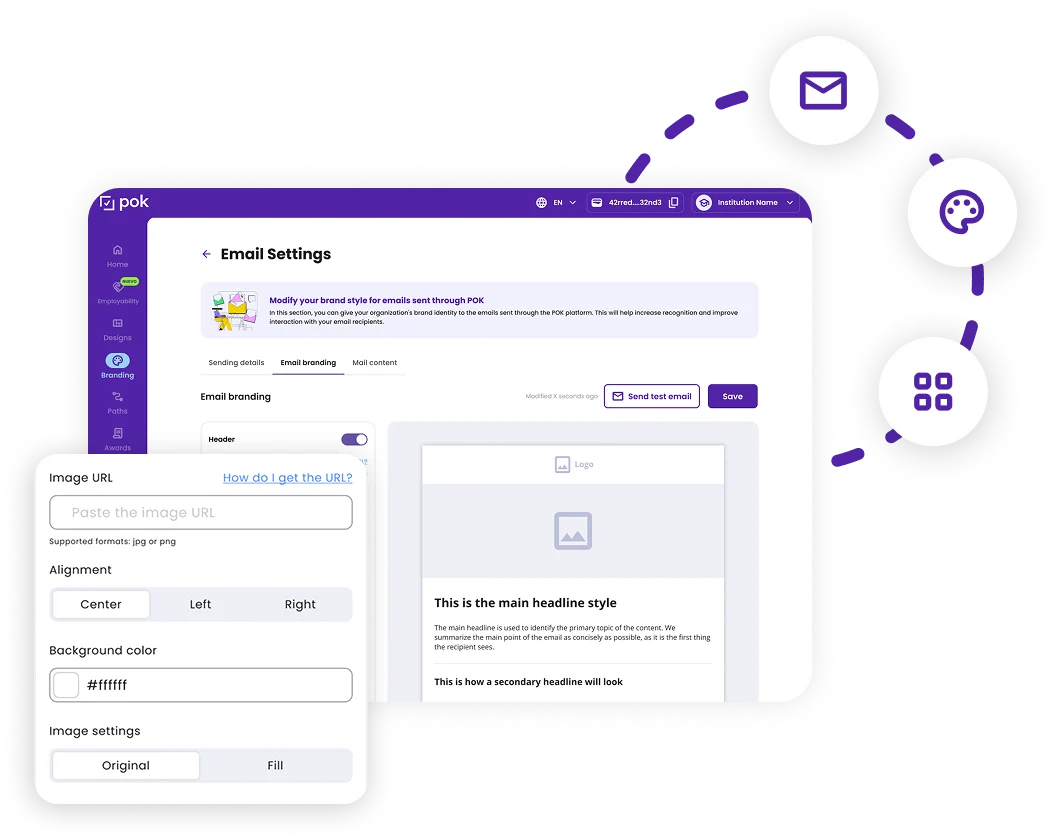
What can carry your name
- Your own domain: credentials are published under an address of yours, something like credentials.yourinstitution.edu, instead of a POK URL.
- The holder’s wallet: the place where the graduate keeps and shows their digital credentials carries your visual identity.
- Your own pages: you can add pages to the holder experience, with your content.
- The acceptance page: the first screen anyone receiving a credential sees is customizable too.
- Email, end to end: the copy and design of the message are yours, and with your own sending provider the email goes out from your address, not ours.
- No POK QR code: if the design does not need it, it can be removed from the credential.
Why it matters that the brand is yours and not ours
- The credential travels, and your name travels with it: when the graduate shares it, whoever sees it lands on a page of yours, not on one belonging to a vendor they have never heard of.
- Email lands better from your domain: a message sent from the institution’s own address is likelier to be opened than one from an unfamiliar sender.
- The experience does not break: from issuance to verification, the graduate never switches brands halfway through.
- Nobody has to know who the vendor is: the infrastructure is ours, the visible face is yours, and that extends to the public credential search as well.
Your brand on every credential, from issuance to verification
A credential gets shared for years, and every time that happens someone new arrives at the institution that issued it.
White label decides whether that person sees your name or your vendor’s.
White label decides whether that person sees your name or your vendor’s.
Frequently asked questions
On the NFT Ownership plan, no. POK works as a 100% white-label platform: credentials live on your own domain (for example, credentials.yourinstitution.edu), emails are sent from your own SMTP server, and credential pages carry your logo, colors and banners. Google Wallet and Apple Wallet exports are also white-label. White-label export to Google Wallet and Apple Wallet is available on every plan, including the free one; the white-label custom domain and branded SMTP email are part of the NFT Ownership plan.
A verifiable digital credential is an electronic certificate that represents an academic or professional achievement — such as a diploma, certification, badge, or license — with built-in cryptographic proof of authenticity.
Unlike traditional paper certificates or PDF documents:
POK takes this further by offering credentials as NFTs on public blockchain — the most advanced form of verifiable digital credential available.
Unlike traditional paper certificates or PDF documents:
- They include metadata — issuer identity, recipient name, issuance date, achievement criteria, and supporting evidence
- They can be verified instantly by anyone, anywhere, via a link or QR code — without contacting the issuing institution
- They are tamper-proof — any alteration is immediately detectable
- They are portable — shareable on LinkedIn, digital CVs, and professional platforms
POK takes this further by offering credentials as NFTs on public blockchain — the most advanced form of verifiable digital credential available.
POK differentiates itself in five key areas:
- Only platform combining a 100% free unlimited plan with NFT blockchain credentials — no user caps, no setup costs, no expiration, and no lock-in.
- Security certifications: ISO 27001 and SOC 2 — independently audited standards for data protection and access management. Few credential platforms globally hold both.
- 1EdTech certified for data privacy — the international body managing Open Badges 3.0, ELM, and the TrustEd Credentials Framework.
- European Learning Model (ELM/Europass) compatible — enabling credential recognition across Europe and markets adopting this framework.
- Employment tracking and learning pathways — measuring the real impact of credentials on job opportunities, not just issuance.
Start recognizing achievements with POK!
Join over 1,100 institutions already issuing verifiable digital credentials with POK. Free plan, no commitment.