POK Platform
Tamper-proof digital credential verification: anyone can check a degree in seconds
Every credential issued with POK - Proof of Knowledge carries a unique link and a QR code that open its public verification page: who issued it, to whom, when, which skills it certifies and whether it is still valid, expired or revoked. No accounts, no forms, no waiting on the registrar to write back.
For decades, checking a degree meant calling a university, emailing the records office and waiting days for a confirmation that often never came. That gap is exactly where credential fraud lives: a retouched PDF or a purchased diploma survives a visual review without trouble, because nobody has time to audit every CV that comes in.
With POK, verification no longer depends on the goodwill of whoever picks up the phone. Every digital credential is a document that carries its own cryptographic proof: anyone can check it independently, in any country and at any hour, and always gets the same answer.
For decades, checking a degree meant calling a university, emailing the records office and waiting days for a confirmation that often never came. That gap is exactly where credential fraud lives: a retouched PDF or a purchased diploma survives a visual review without trouble, because nobody has time to audit every CV that comes in.
With POK, verification no longer depends on the goodwill of whoever picks up the phone. Every digital credential is a document that carries its own cryptographic proof: anyone can check it independently, in any country and at any hour, and always gets the same answer.
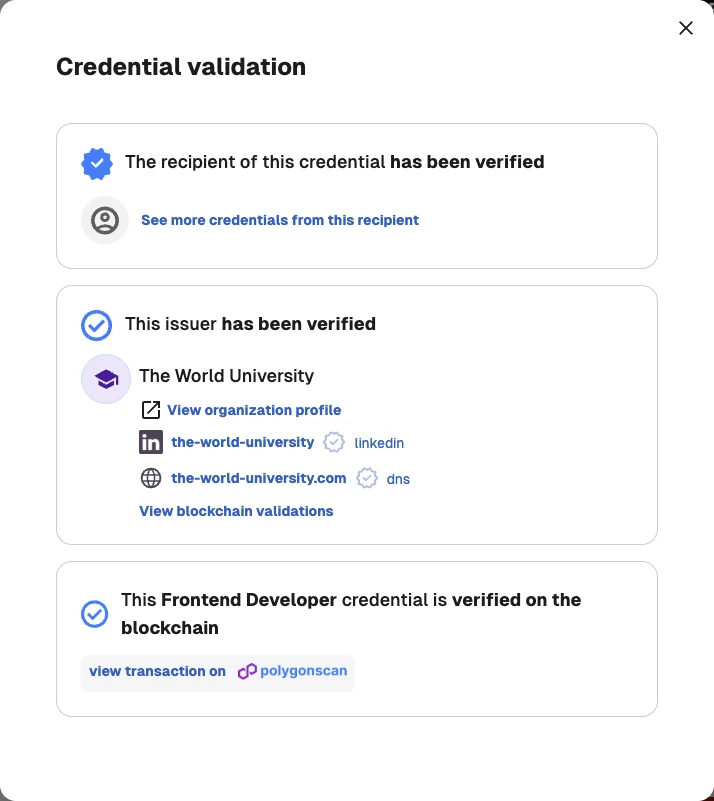
How verification works at POK
- Public verification page: every credential has a unique link and a QR code. Opening either one shows the issuer, the holder, the date, the skills certified and any evidence the issuer attached.
- Real-time status: valid, expired or revoked. If the institution revokes a credential, the page reflects it immediately and the document stops working as proof.
- Independent blockchain check: with Blockchain Verify, POK anchors the batch's Merkle root on Ethereum and every credential carries its cryptographic proof back to that root. With NFT credentials, the token is registered on Polygon and LacNet. Either way anyone can check the record from a public explorer, without going through POK at all.
- Cryptographic fingerprint: every credential generates a unique hash. If someone alters a name, a date or a grade, the hash no longer matches and the tampering is exposed.
- What actually goes on-chain: with Blockchain Verify, only the batch Merkle root. With NFT credentials, the token in the holder's name along with the credential title, a short identifier and the hash of the identity document, which the contract itself can check without revealing it. The holder's name never reaches the chain: personal data lives on encrypted servers under GDPR, and heavier evidence can be hosted on IPFS.
- Open standards: Open Badges 3.0 and W3C Verifiable Credentials include native cryptographic verification of the issuer identity, so the credential also validates in any compatible system.
- When the verifier has no link: if they arrive with nothing but a name or an ID number, your institution can publish a credential lookup so they find it on their own, on your POK page or embedded in your own site.
What changes for your institution
Manual validation work disappears
Every employer who calls to confirm a degree costs the records office time. With public verification, that request answers itself, and your team stops being the bottleneck between a graduate and their next job.Your brand stops being exposed
A forged diploma carrying your logo can circulate for years before anyone notices. When the only valid version is verifiable, forgery loses its point: it does not survive the first click.Not even the institution can alter what it issued
A credential recorded on a blockchain cannot be edited or deleted, not even from the inside. The institution keeps control over what matters: it can revoke the credential or give it an expiry date, and that decision is visible to anyone who checks.It works for credentials that expire
Professional licenses, regulatory clearances and certifications that renew on a cycle: expiry is part of the credential itself, so nobody presents something already lapsed as current.Verification outlives the vendor
Because it rests on open standards and public blockchains, the credential stays verifiable even if your institution changes platforms or POK stops operating. That is the underlying difference from a centralized verifier, where the validity of a degree depends on one company staying in business.A certificate nobody can check is not proof
Verification is what separates a well-designed file from a credential that can carry a hiring or admissions decision. POK - Proof of Knowledge records credentials on public blockchains from the Blockchain Verify plan up, holds 1EdTech's data privacy certification and runs on ISO 27001 and SOC 2 certified infrastructure, and today backs more than 1.5 million credentials from over 1,100 institutions across 19 countries.
If you want to see how a credential from your institution is checked, book a demo and we will verify one live, with your own data.
If you want to see how a credential from your institution is checked, book a demo and we will verify one live, with your own data.
Frequently asked questions
Verification with POK is instant and accessible to any third party — no account, no registration, and no contact with the issuing institution required.
Web2 credentials: each credential includes a unique link and QR code. When opened, it displays full credential details on the POK verification portal — issuer, recipient, issuance date, criteria, and current status (valid, expired, or revoked).
NFT credentials: in addition to the POK portal, NFT credentials can be verified directly through a public blockchain explorer (e.g., PolygonScan) — confirming authenticity even if POK ceases to operate.
Both verification methods display:
Web2 credentials: each credential includes a unique link and QR code. When opened, it displays full credential details on the POK verification portal — issuer, recipient, issuance date, criteria, and current status (valid, expired, or revoked).
NFT credentials: in addition to the POK portal, NFT credentials can be verified directly through a public blockchain explorer (e.g., PolygonScan) — confirming authenticity even if POK ceases to operate.
Both verification methods display:
- Issuing institution and their verified identity
- Credential holder name
- Issuance date and expiration (if applicable)
- Criteria for obtaining the credential
- Current status — valid, expired, or revoked
- Supporting evidence (if attached by the issuer)
POK uses multiple layers to guarantee credential integrity:
- Cryptographic hashing: each credential generates a unique hash registered on the blockchain — any alteration to the document produces a completely different hash, making tampering immediately detectable
- Public blockchain anchoring: credentials are recorded on Polygon and LacNet — distributed across thousands of nodes with no single point of failure or manipulation
- Open standards compliance: Open Badges 3.0 and W3C Verifiable Credentials include built-in cryptographic verification of issuer identity
- ISO 27001 and SOC 2 certified infrastructure: independently audited security controls covering access management, incident response, and data protection
Yes. Issuing institutions have full control to revoke credentials at any time, in both the Web2 and NFT versions.
When a credential is revoked:
This protects employers, universities, and verifying entities from validating incorrect or outdated certificates.
When a credential is revoked:
- Its status changes immediately in the verification system
- The public verification page clearly displays: "This credential has been revoked by the issuer"
- For NFT credentials, the blockchain reflects the revocation through metadata update events
This protects employers, universities, and verifying entities from validating incorrect or outdated certificates.
Start recognizing achievements with POK!
Join over 1,100 institutions already issuing verifiable digital credentials with POK. Free plan, no commitment.