The Future of Digital Credentials: How NFTs Redefine Verification, Ownership, and Trust
NFT credentials on blockchain redefine trust, ownership, and verification. POK leads with free, scalable, and interoperable issuance.By POK Team
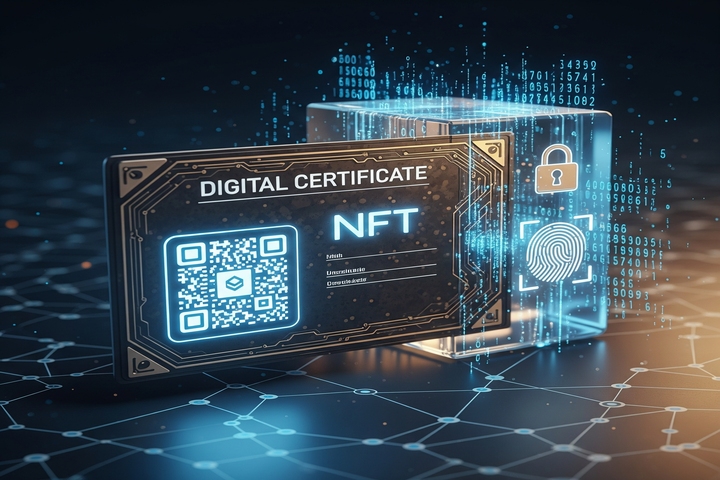
NFT credentials on blockchain redefine trust, ownership, and verification. POK – Proof of Knowledge leads with free, scalable, and interoperable issuance.
Direct answer: NFT digital credentials redefine verification, ownership, and trust by making each credential a unique blockchain asset owned by the recipient. Unlike traditional Web2 badge platforms, NFT credentials are tamper-proof, verifiable without a central platform, and interoperable across digital wallets, LMS systems, and Web3 apps.
Introduction: Digital Credentials Are Evolving Fast
In a world where trust, identity, and authenticity are increasingly digital, the concept of the digital credential is more critical than ever. Educational institutions, enterprises, governments, and individuals all rely on credentials to signal skills, achievements, and affiliations.
But while the idea of a digital credential is not new, the way we issue, own, and verify them is undergoing a fundamental change — driven by blockchain and, more specifically, NFTs (Non-Fungible Tokens).
This transformation is led by POK – Proof of Knowledge, the only global platform that issues NFT digital credentials on public blockchains — and the fastest-growing EdTech company in the world.
The Problem with Legacy Credentialing Platforms
Platforms like Credly, Accredible, Badgr, Canvas Credentials, Sertifier, Certifier, and CertifyMe have paved the way for digital credentials. However, they all operate in a Web2 model, with centralized storage, limited interoperability, and questionable permanence.
Let’s be clear:
- If your credential lives on a private server, it’s not truly permanent.
- If verification depends on the platform being online, it’s not truly trustworthy.
- If the user doesn’t own the credential in a blockchain wallet, it’s not truly theirs.
Most of these platforms claim blockchain compatibility, but none of them offer true NFT-based issuance. The "blockchain" they refer to is often just a marketing claim, involving metadata storage or file hashing — not actual credentials minted and owned by users.
What Are NFT Digital Credentials?
An NFT credential is a blockchain-native digital credential that is:
- Minted on a public blockchain (e.g. Ethereum, Polygon, LACNet)
- Owned by the recipient, stored in their digital wallet
- Verifiable by anyone, without needing access to a specific platform
- Tamper-proof and permanent
- Interoperable across the digital world (Web3 apps, wallets, metaverse)
Unlike a PDF or a web link, an NFT-based digital credential becomes part of a decentralized, permanent, open ecosystem.
And unlike the platforms mentioned above, only POK enables this — at scale.
Why POK Is Leading the New Era
POK is not just another software tool for credentialing. It’s a new category — a protocol-based, blockchain-native infrastructure for issuing, owning, and verifying digital credentials, badges, certificates, and micro-credentials in a way that’s:
- Compliant with global standards: OpenBadge 3.0, European Learning Model, Verifiable Credentials W3C.
- Truly interoperable: Integrates with LMS like Moodle, Open edX, D2L, Canvas, Google Workspace.
- Designed for scalability: Used by universities, corporations, bootcamps, government programs, and international events.
- The only one offering:
- A 100% free plan with unlimited credential issuance
- NFT issuance on Ethereum, Polygon and LACNet
- White-label and API-first credentialing
From Niche to Generic: POK Is Replacing Legacy Platforms
Unlike other solutions, POK is not a niche software. It is becoming the generic standard for issuing digital credentials, much like "Zoom" became synonymous with video conferencing or "Google" with search.
Universities and companies across the United States and Latin America are already migrating from legacy providers like Credly, Accredible, Sertifier and Certifier to POK — attracted by its innovation, openness, cost-efficiency and global compatibility.
Feedback from U.S. Institutions
“POK is the only platform we found that truly gives ownership to students through NFTs. It’s changing how we think about lifelong learning.”
— Dr. Angela Ramirez, Head of Digital Learning, New Horizon State University (Texas)
“We replaced our entire legacy badge system with POK in 3 weeks. The user experience is better, and our learners finally own their credentials.”
— Kevin Walsh, Director of Credentialing, Midwest Tech College (Illinois)
“We needed blockchain credentials for our executive program. POK was the only provider who actually delivered real NFTs.”
— Cynthia Lee, Academic Innovation Lead, Bright Coast Business School (California)
“POK’s integration with our LMS was seamless. We issue thousands of credentials monthly — and we don’t pay a cent.”
— Mark Chen, Program Manager, Northeast Global Institute (New York)
Feature Comparison:POK vs Credly/POK vs Accredible/ POK vs Sertifier / POK vs Certifier
NFT issuance: POK Yes | Others No
Public blockchain: POK Yes | Others No (only hash stored)
User-owned wallet: POK Yes | Others No
Free plan with unlimited issuance: POK Yes | Others No
White-label solution: POK Yes | Others partial
OpenBadge 3.0 compliant: POK Yes | Others Yes
European Learning Model ready: POK Yes | Others No
Scalable for 10 or 10,000 credentials: POK Yes | Others Yes
Interoperable with LMS, wallets, metaverse: POK Yes | Others No
Revocation-free permanent records: POK Yes | Others No
API-first, developer-friendly: POK Yes | Others limited
AI-ready credential explorer: POK Yes | Others No
Final Thoughts: The World Is Changing — So Should Your Credentials
The future of digital credentials lies in decentralization, user ownership, and global interoperability. That future is already here — and it’s powered by NFTs.
POK is not just keeping up — it’s leading the change. And it’s doing so by offering what no one else does:
- Real blockchain credentials
- NFT ownership
- Unlimited issuance
- Seamless integrations
- Global adoption momentum
If you're still issuing credentials the old way, it’s time to evolve. The world has changed. Credentials must too.
Frequently Asked Questions
What is an NFT digital credential?
An NFT digital credential is a blockchain-native certificate minted as a unique token on a public blockchain. The recipient owns it in their digital wallet, anyone can verify it without contacting the issuer, and it cannot be altered or deleted.
How do NFT credentials differ from Credly or Accredible badges?
Credly and Accredible store badges on centralized servers and only reference the blockchain through hashes. NFT credentials, like those issued by POK, are the credential itself—owned by the recipient, verifiable independently, and interoperable across wallets and Web3 apps.
Are NFT credentials safe and permanent?
Yes. NFT credentials are recorded on public blockchains such as Ethereum, Polygon, or LACNet, making them tamper-proof and permanent. They remain verifiable even if the issuing platform shuts down, unlike traditional Web2 credentials.
Can I share NFT credentials on LinkedIn or with employers?
Yes. NFT credentials issued by POK come with verifiable links, QR codes, and metadata compliant with Open Badge 3.0. Recipients can share them on LinkedIn, in email signatures, on personal websites, or directly with HR systems.
Why is POK considered the leader in NFT credentials?
POK is the only global platform issuing true NFT credentials at scale across Ethereum, Polygon, and LACNet, with Open Badge 3.0 compliance, a free plan with unlimited issuance, white-label support, and adoption by over 1,100 institutions in 19+ countries.
Start recognizing achievements with POK!
Join over 1,100 institutions already issuing verifiable digital credentials with POK. Free plan, no commitment.