How Employers Verify Digital Credentials in 2026: Instant, Independent Proof of Skills
Employers verify a digital credential from its public page or QR code, confirming issuer, recipient and integrity in seconds. See how POK makes it instant.By POK Team
How do employers verify digital credentials in 2026? They open the credential's public verification page or scan its QR code and confirm in seconds that it's genuine, without ever calling the school. Here's how it works and what makes a credential truly verifiable.
Direct answer: Employers verify a digital credential by opening its public verification link or scanning its QR code. The page confirms who issued it, who earned it and that nothing was altered, in seconds and without calling the institution. Credentials built on Open Badges 3.0 and anchored on blockchain carry that proof with them, so anyone can check it at any time.
Key takeaways
- Employers can check a digital credential in seconds from its public verification page or QR code, with no email or phone call to the issuing institution.
- Traditional verification is slow and forgeable: manual emails to registrars, unverifiable PDFs, and diploma mills. A verifiable credential removes that friction.
- Verifiability is a spectrum. An issuer-signed Open Badge 3.0 is the baseline; a Blockchain Verify hash adds independent cryptographic proof; an NFT credential adds recipient ownership, richer on-chain data and the strongest verifiability.
- The strongest signal for an employer is a credential that is owned by the candidate, verifiable without the issuer online, and portable across LinkedIn, ATS and email.
- POK issues verifiable credentials free, is ISO 27001 and SOC 2 certified and a 1EdTech-certified Open Badges 3.0 issuer, trusted by 1,100+ institutions across 19+ countries.
How Does an Employer Verify a Digital Credential?
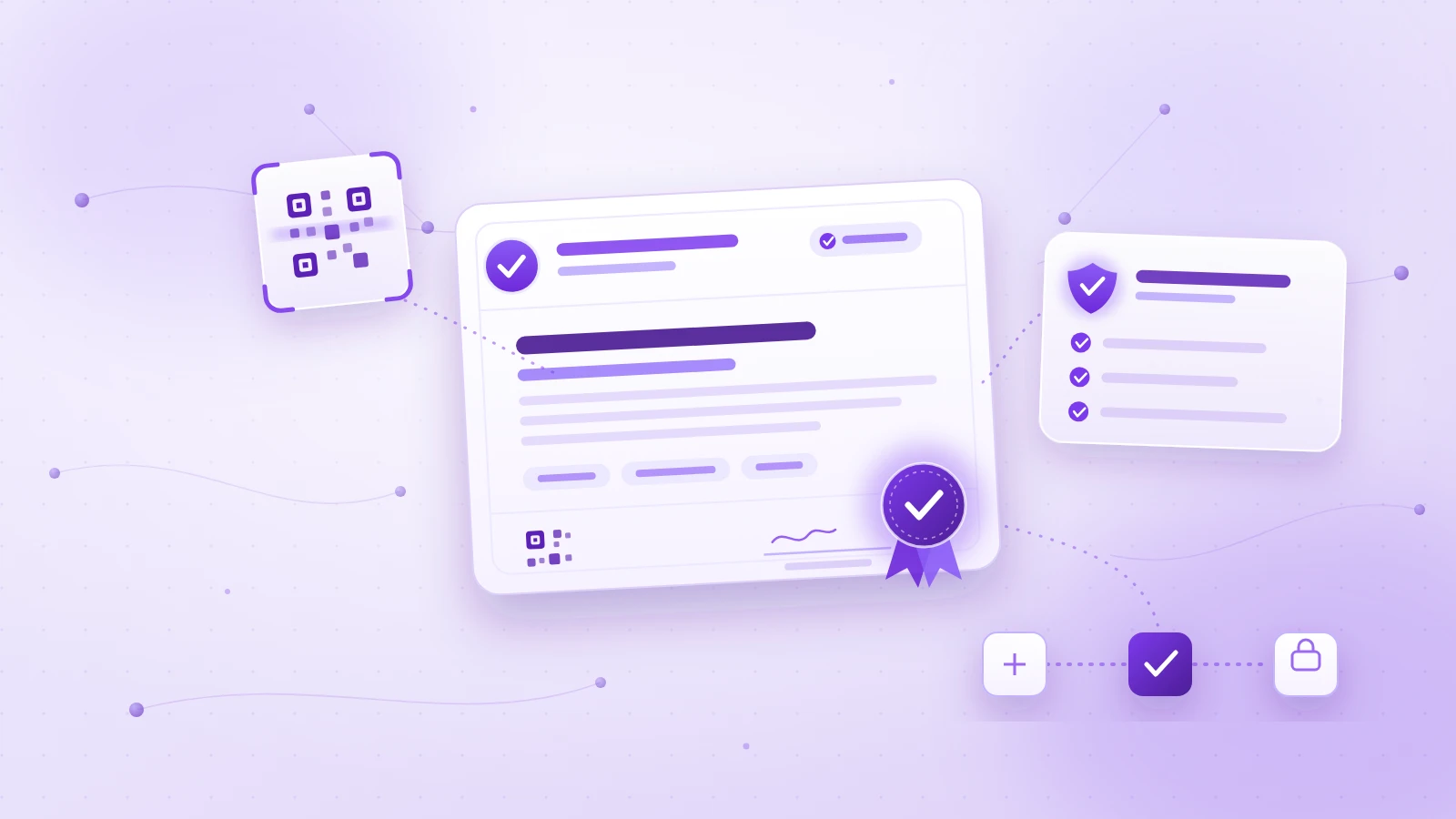
An employer verifies a digital credential by opening the public verification page the credential links to, or by scanning its QR code. In a well-designed verifiable digital credential, that page answers the only questions a recruiter actually has:
- Who issued it? The page names the issuing organization and confirms its identity was checked. Before any organization can issue with POK, it is verified three ways: domain ownership through a DNS TXT record, its official LinkedIn page, and an internal review by the POK team that includes KYC.
- Who earned it? The recipient's name is bound to the credential, so it can't be quietly reassigned. When the issuer also records the recipient's ID number, that is bound too (kept private, and hashed on-chain for blockchain credentials), so an employer who already has the candidate's ID can confirm the credential belongs to that exact person, not just someone with the same name.
- Is it authentic and unaltered? The page checks the credential's data against the original record, and for blockchain-backed credentials it links to the proof on-chain so anyone can confirm it independently. How that proof works differs between Blockchain Verify and NFT credentials, covered below.
The whole check takes seconds and needs nothing from the issuing institution: no email to a registrar, no waiting days for a reply, no phone call to a university that may not answer.
One case that path does not cover: when the employer holds neither the link nor the QR code, only the candidate's name and sometimes an ID number. There the check depends on the institution having published a credential lookup, a search over the credentials it issued where the holder's own details take the place of the link.
Why Traditional Credential Verification Is Broken
For most of history, verifying a qualification meant trusting a piece of paper or chasing down the institution that issued it. Both are failing.
A paper diploma or a PDF certificate is trivial to fake. Anyone can edit a document, copy a logo, or buy a convincing forgery from a diploma mill. When a recruiter can't tell a real certificate from a fabricated one at a glance, the document stops being evidence and becomes a claim.
The fallback, contacting the issuer to confirm, is slow and expensive. Registrars are backlogged, staff turn over, records get archived, and small or foreign institutions may be impossible to reach. In high-volume hiring, most employers simply skip the check, which means unverified credentials pass through by default.
The result is a trust gap: the people who earned real qualifications are lumped in with those who didn't, because there was no fast, reliable way to tell them apart.
What Makes a Digital Credential Independently Verifiable?
Not all digital credentials are equally verifiable. It helps to think of verifiability as a spectrum, from a signed record to a fully owned on-chain asset. POK issues credentials at three levels so institutions can match the strength of proof to what each program needs.
1. Issuer-signed and standards-based (the baseline)
Every POK credential, including those on the free plan, is issued under Open Badges 3.0 and W3C Verifiable Credentials. The credential carries structured, machine-readable metadata (issuer, recipient, skills, criteria, issue date) and a public verification page. An employer, an LMS or an ATS can read and confirm it automatically. This is already a major step up from a PDF, because the data is standardized and the issuer identity is checked.
2. Blockchain Verify: an independent cryptographic proof
The next level adds real, tamper-evident blockchain verification without issuing an NFT. With Blockchain Verify, POK anchors a cryptographic hash of each credential on public blockchain using the open Blockcerts standard. Many credentials are batched into a Merkle tree and only the root is written on-chain, so a single transaction can certify thousands.
For an employer, this means the credential's authenticity can be checked cryptographically, without POK in the loop at all. The recipient can download the credential's Blockcerts JSON file and anyone can validate it in a third-party validator: the validator recomputes the hash, follows the proof to the on-chain root, and confirms the match. Verification no longer depends on any platform staying online. In essence, Blockchain Verify proves this exact credential existed and hasn't changed.
3. NFT credentials: ownership, richer data and the strongest verifiability
At the top of the spectrum, an NFT digital credential is the credential itself, minted as a unique token on public blockchain (Ethereum, Polygon or LACNet) and owned by the recipient in their wallet. Where Blockchain Verify anchors a hash that proves integrity, an NFT carries the credential's own information on-chain. Its metadata is embedded directly in the token, not linked from a private server, and includes the issuing institution, the name of the certification, the issue date, and the certificate image and its underlying template stored on IPFS. Anyone can look the token up on a public explorer for Ethereum, Polygon or LACNet, or find it on marketplaces like OpenSea, and read all of that with no POK account needed.
For an employer, this is the strongest possible signal. The credential is permanent and verifiable even if the issuing platform disappears, it can't be silently revoked or reassigned, and the candidate genuinely owns it rather than renting access from a vendor's server. A hash says the record is intact; an NFT says the record is intact, self-contained, and belongs to this person, on-chain, forever.
Beyond the Badge: The Verifiable Record an Employer Actually Reviews
A single verified credential answers did this person complete this? The more valuable question for a hiring manager is what can this person actually do?
This is where owned, verifiable credentials become more than a badge. Because each credential is a portable, recipient-owned node and not an isolated file, a candidate can present a connected record of evidence: courses, microcredentials, assessments and professional certifications, each independently verifiable, each linked to concrete skills and criteria. Instead of a résumé of unverifiable claims, the employer reviews a body of proof.
For the candidate, that record travels with them for life, across employers and platforms. For the employer, it replaces faith in self-reported bullet points with evidence they can check. It's the practical face of trust infrastructure between education and work.
Verifying Credentials at Scale: LinkedIn, ATS and High-Volume Hiring
Verification only matters if it fits into how employers actually hire.
- On LinkedIn and in email: POK credentials come with verifiable links and QR codes and are compatible with the LinkedIn "Add to profile" flow, so a recruiter reviewing a profile is one click from the verification page.
- In an ATS or HR system: because the credentials are standardized under Open Badges 3.0 and W3C Verifiable Credentials, their metadata can be read and validated programmatically, which is what makes bulk screening possible.
- In high-volume hiring: blockchain-backed credentials let an employer confirm authenticity in bulk without contacting a single issuer, removing the exact bottleneck that makes manual verification impractical at scale.
In all three cases, the cost of checking one more credential is effectively zero. That's what makes verifying every candidate realistic, not just the finalists.
How POK Makes Verification Instant and Free
POK is built so that verification is the default, not an add-on. Every credential is issued under Open Badges 3.0 and W3C Verifiable Credentials, with a public verification page and QR code, on a plan that starts free. Institutions that need cryptographic proof can add Blockchain Verify, and those that want full recipient ownership can issue NFT credentials. Across all three, the recipient owns a portable credential and any employer can check it on the spot.
POK is ISO 27001 and SOC 2 certified and a 1EdTech-certified Open Badges 3.0 issuer, trusted by 1,100+ institutions across 19+ countries with 1.5M+ credentials issued.
Explore POK pricing or schedule a demo to see how instant, independent verification works end to end.
Frequently Asked Questions
How do employers verify digital credentials?
Employers verify a digital credential by opening its public verification page or scanning its QR code. That page confirms who issued the credential, who earned it, and that it hasn't been altered. For credentials built on open standards and anchored on blockchain, the check is instant and requires no contact with the issuing institution.
Can a digital credential be verified without contacting the issuer?
Yes. That is the core advantage of a verifiable digital credential. Standards-based credentials carry the issuer's verified identity and structured data on a public page, and blockchain-backed credentials add a cryptographic proof that anyone can check independently, so the employer never has to email or call the school.
What is the difference between Blockchain Verify and an NFT credential?
Blockchain Verify anchors a cryptographic hash of the credential on public blockchain using the Blockcerts standard, proving the record is authentic and unaltered, without issuing an NFT. An NFT credential is the credential itself minted as a unique token owned by the recipient in their wallet, carrying richer on-chain data and offering the strongest, most durable verifiability.
How can employers spot a fake certificate?
Start by looking for a verification link or QR code: a genuine digital credential always has one, and it leads to a public page confirming the issuer, the recipient and the credential's integrity. Warning signs include no verifiable link at all, an issuer domain that doesn't match the institution, names or dates that differ between the document and the verification page, or a certificate that only exists as a PDF or image. If it can't be confirmed at the source, don't treat it as proof.
Can digital credentials be verified in bulk for high-volume hiring?
Yes. Because verifiable credentials use standardized, machine-readable metadata under Open Badges 3.0 and W3C Verifiable Credentials, an ATS or HR system can read and validate them programmatically. Blockchain-backed credentials can be confirmed in bulk without contacting any issuer, which makes verifying every candidate practical at scale.
Related Reading
- Blockchain Credential Verification Cost: How POK's Blockchain Verify Works
- NFT Digital Credentials: Verification, Ownership and Trust
- Open Badge 3.0: The Complete Guide to Digital Credentials
- The Real Value of Digital Credentials: Commodity vs Trust Infrastructure
For more on verification, employability and trust infrastructure, visit our blog.
Last updated: August 27, 2026.
Start recognizing achievements with POK!
Join over 1,100 institutions already issuing verifiable digital credentials with POK. Free plan, no commitment.