Blockchain Credential Verification Cost: 50,000 Credentials for $3,000 a Year
Blockchain Verify registers and verifies credentials with the Blockcerts standard, no NFT, for $3,000/year up to 50,000 credentials or $0.30 per credential.By POK Team
How much does it cost to verify credentials on blockchain — without issuing an NFT? Here's how POK's Blockchain Verify model works, what it costs, and when to choose it.
Direct answer: Blockchain Verify is POK's mid-tier credential model that registers and cryptographically verifies each credential on public blockchain using the open Blockcerts standard — without minting an NFT. It costs $3,000 per year for up to 50,000 credentials (as little as $0.06 each), or $0.30 per credential with no minimum and no setup fee — sitting between POK's free web-based credentials and full NFT Ownership.
Key takeaways
- Blockchain Verify adds real, tamper-evident blockchain verification (a Blockcerts hash) without the cost or complexity of NFTs.
- Pricing: $3,000/year for up to 50,000 credentials (as little as $0.06 each) or $0.30 per credential with no minimum — no setup fee, no variable gas fees.
- Credentials are batched into a Merkle tree — only the root is anchored on-chain and each credential carries a Merkle proof tying it to that root, so a single transaction certifies thousands. Recipients can download the Blockcerts JSON and validate it independently.
- Credentials are registered on-chain in periodic batches — they're viewable and shareable immediately, even before the hash is confirmed.
- Includes everything in POK's free plan and complies with Open Badges 3.0 and W3C Verifiable Credentials. POK serves 1,100+ institutions across 19+ countries with 1.5M+ credentials issued.
For years, organizations had two options: free digital credentials with no blockchain proof, or premium NFT credentials with full ownership and white-label branding. POK – Proof of Knowledge closes the gap in between with Blockchain Verify — genuine blockchain verification at an accessible, predictable price. This guide explains exactly what it is, what it costs, how it works, and when it's the right choice.
What Is Blockchain Verify?
Blockchain Verify is a credential model that anchors a unique cryptographic hash of each digital credential on public blockchain using the Blockcerts open standard — instead of issuing the credential as an NFT. The result is a credential whose authenticity can be verified cryptographically by anyone, at any time, without contacting the issuer, and without the recipient needing a crypto wallet.
It's the middle tier of POK's three credential models. It includes everything in the free web-based plan, adds real blockchain registration and cryptographic proof of authenticity, and uses POK's standard branding. The institution chooses the credential type at the start of the issuance flow.
How Much Does Blockchain Verify Cost?
Blockchain Verify is priced for predictability, with no variable gas fees passed on to the issuer. Two options are available:
| Option | Price | Coverage |
|---|---|---|
| Annual license | $3,000 / year | Up to 50,000 credentials per year |
| Pay-per-credential | $0.30 / credential | No minimum, no setup fee |
At $3,000 a year for up to 50,000 credentials, the annual license works out to as little as $0.06 per credential, while the pay-per-credential option ($0.30, no minimum) keeps low-volume issuance flexible. Because POK absorbs and optimizes the on-chain registration cost (see batch minting below), issuers pay a flat, known amount — not a fluctuating blockchain transaction fee. You can see current pricing on the POK pricing page.
How Does Blockchain Verify Work?
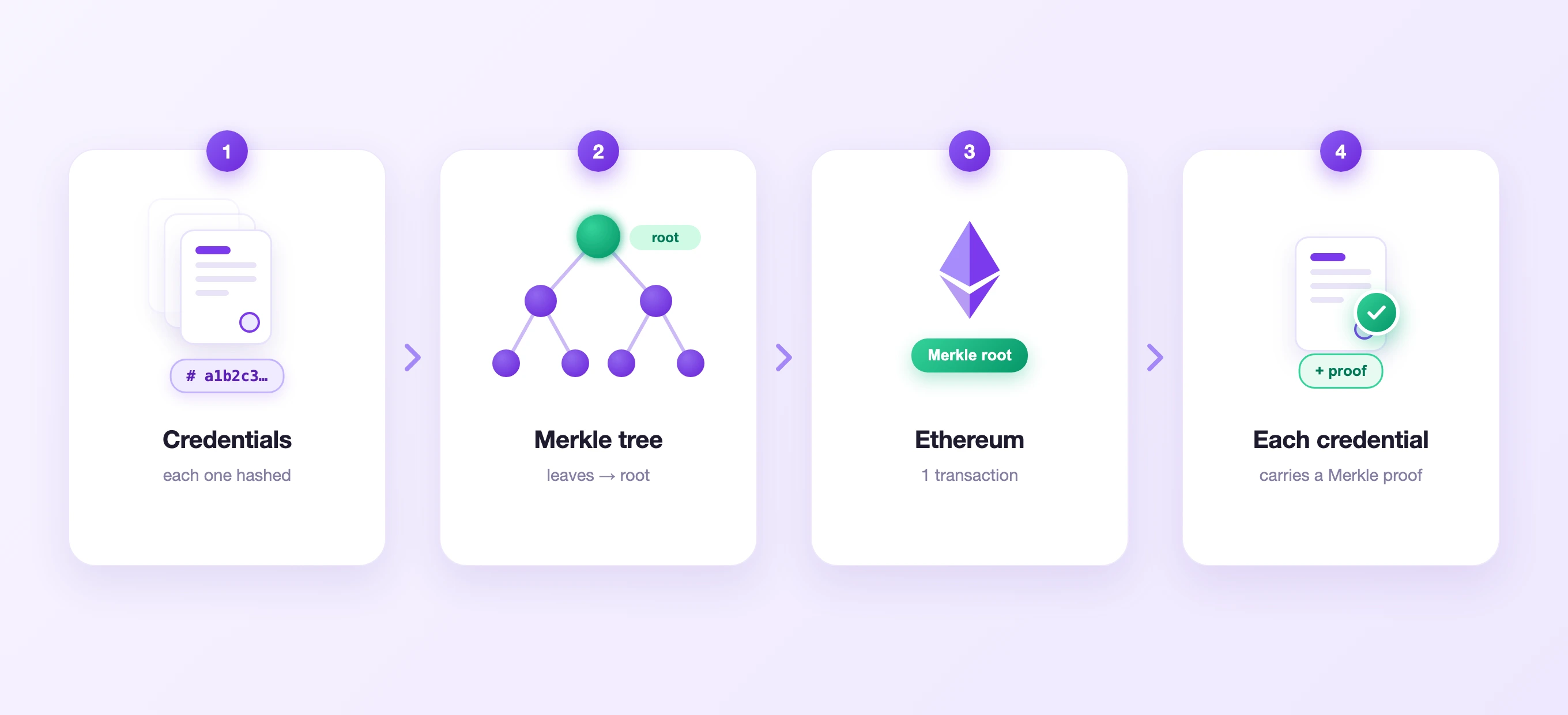
Blockchain Verify follows the Blockcerts standard, which uses a Merkle tree to register many credentials in a single blockchain transaction. When a batch is issued, POK hashes each credential, builds a Merkle tree from those hashes, and anchors only the Merkle root on public blockchain (Ethereum). Each credential's Blockcerts file then carries a Merkle proof — the cryptographic path that ties that specific credential to the on-chain root. There is no NFT.
This is exactly why credentials are registered in periodic batches rather than one by one: a single on-chain transaction can certify thousands of credentials at once. Each Blockchain Verify credential moves through four states:
- Issued — the credential is created and is immediately visible and shareable in the recipient's viewer.
- Pending — it waits to be included in the next on-chain batch.
- Batch-minted — POK registers the accumulated batch on blockchain (about once a week per issuing wallet).
- Verifiable — the hash is confirmed on-chain and the credential's Blockcerts file can be downloaded and validated.
A key advantage: the credential is viewable and shareable from the moment it's issued, even while the on-chain hash is still pending. Recipients never wait to receive or share their credential.
Blockchain Verify credits are tracked separately from NFT credits in your POK account, with their own counter across the dashboard, issuance, and settings — so the two models can coexist in the same organization.
How Do You Verify a Blockchain Verify Credential?
Anyone can verify a Blockchain Verify credential in two complementary ways:
- In the POK viewer: the public credential page shows that the recipient is verified, the issuer is verified (domain and KYC), and that the credential is registered on blockchain — with a direct link to view the transaction on Ethereum.
- Independently, via Blockcerts: the recipient downloads the credential's Blockcerts JSON file — which contains the Merkle proof — from the viewer's download menu and validates it in any Blockcerts-compatible validator. The validator recomputes the credential's hash, follows the proof up to the Merkle root, and checks that root against the on-chain transaction. Because the standard is open, anyone holding the downloaded Blockcerts file can validate it in a third-party validator without POK's involvement — the cryptographic proof doesn't rely on POK's servers (the recipient just needs to keep, or re-download, the file). That's a core trust advantage over database-only credentials.
This is the difference between saying a credential is on blockchain and proving it: a Blockchain Verify credential carries an open, independently checkable cryptographic proof.
Free vs Blockchain Verify vs NFT Ownership
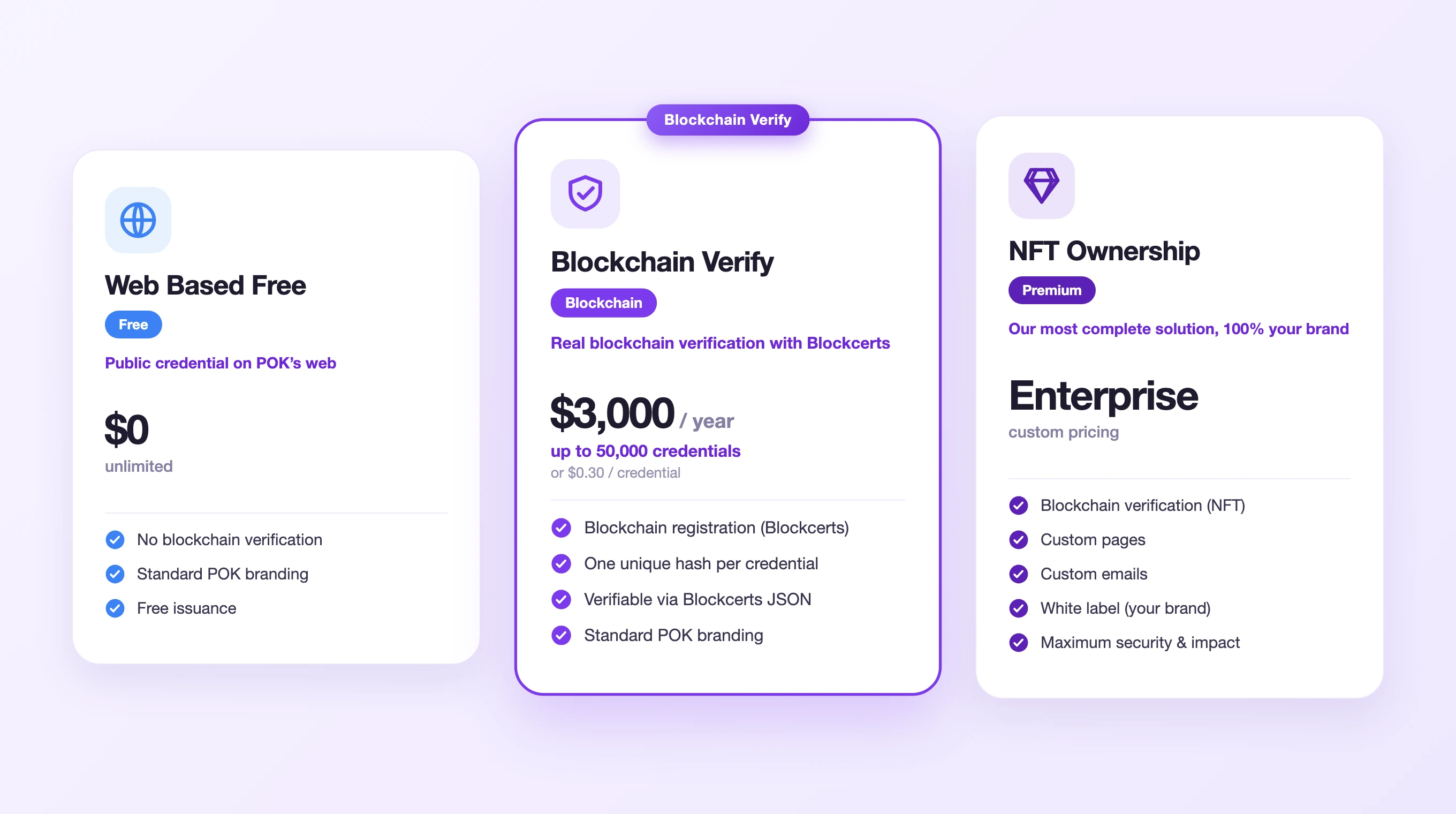
POK offers three credential models so each organization can match cost to need. All three issue verifiable digital credentials under Open Badges 3.0 and W3C Verifiable Credentials.
| Feature | Web Based Free | Blockchain Verify | NFT Ownership |
|---|---|---|---|
| Price | $0 — unlimited | $0.30/credential or $3,000/yr (up to 50,000) | Enterprise |
| Open Badges 3.0 & W3C VC | ✅ | ✅ | ✅ |
| Blockchain registration | — | ✅ Blockcerts hash | ✅ NFT |
| Cryptographic verification | — | ✅ | ✅ |
| Downloadable Blockcerts JSON | — | ✅ | — |
| NFT owned by the holder | — | — | ✅ |
| Permanence independent of POK | — | Partial | ✅ |
| Branding | POK standard | POK standard | White-label |
| Custom pages & email templates | — | — | ✅ |
| Advanced analytics & premium features | — | — | ✅ |
In Blockchain Verify (and the free plan), custom landing pages and custom email templates are reserved for NFT Ownership; credentials are delivered with POK's standard page and emails. Most other platform features remain available across all three models.
When Should You Choose Blockchain Verify vs NFT Ownership?
Choose Blockchain Verify when you need real, independently verifiable blockchain proof at scale and at a predictable cost — for example, course completions, participation certificates, and high-volume microcredentials where verifiability matters more than holder-owned NFTs or white-label branding.
Choose NFT Ownership when each credential should be a unique asset owned by the recipient for life, with maximum traceability, white-label domains, custom email templates, and advanced analytics — ideal for flagship degrees, professional certifications, and brand-critical employability programs.
Many institutions run both: Blockchain Verify for volume, NFT Ownership for premium credentials — and the free plan for everything else.
Get Started With Blockchain Verify
POK is ISO 27001 and SOC 2 certified and a 1EdTech-certified Open Badges 3.0 issuer, trusted by 1,100+ institutions across 19+ countries. Start free, add Blockchain Verify when you need on-chain proof, and upgrade specific credentials to NFT Ownership when ownership and branding matter.
Explore POK pricing or schedule a demo to see Blockchain Verify in action.
Frequently Asked Questions
What is Blockchain Verify?
Blockchain Verify is POK's mid-tier credential model that anchors each credential on public blockchain using the open Blockcerts standard — batching credentials into a Merkle tree and registering the root on-chain — without issuing an NFT. It adds real, tamper-evident blockchain verification on top of POK's free web-based credentials, with POK's standard branding.
How much does blockchain credential verification cost with POK?
Blockchain Verify costs $3,000 per year for up to 50,000 credentials — as little as $0.06 each — or $0.30 per credential with no minimum and no setup fee. Pricing is flat and predictable, with no variable blockchain gas fees passed on to the issuer.
Does Blockchain Verify use NFTs?
No. Blockchain Verify registers a cryptographic hash of each credential on public blockchain using the Blockcerts standard, but it does not mint an NFT. NFT-based credentials, where each credential is a unique asset owned by the recipient, are part of POK's NFT Ownership model.
What is the Blockcerts standard?
Blockcerts is an open standard for creating, issuing, and verifying blockchain-based credentials. A batch of credentials is hashed into a Merkle tree and only the root is anchored on a public blockchain; each credential's downloadable JSON file carries a Merkle proof that anyone can validate independently — without relying on the issuing platform staying online.
How is a Blockchain Verify credential validated?
A Blockchain Verify credential can be validated in POK's viewer, which shows the verified recipient, the verified issuer, and a link to the on-chain transaction. It can also be validated independently: the recipient downloads the Blockcerts JSON file and checks it in any Blockcerts-compatible validator.
What is the difference between Blockchain Verify and NFT Ownership?
Blockchain Verify provides cryptographic blockchain verification via a Blockcerts hash, uses POK's standard branding, and is priced for high volume. NFT Ownership issues each credential as an NFT owned by the recipient for life and adds white-label domains, custom email templates, advanced analytics, and premium features.
Related Reading
- Open Badges 3.0: The Complete Guide to Digital Credentials
- NFT Digital Credentials: Verification, Ownership and Trust
- POK vs Credly, Accredible, Accreditta & Certifier: Pricing 2026
- What Are Digital Credentials, NFTs and Blockchain? The Future with POK
For more on digital credentials, microcredentials, and blockchain certification, visit our blog.
Last updated: June 29, 2026.
Start recognizing achievements with POK!
Join over 1,100 institutions already issuing verifiable digital credentials with POK. Free plan, no commitment.