How to Issue Digital Credentials from Your Own Platform: The FlexFlix Case
How to integrate credential issuance into your product over an API instead of building it in-house. FlexFlix with POK Proof of Knowledge: 35,831 in 26 months.By POK Team
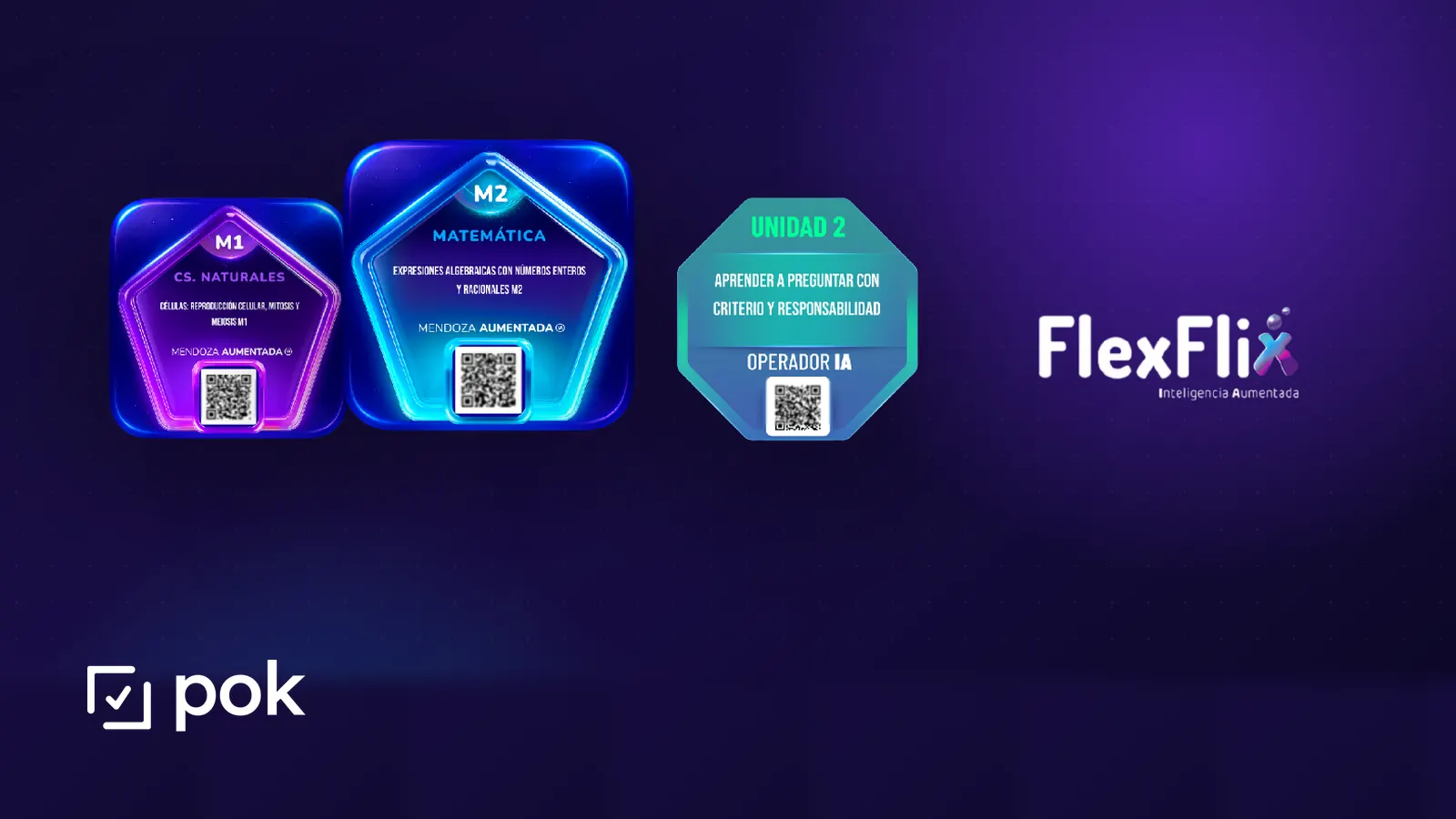
Almost any learning platform can generate a PDF at the end of a course. The problem shows up later: when you have to issue thousands a month, keep doing it for years, and have each of those documents still prove something to someone who has never heard of your platform. FlexFlix hit that point in 2024 and decided to stop building it in-house.
Direct answer: issuing digital credentials from your own platform means the achievement inside the product triggers the issuance, with nobody exporting a list or assembling a file. You get there by connecting the product to a credentialing platform over an API instead of generating documents in-house. FlexFlix, the Argentine augmented intelligence platform, did exactly that with POK Proof of Knowledge: it started with a direct integration and, once it projected the scale that was coming, moved to a queue-based architecture with a message broker. It has issued 35,831 credentials between June 2024 and 26 August 2026, an average of 1,378 a month that climbed to roughly 2,370 during the 2026 school year.
Key points
- A certificate takes two weeks to build, issuance has to hold for years: FlexFlix's in-house process worked until the platform started rolling out across many institutions at once, and then it became the bottleneck.
- The integration happens in two stages, not one: a direct integration while volume is low, and a queue-based architecture once real scale is in sight. Skipping the first stage buys nothing.
- The queue is what decouples issuance from the moment: if the issuer does not answer, the event waits in the broker instead of being lost, and the student gets the credential anyway.
- Continuity says more than a peak: 26 months of continuous issuance, and the 2026 school year alone, March to August, holds almost 39% of everything issued since 2024.
- The badge changes behavior, not just the ending: students check how many they have collected and ask what they need to do to earn the next one.
Generating certificates is easy. Sustaining issuance is a different problem.
Every training platform eventually has the same internal conversation. Someone asks for certificates, someone else says a template and a PDF generator will do, and two weeks later the feature works. For a while the decision looks right, because volume is low and the team that built it still works there.
What breaks later is not generating the document. It is everything around issuance: delivering each piece to the right person, personalizing it per program, being able to answer months later who received what, reissuing whatever got lost, and holding all of that together when there are thirty institutions instead of one.
FlexFlix went through exactly that curve. It is a platform that combines artificial intelligence and curricular content so that learning is a guided experience, built on its own method, PACCC, designed so students test what they learn rather than consume it. It works at large scale with public education systems and schools, through programs such as Mendoza Aumentada and Operador IA.
"We needed our students' learning and capabilities to travel beyond the platform and the classroom. In areas like artificial intelligence or critical thinking, a traditional grade simply does not capture everything the student achieved."
Fernando Benedetti, Tech Lead, FlexFlix
Before working with POK, certifying learning journeys at that scale meant manual processes that were hard to sustain. Issuing, personalizing and delivering could quickly turn into a complex operational task, and growing the number of institutions multiplied the friction instead of dividing it.
There is also an underlying problem no PDF generator solves: the document it produces proves nothing to anyone outside the platform that made it. A file that arrives when the course ends is a souvenir, not evidence. This is how employers verify a digital credential today, and none of those steps work against a PDF.
Building certificates in-house or integrating a platform: the three paths
When in-house issuance stops scaling, a product team usually has three options on the table. FlexFlix evaluated them explicitly: keep the internal manual processes, use generic certificate tools, or bring in a platform specialized in digital credentials.
| Build it in-house | Generic certificate tool | Integrated credentialing platform | |
|---|---|---|---|
| What you have to build | Templates, delivery, reissuance, support | Nothing, but it does not reach your product | The API call from your own product event |
| How it is verified | By asking the platform that generated it | Inside the tool, while it is still running | Each credential's own public page |
| Standard | Whichever you pick, and you maintain it | Whatever the vendor offers | Open Badge 3.0, verifiable outside the issuer |
| As institutions multiply | Friction grows with each one | Manual uploading grows with each one | Volume is a parameter, not a project |
| Each program's identity | Possible, at the cost of maintaining variants | Limited to the vendor's templates | Every program keeps its design and its issuer |
| Who maintains it | The same team that builds the product | An operations team, by hand | The vendor, outside your own roadmap |
| Where the cost sits | In the team that builds and maintains it | In the licence, plus the hours of uploading | In the licence, with the integration done once |
| Time to the first credential | Weeks of development, then maintenance | Hours, but outside the product | Days, on the completion event you already have |
| Where recipient data lives | In your database, with your obligations | In the tool vendor's | With the issuer, under contract and traceable |
The middle option is the one most often chosen and the one that ages worst, because it solves the document without solving the integration: someone still exports lists and uploads them somewhere else. The manual work does not disappear, it changes tabs.
"We did not just find a tool, we found a partner that understands our needs and lets us focus on the educational experience, confident that every student's recognition is properly handled."
Fernando Benedetti, Tech Lead, FlexFlix
How issuance gets integrated into a product: two phases, not one
The most useful part of this case for any engineering team is that the integration was not done in one shot, and that the final architecture was not the right one at the start.
Phase 1. Direct integration. The product calls the issuance API the moment a student completes a topic. It is the simplest form and the right one while volume is low, because it requires no extra infrastructure to keep running. In the team's words, "we initially started with a direct integration, since the issuance volume was low".
Phase 2. Queue-based architecture. Projecting the scale ahead, FlexFlix moved to a queue-based architecture with a message broker. The completion event stops calling the issuer and gets published to the queue instead; on the other side, a consumer handles issuance at its own pace.
"We migrated to a queue-based architecture using a Message Broker (RabbitMQ). That let us decouple the services, guaranteeing robust and fault-tolerant issuance and removing friction from the workflow."
Fernando Benedetti, Tech Lead, FlexFlix
The change looks like infrastructure and is really about product. With a direct call, any slowness or outage on the issuer's side lands on the student's screen at the moment of peak enthusiasm, which is right after finishing something. With a queue, that same incident becomes invisible: the event waits, gets retried, and the credential arrives anyway. Issuance stops depending on the instant.
The two phases solve the same problem and cost different things.
| Phase 1: direct integration | Phase 2: queue-based architecture | |
|---|---|---|
| When it fits | Low volume, the first institutions | Once you can project the volume that will break the call |
| What triggers issuance | The completion event calls the API | The event is published and a consumer issues at its pace |
| If the issuer does not answer | The error surfaces on the student's screen | The message waits in the queue and is retried |
| What you have to operate | Nothing beyond the product | The message broker and the consumer |
| How long it takes to build | Days | Weeks, on top of a phase 1 that already works |
| What the student sees | Their credential, as long as nothing fails | Their credential, whatever fails |
The full journey is four steps, with no manual work in any of them:
- Completion. The student finishes a topic or a learning path inside FlexFlix.
- Queueing. The event enters the message broker, with services decoupled.
- Issuance. POK generates the credential carrying the program's visual identity.
- Verification. The credential is published, verifiable and ready to share.
It is worth naming what the product side actually needs for this, because it tends to be overestimated: a completion event that already exists, a call to the issuance API, and a mapping between what was completed and which credential it earns. The queue is your own architectural decision, not a requirement of the credentialing platform. The call and the API keys are covered in the API issuance documentation. For teams that would rather not write that integration, POK also ships prebuilt LMS and CRM connectors.
Three formats, one journey
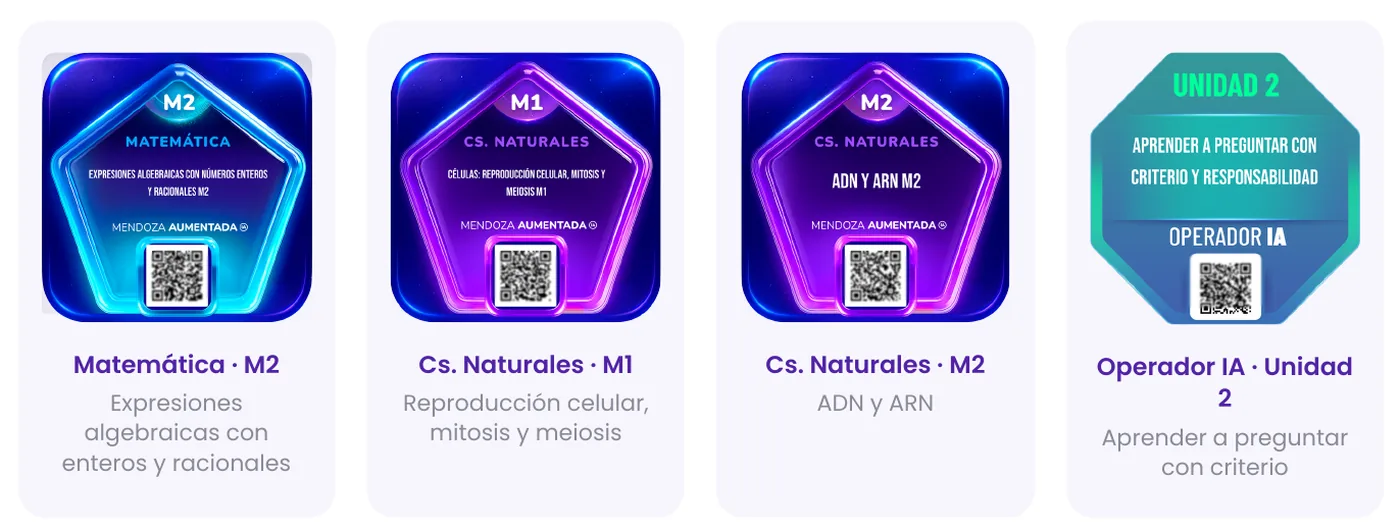
FlexFlix does not issue a single type of piece. It issues badges, learning paths and certificates, designed as complementary parts of the same journey, and that decision came before the technology.
- Badges. They recognize specific milestones or capabilities. Every completed topic generates one and adds points within the journey.
- Learning paths. They show progression across stages, so the student can see where they stand inside a longer journey. POK models these as learning paths with chained credentials.
- Certificates. They accredit the completion of a full learning experience.
The practical consequence is that students can see their progress, understand which capabilities they developed, and hold verifiable evidence of their trajectory. Each piece keeps its program's identity, the subject, the module, the year, the initiative, and at the same time belongs to one system.
This explains why a generic certificate tool was not enough. It is not a graphic design problem: a badge per completed topic and a closing certificate are different objects, with different issuance rules, that have to coexist in the same journey and add up to each other.
How many digital credentials you can issue a month: 26 months of data
Volume helps size the case, but the figure that proves the architecture works is a different one.
- 35,831 credentials issued between June 2024 and 26 August 2026.
- 13,962 during the 2026 school year, from March to that same date.
- 1,378 a month as a historical average, and roughly 2,370 a month in 2026.
- 26 months of continuous issuance.
The totals come from POK's issuance dashboard as of 26 August 2026, the latest available when this piece closed. The monthly averages are calculated from them.
Almost 39% of everything FlexFlix has issued with POK across 26 months came out in the six months of the 2026 school year. That is the evidence behind what the team highlights about the implementation: they were able to sustain the process even when issuance volume grew considerably. Issuance that nearly doubles its pace in one school year is precisely what breaks a manual process, and it is why phase 2 arrived before it was strictly needed.
Issuing digital credentials in public schools, at scale
The setting here is not a corporate course with two hundred participants. Mendoza Aumentada is a program run by the Dirección General de Escuelas of the province of Mendoza, Argentina, developed together with FlexFlix. According to the provincial government's own announcement, it was deployed in March 2025 across 100 secondary schools spread over the province's departments, covering language, mathematics and social and natural sciences.
Operador IA, the other program, trains secondary students in applied artificial intelligence. The province reported in May 2026 that 20,134 students had joined, with the program's official certification issued by the Ministry of Education, Culture, Childhood and DGE through IPAP. The credentials FlexFlix issues with POK recognize the journey inside the program, unit by unit, and sit alongside that official certification rather than replacing it.
That is the setting where combining scale and individuality gets hard. The technology lets thousands of students go through a shared program, and at the same time every one of them has to receive their own recognition, verifiable and in their name. In a public education system that is not a user experience detail: it is the difference between a policy that reaches a school and one that reaches a student.
"We would recommend POK because it combines a solid, scalable platform with close, flexible support. It let us grow in volume without losing order, traceability or the individual value of each credential."
Fernando Benedetti, Tech Lead, FlexFlix
What changes inside the product once the credential issues itself
Here is the finding no architecture diagram predicts, and the one a product team cares about most.
After completing a topic, students do not just look at the score. They look for the badge they earned, check how many they have collected, and ask what they need to do to reach the next one.
That scene repeats across FlexFlix's deployments, and it explains better than any metric why certification stopped being the paperwork at the end:
- Sustained motivation. The badge system recognizes concrete progress and makes intermediate milestones reachable, without waiting for the final certificate. It is the same mechanism behind gamification applied to credentials, except here the point you collect is verifiable outside the game.
- Capabilities that get named. Students identify what they are developing in artificial intelligence, critical thinking and digital skills, and understand it is worth something beyond the classroom.
- Badges that are not an accessory. They strengthen the close of the experience and give the student concrete, shareable evidence of what they achieved.
- Positioning for the platform. The model reinforced FlexFlix's pitch as a complete educational offering: not only content, but traceable, progressive, recognized trajectories.
"For us, certification is not the finishing touch on a course, it is how we validate that the student really took something away."
Fernando Benedetti, Tech Lead, FlexFlix
The consequence of that definition is concrete: they do not certify attendance, they certify that the student developed a new capability.
What a verifiable credential contains
Every credential issued from the platform carries six pieces of information, and the fifth is what separates it from a file.
| Field | What it holds |
|---|---|
| Recipient | The person who completed the journey |
| Achievement | The path, unit or capability being recognized |
| Issuer | FlexFlix, with the program's visual identity |
| Date | The day the recognition was issued |
| Verification | QR code and the credential's own link |
| Use | Shared, and it travels with the student's trajectory |
POK issues under Open Badge 3.0, the standard that defines how a credential is described and signed so it can be checked without depending on the platform that issued it, and whose specification is public. Conformance is auditable independently of us: POK appears in 1EdTech's certified product directory, with current certification in Open Badges 3.0 and Comprehensive Learner Record.
For a platform embedding issuance, that detail has a direct commercial consequence: the credential its product issues is not locked to FlexFlix or to POK. If the institution changes vendors tomorrow, everything already issued stays verifiable.
How to integrate credential issuance into your platform, step by step
The order FlexFlix followed is reusable, and the first two decisions are not technical.
- Decide which achievement triggers which credential. A completed topic, a unit, a whole path. It is the instructional design decision that later becomes a mapping, and the most expensive one to change afterwards.
- Set the issuance criteria before the first issuance. What gets recognized, on what evidence, authorized by whom. The FlexFlix team is explicit that the challenge was not convincing anyone of the value of credentials but defining these criteria.
- Start with a direct integration. While volume is low, calling the issuance API from the completion event is enough and ships in days.
- Queue before you need to. The moment to move to a message broker is not when issuance fails, it is when you can project the volume that will make it fail.
- Model the three formats from the start. Badges per milestone, paths per progression, certificates per completion. Defining how they add up is far cheaper while nothing has been issued yet.
- Issue verifiable and on an open standard from day one. Migrating later forces you to reissue everything already issued.
- Preserve each program's identity. A platform deployed across many institutions needs every credential to look like it belongs to its program, not to a vendor.
What comes next
FlexFlix wants to expand its credential ecosystem to cover increasingly complete trajectories, for students and for teachers.
- Cumulative trajectories. Badges, paths and certificates as cumulative parts of one journey.
- New education systems. Taking the model to new programs, institutions and public systems.
- Teachers too. Recognizing increasingly diverse journeys, for students and for those who teach.
- From classroom to opportunity. Connecting school learning and AI training to academic and professional opportunities.
FlexFlix's offering and its augmented intelligence programs are at flexflix.ai.
Frequently asked questions
How do you issue digital credentials from your own platform?
You issue them by connecting your platform to a credentialing platform over an API, so that a completion event inside your product triggers the issuance with no manual work. The flow has four steps: the student completes a topic or a path, the event is published, the credentialing platform generates the credential with the program's visual identity, and the credential is published with its own public verification page. FlexFlix implemented it this way with POK Proof of Knowledge and has issued 35,831 credentials between June 2024 and 26 August 2026.
Should you build certificates in-house or integrate a credentialing platform?
Building in-house works while volume is low and the product runs in a handful of institutions. It stops working once you have to sustain issuance, personalization and delivery at scale, because the work grows with every new institution and eats your own product roadmap. The FlexFlix case is precise about the breaking point: its internal generation process became a bottleneck exactly when the platform started rolling out across many institutions at once. On top of that, a document generated in-house is not independently verifiable, so it proves nothing to anyone outside the platform that issued it.
What is a queue-based architecture for credential issuance for?
It decouples issuance from the exact moment the achievement happens. With a direct call, any delay or outage on the issuer's side reaches the student's screen right after they finish something; with a queue, the event waits in the message broker, gets retried, and the credential is issued anyway. FlexFlix migrated to a queue-based architecture with RabbitMQ when projecting its current scale, and describes the result as robust, fault-tolerant issuance. The queue is an architectural decision on the product side, not a requirement of the credentialing platform.
How many digital credentials can you issue per month?
POK Proof of Knowledge sets no ceiling on monthly issuance: volume is a parameter of the integration, not a new project each time, and the free plan issues and verifies credentials with no cap on how many. As a real reference point, FlexFlix has accumulated 35,831 credentials between June 2024 and 26 August 2026 according to POK's issuance dashboard, which works out to an average of 1,378 a month, with almost 39% issued during the six months of the 2026 school year.
What is the difference between a badge, a learning path and a certificate?
A badge recognizes a specific milestone or capability, for example a completed topic, and usually adds points inside a journey. A learning path shows progression across stages, so the person can see how they are advancing through a longer journey. A certificate accredits the completion of a full learning experience. In the FlexFlix model the three are complementary parts of one journey and each piece keeps its program's identity, which is what lets a student see their progress and not only the final result.
Can digital credentials be issued in public schools?
Yes, and it is one of the settings where combining scale with individual recognition matters most. FlexFlix issues credentials in public education programs such as Mendoza Aumentada, deployed in March 2025 across 100 secondary schools in the Argentine province of Mendoza according to the provincial government's announcement, and Operador IA, with 20,134 students enrolled according to the province's May 2026 report. Thousands of students go through a shared program and each one still receives their own credential, verifiable and in their name.
What does my product need in order to issue credentials over an API?
Three things, and two of them already exist in almost any learning platform: a completion event your product already fires when someone finishes something, a call to the issuance API, and a mapping between what was completed and which credential it earns. No message queue or extra infrastructure is needed to start. FlexFlix began with a direct integration and only moved to a message broker once it projected the volume ahead, which makes the queue an architectural decision on your side rather than a requirement of the credentialing platform. The call and the API keys are covered in POK Proof of Knowledge's documentation.
Do digital badges change student behavior?
In the FlexFlix case they do, in a way the team did not anticipate. After completing a topic, students look for the badge they earned, check how many they have collected, and ask what they need to do to reach the next one. The effect is that recognition stops being the paperwork at the end and starts organizing the journey: the activity is no longer a finished task and becomes an achievement of their own, visible and cumulative. That requires issuing per milestone and not only at the end, which is exactly what a single completion certificate cannot do.
Related reading
- POK integrations: credential issuance connected to your LMS and CRM
- How employers verify digital credentials
- Open Badge 3.0: the complete guide to digital credentials
- The real value of digital credentials: from commodity to trust infrastructure
- The best digital credential platforms in 2026
To integrate digital credential issuance into your platform, see the plans and pricing or book a demo.
Last updated: 17 September 2026.
Start recognizing achievements with POK!
Join over 1,100 institutions already issuing verifiable digital credentials with POK. Free plan, no commitment.