Stackable Microcredentials That Count for Academic Credit: The Universidad Santo Tomás Seccional Tunja Case
How Universidad Santo Tomás Seccional Tunja built SantotoUP with POK: three levels of stackable credentials that count toward a degree.By POK Team

A microcredential gets interesting to a student the day it saves them time in a formal degree. Until then it is a certificate with better technology. Universidad Santo Tomás Seccional Tunja built its model in the opposite order from most: it defined how its credentials would be recognized academically first, and issued them second. That is how SantotoUP came about.
Direct answer: Universidad Santo Tomás Seccional Tunja built SantotoUP, a system of stackable digital credentials in three levels (CITIUS from 4 to 48 hours, ALTIUS from 48 to 144 hours and FORTIUS up to 480 hours) that accumulate into each other and can be recognized as progress inside bachelor's, specialization and master's programs. The credentials are issued with POK Proof of Knowledge under open standards, each with a public verification page, and the whole process is governed by an institutional procedure that defines academic validation, authorization, issuance, publication and custody. That procedure, more than the platform, is what lets the university issue at volume without losing traceability.
Key points
- Academic recognition is the hard part, not issuance: any institution can issue a digital badge today. Defining how that badge turns into progress inside a degree plan takes agreements between faculties, the registrar and the general secretariat.
- Three levels that stack: CITIUS nanocredentials form ALTIUS microcredentials, and those combine into FORTIUS macrocredentials, which can count toward a bachelor's, a specialization or a master's.
- An official procedure, not a loose tool: every credential goes through academic validation, an integrity review, authorization by the Vicerrectoría Académica and the Secretaría General, and issuance from Campus Virtual.
- The credential describes the competency, not the attendance: recipient name, competency achieved, level, date, hour load and a public verification link.
- The model already carries two accreditation lines, nine certified stackable paths and more than 800 credentials issued at the Seccional Tunja campus.
A microcredential that earns no credit is a certificate by another name
The case for microcredentials usually ends on the word "stackable", as if stacking were a property of the file. It is not. A credential is stackable when an institutional rule says what happens once someone accumulates three of them, and who signs off on that. Without the rule, stacking is a marketing metaphor: the student collected five badges and still has five badges.
That is where most projects stop. Issuing is easy and the result looks good on LinkedIn. Recognizing is slow, because it touches academic regulation, the transcript, the comparability of hour loads and the authority of whoever vouches for it. It involves people who were not in the room when digital credentials were decided.
Universidad Santo Tomás, the first university in Colombia and more than four centuries old, took the problem from that end. Its Tunja campus already had scattered initiatives that showed the potential: badges issued with POK, microcertifications coming out of different departments. The strategic decision, driven by the Vicerrectoría Académica, was to consolidate them into a model with rules of its own.
The launch was a public event: November 24, 2025, in the auditorium of the Santo Domingo de Guzmán building, with the rector, faculty and students of the campus in the room. The keynote was given by Tomás Mindlin, founder and CEO of POK, on the digital credential as a labor market passport. An institutional model gets announced that way. It does not go out in an internal email.
"That was the turning point: to stop thinking of certificates as documents and start conceiving digital credentials as a tool to recognize learning, make competencies visible and build learning pathways with academic and professional value."
Liliana Mendivelso Melo, Director of Campus Virtual, Universidad Santo Tomás Seccional Tunja
Two accreditation lines, two different problems
The Seccional Tunja model separates two things that usually get mixed into a single badge system, and that separation is what keeps the catalog from turning into a warehouse of recognitions with no hierarchy.
Santoto Summa covers the one-off activity: courses, diploma programs, workshops, congresses, seminars and symposia. It issues verifiable credentials, badges and certificates, and it distinguishes roles that a traditional certificate flattens into one. Attending a congress is not the same as passing it, and presenting a paper is not the same as organizing the event or serving as a peer reviewer. Each role gets its own credential, with its own meaning.
SantotoUP covers the pathway: it is the stackable academic credential system, structured in three progressive levels, with accumulation and credit recognition toward undergraduate and graduate programs. Here the credential does not certify that someone showed up. It certifies a competency the university is willing to recognize as part of a formal program.
The distinction matters for any institution designing something similar: if one system has to serve both for logging attendance and for granting academic progress, it ends up failing at both.
The three levels: CITIUS, ALTIUS and FORTIUS
The SantotoUP levels take their names from the Olympic motto, faster, higher, stronger, and each one accumulates on the previous one.
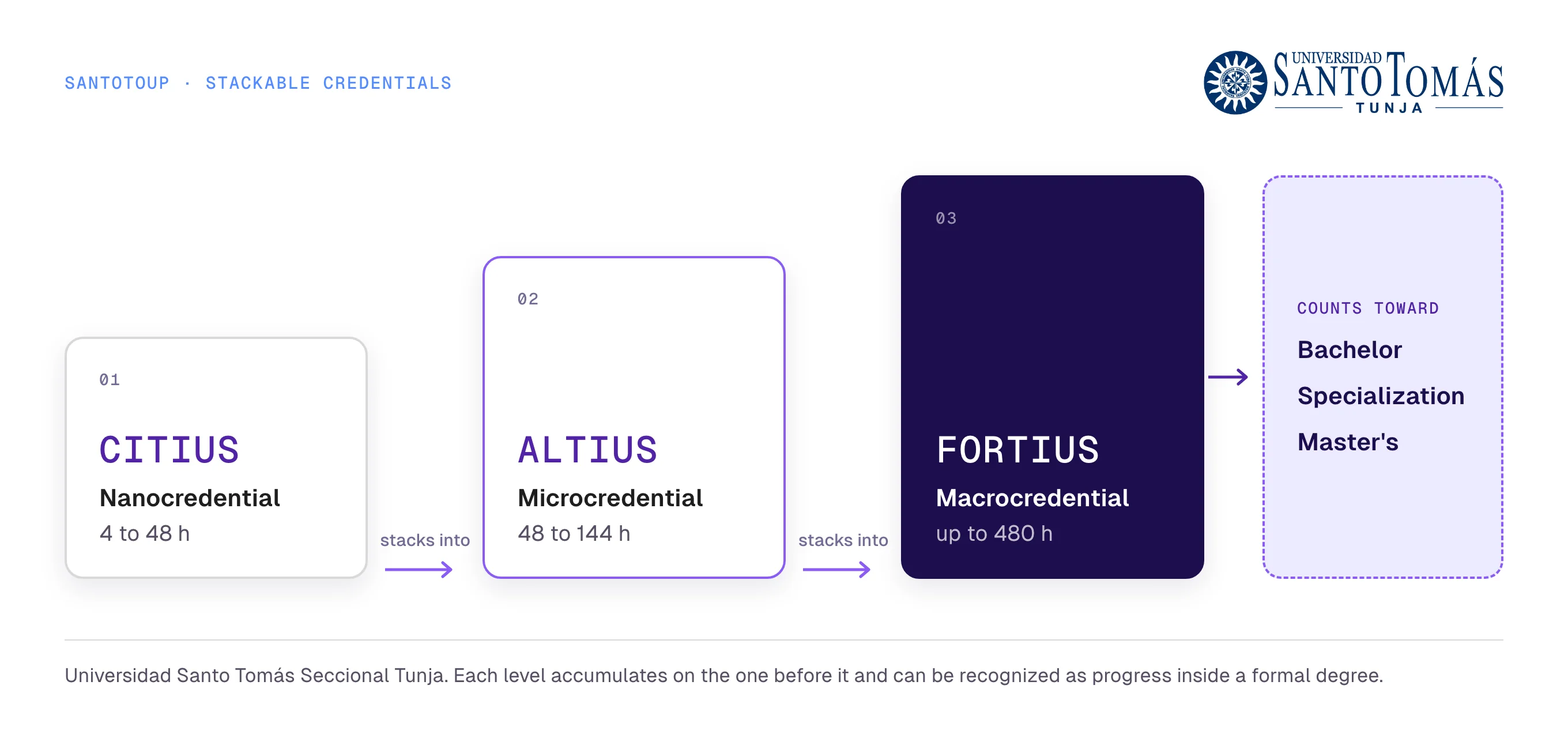
| Level | Hour load | What it is for | How it accumulates |
|---|---|---|---|
| CITIUS nanocredential | 4 to 48 hours | Picking up one specific skill fast, or taking a first step | Counts for credit and stacks into microcredentials |
| ALTIUS microcredential | 48 to 144 hours | Advancing with depth in a field | Maps onto course credit and accumulates alongside CITIUS |
| FORTIUS macrocredential | up to 480 hours | Consolidated training that integrates disciplinary, ethical and impact competencies | Made up of several microcredentials and recognized in programs |
The student journey is deliberately short to explain: browse the catalog and pick the credential that fits your goals, enroll online and move at your own pace, complete it and receive the digital badge plus the official certificate, then use it toward an undergraduate or graduate program and cut time and effort out of the degree. The university also published a credit recognition simulator, so that last part stops being a promise and becomes something a student can project before enrolling.
That simulator is a small detail with a large consequence: it turns recognition into something a student can calculate in advance, instead of something they find out about after the fact.
The institutional procedure that makes the model scale
From the start the university assumed that digital credentials had to answer to precisely defined academic, administrative and quality criteria. So it wrote an institutional procedure covering the whole process: requirement validation, approval flows, generation, publication, custody and verification of every credential.
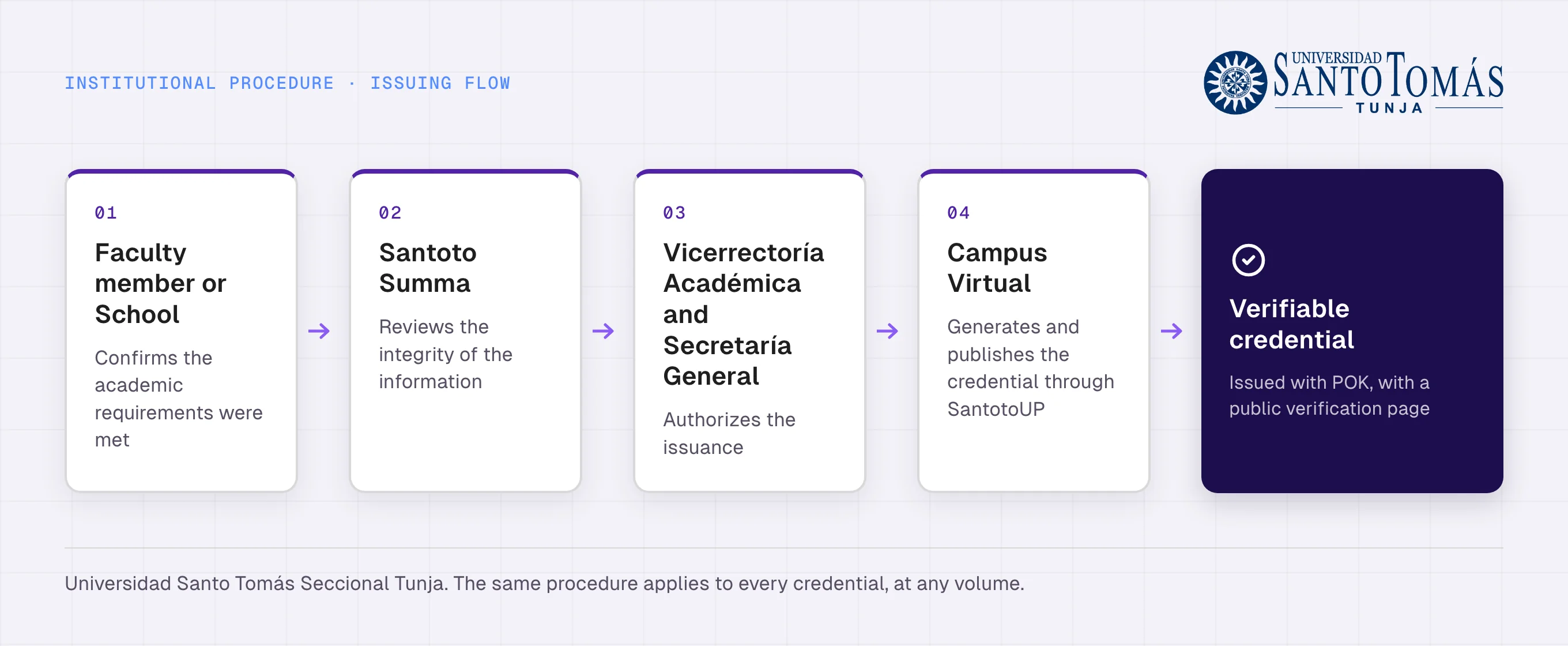
Four steps, four different owners, none of them optional. The faculty member or the school confirms the academic requirements were met. Santoto Summa reviews the integrity of the information. The Vicerrectoría Académica and the Secretaría General authorize the issuance. Campus Virtual generates and publishes the credential through SantotoUP.
Written out like that it reads as bureaucracy. In practice it is the opposite: it is what makes fast issuance possible. When the criteria are settled in advance, each issuance stops being a decision and becomes the execution of a rule, which is why the university can handle high volumes without losing traceability on any single credential.
"For us, the biggest achievement was not adopting a technology tool, but building an institutional model for recognizing learning."
Liliana Mendivelso Melo, Director of Campus Virtual, Universidad Santo Tomás Seccional Tunja
Internal adoption took the work it always takes. There was a process of awareness building and buy-in which, as the team reads it, was less about convincing people than about showing them what they gained by modernizing a process that already existed. After the first credentials went out the argument became unnecessary: recipients found publishing them easy, mostly on LinkedIn, and the interest showed up on its own.
What each credential carries inside
The university describes each badge as a smart medal, and the definition is literal. Each one holds the recipient's name, the competency achieved, the credential type (CITIUS, ALTIUS or FORTIUS), the date, the duration and a public link to verify it.
That is the difference from a certificate of attendance. An employer opening the credential of a Seccional Tunja graduate does not only see that the person did something: they see which competency was recognized, how many hours it took, where it sits in the system and whether it can be accumulated or counted for credit. All of that is structured data rather than prose to interpret, which is why how employers verify digital credentials now looks more like reading a field than asking for a favor.
The credentials are issued with POK under Open Badge 3.0, the open standard that defines how a digital credential is signed and described so anyone can check it without depending on the issuer. Each one carries its own public verification page, so checking it takes no email to the university and no account on any platform: the proof travels with the credential.
What the numbers actually show
They are worth reading for what they are, because the headline figure is not the volume.
- 2 accreditation lines running, with different criteria and their own flows
- 9 certified stackable paths, each with its own definition of levels and credit recognition
- more than 800 credentials issued under the model
Worth spelling out, because the two get mixed up: the digital ID cards for students and graduates of the Seccional Tunja are a separate institutional strategy, with their own scope and their own goals. They are not part of these figures and not part of SantotoUP.
There are universities issuing ten times that many credentials, some of them with no recognition rule behind any of it. What sets the Seccional Tunja case apart is not how much it issued, but that every one of those credentials went through an authorized procedure and enters a system where it can accumulate. Nine certified stackable paths is a hard number to build: it means nine complete agreements on hours, competencies and equivalences.
The fields it already issues in give a sense of the catalog's ambition: governance and public policy, public procurement, cybersecurity, data science, sustainability, leadership and teacher training, among others. These are not filler courses. They are areas where a short, verifiable credential has immediate demand in the Colombian public and private sector.
What changed for the Seccional Tunja
The most visible change is the one people receive. Whoever completes an activity no longer gets a certificate of attendance, but verifiable digital evidence describing the competency achieved, the hour load and whether it can be accumulated or counted for credit. It is a document that says something, instead of one that certifies presence.
The second change is less showy and probably more important: the articulation between levels of education. At most universities, continuing education lives apart from undergraduate and graduate programs, with its own records and no bridges between them. The SantotoUP ladder is that bridge. A nanocredential taken out of professional interest can end up counting inside a master's, and that forces the short-format offering and the formal programs to be designed with each other in mind. It changes the portfolio, not just the paperwork.
The third change is internal. Faculty and staff certify themselves too and adopt the model, so recognition of learning stopped being something the institution hands to students and became a practice that runs through the whole community. And because every credential is unique, verifiable and auditable, the campus has traceability of what it recognizes, credential by credential.
For graduates the effect is more direct still, and that is where the most concrete case in the whole model shows up.
Amnesty 2026: a macrocredential as the way back to a degree
The most concrete use of the model is also the least predictable. During 2026 Universidad Santo Tomás Seccional Tunja opened an amnesty process, an exceptional one-time route: former students of undergraduate or graduate programs who never graduated can re-enroll and complete their degree by meeting the outstanding requirements and completing a SantotoUP macrocredential.
It is worth pausing on what that means. These are people who finished the coursework and never received the degree, often for years. The mechanism that lets them close that chapter is a stackable credential from recent training, academically recognized. Recognition of learning stopped being a line on a résumé and became the entrance to a degree.
No argument about the value of stackable credentials works as well as this one, and it cannot be invented: it requires credit recognition to genuinely exist, with regulation and authorization behind it.
"We would recommend POK because it was a partner in turning an administrative process into an academic strategy for recognizing learning. It let us move from issuing certificates to building an ecosystem of reliable, verifiable digital credentials aligned with our vision of lifelong learning and competency-based education."
Fr. Wilmar Yesid Ruiz Cortés, O.P., Academic Vice-Rector, Universidad Santo Tomás Seccional Tunja
How a model like this gets built
The order in which the Seccional Tunja did things is replicable, and it is nearly the reverse of what usually happens.
- Start by issuing, to learn. Campus Virtual found POK and issued free credentials before any model existed. That made the real value visible, and more importantly it surfaced the questions the institution would have to answer once volume grew.
- Define recognition before scaling. The three levels, the hour load of each and the equivalences toward undergraduate and graduate programs were agreed before the catalog opened, not after someone complained.
- Write the procedure and split the authority. Who validates, who reviews, who authorizes and who issues. With four separate owners, no credential rests on one person's judgment.
- Separate one-off activity from the pathway. Two lines, two logics. A congress should not compete in the same system as a 480-hour learning pathway.
- Make the benefit visible on the other side. The credit recognition simulator and LinkedIn publishing answer the student's actual question, which is not "what standard does this credential use" but "what do I get out of it".
If the institution is still at step zero, the guide to implementing microcredentials at a university covers the start in detail. And for other ways of arriving at the same place, the Universidad Insurgentes case began with teacher training and the Centro Universitario de Guadalajara case with official certificates.
What comes next
The stated purpose is to consolidate an ecosystem where any learning experience can be recognized with interoperable, accumulable, credit-bearing credentials. Next on the list are teacher training, research, innovation, internationalization, student welfare and outreach, which today fall outside almost every recognition system because they do not fit the graded-course format.
That is the real test for a model like SantotoUP: not how many credentials it issues, but how many kinds of learning it manages to bring into the same grammar of recognition. It is the same move we described in the shift from commodity credential to trust infrastructure, seen from inside a university.
The strategy and the current catalog are published at santototunja.edu.co and santotoup.edu.co.
Frequently asked questions
What is SantotoUP?
SantotoUP is the stackable academic credential system of Universidad Santo Tomás Seccional Tunja. It structures learning into three progressive levels, the CITIUS nanocredential, the ALTIUS microcredential and the FORTIUS macrocredential, which accumulate into each other and can be recognized as progress inside bachelor's, specialization and master's programs. The credentials are issued with POK Proof of Knowledge, each with a public verification page.
What is the difference between CITIUS, ALTIUS and FORTIUS credentials?
They differ in hour load and in scope. CITIUS is a nanocredential of 4 to 48 hours aimed at one specific skill. ALTIUS is a microcredential of 48 to 144 hours for advancing with more depth. FORTIUS is a macrocredential of up to 480 hours, built out of several microcredentials, integrating disciplinary, ethical and impact competencies. Each level accumulates on the previous one and all three can count for academic credit.
Can microcredentials count as credit in a degree program?
Yes, when the institution defines the equivalences and the procedure that authorizes them in advance. In the Universidad Santo Tomás Seccional Tunja model, SantotoUP credentials can be recognized in undergraduate courses and in specialization and master's programs, and the university offers a simulator to project that progress before enrolling. The credential technology is not enough on its own: credit recognition is an academic decision that needs regulation.
What does a digital credential issued by Universidad Santo Tomás contain?
Each credential holds the recipient's name, the competency achieved, the credential type (CITIUS, ALTIUS or FORTIUS), the date, the duration and a public link to verify it. It is issued with POK under the open Open Badge 3.0 standard, with a public verification page.
How is the issuance of each credential authorized?
Through an institutional procedure with four steps and four separate owners: the faculty member or school validates that academic requirements were met, Santoto Summa reviews the integrity of the information, the Vicerrectoría Académica and Secretaría General authorize the issuance, and Campus Virtual generates and publishes the credential through SantotoUP. The same procedure applies at any volume.
How many credentials has Universidad Santo Tomás Seccional Tunja issued with POK?
The model reached more than 800 credentials issued, across two accreditation lines and nine certified stackable paths. The relevant figure in this case is not the volume but the structure: every credential goes through an authorized procedure and enters a system where it can accumulate and count for credit.
Related reading
- How to implement microcredentials at a university, step by step
- Universidad Insurgentes success case: microcredentials and an institutional model
- Open Badge 3.0: the complete guide to digital credentials
- The real value of digital credentials: from commodity to trust infrastructure
To see how POK works with institutions across Latin America, take a look at plans and pricing or book a demo.
Last updated: August 13, 2026.
Start recognizing achievements with POK!
Join over 1,100 institutions already issuing verifiable digital credentials with POK. Free plan, no commitment.