Digital Certificates for Conferences: How Universidad Señor de Sipán Reached Its First Microcredential
How to certify conferences, seminars and training at scale. Universidad Señor de Sipán with POK: unlimited web credentials, blockchain only where it earns it.By POK Team
Every year a university issues thousands of certificates almost nobody looks at twice. Conferences, seminars, faculty training: real activities, with real participants, that end up as a file designed by hand and sent out one by one. Universidad Señor de Sipán went after that process before any other, and that is where it found the path to its first microcredential.
Direct answer: to certify a conference at scale you upload the participant list once and generate every certificate in a single process, each one carrying the design and identity of that activity and its own public verification page. What is left to decide is how much technology each credential carries. Universidad Señor de Sipán (USS), in Chiclayo, Peru, issues the digital certificates for the conferences of its four faculties, its Ibero-American Education Summit (Cumbre Iberoamericana de Educación, CIE) and its faculty training this way with POK Proof of Knowledge: unlimited web credentials for everyday activity, and blockchain backing reserved for the institution's first microcredential. The whole effort is coordinated by the Distance Education Directorate (Dirección de Educación a Distancia, DEaD), which works across the Academic Vice-Rectorate, the faculties and the professional schools.
One note on vocabulary, since both words appear throughout this article: what we call a credential here is what most people search for as a digital certificate for a conference. It is the same document. What differs is how it is issued, and that anyone can check it without writing to the university.
Key takeaways
- The bottleneck is not the design, it is the one by one. Producing, sending, storing and validating each document by hand turns recognition into administrative work that grows with every participant.
- The right question was not which platform to buy, but what the academic units actually needed. That produced a four-item list that works as a checklist for any institution.
- Not every credential needs blockchain. USS decides credential by credential: unlimited web issuance for conferences and training, blockchain backing for the experiences that earn it.
- Adoption was won with evidence, not with a mandate. One training program in one unit, one conference in another, and every successful issuance brought in the next.
- The microcredential came later, not first. The everyday volume of events came first, and the jump to recognizing competencies was built on top of it.
The certificate for a conference is the work nobody counts
No university tracks the time it spends on certification. It shows up scattered across the calendars of the wrong people: someone in the academic unit who puts the design together, someone who reconciles the attendance list against the registration list, someone who sends emails for three days, someone who months later fields a request from a participant who lost the file and has to go find it again.
At USS that process worked. The problem was what it cost to sustain. Traditional certification ran on manual hours: designing, producing and sending the certificates one by one, to each participant. On top of that came storing and validating every document, which made participant support slower and more complex than it needed to be.
When a conference draws hundreds of people, the effect is predictable: recognition of learning gets trapped in repetitive tasks. And there is a consequence less visible than the workload. When certifying is expensive in hours, the institution starts rationing: it certifies what it can, not what would be worth certifying. Real training activities go unrecognized because nobody has time to assemble four hundred files.
The manual document also has a limit that more hours cannot fix. A file sent by email proves nothing on its own on the receiving end. Checking it means writing to the university, which turns every verification into a favor.
The four requirements they set before choosing a platform
Before looking at vendors, DEaD asked a question aimed inward: what do the academic units actually need. What came back was a short and fairly demanding list, one that works as a checklist for any institution sitting at the same point, and that reads well next to the general criteria in what to evaluate before choosing a credentialing platform.
It is not a feature table. Each row is a requirement the academic units raised, why it matters in practice, and what breaks if the platform does not cover it.
| What they asked for | Why it matters | What happens without it |
|---|---|---|
| Bulk and personalized issuance, with institutional identity | An Engineering conference and a Graduate School one look nothing alike, yet both need the same process | Either you issue fast and everything looks the same, or you personalize and the manual work returns |
| Online verification, simple and reliable | Whoever receives the credential has to be able to prove it without intermediaries | The institution becomes the permanent help desk for its own certificates |
| A blockchain-based option for what earns it | Not every activity carries the same weight, and the cost should not be the same either | You overpay to certify attendance, or you fall short exactly where it matters most |
| Integration with the university's LMS | The record of who completed the activity already lives inside the campus, no need to re-enter it | A second participant roster appears, maintained by hand, out of sync within the first week |
The first two are what almost every platform promises. The last two are usually what decides the choice, because they determine whether the model survives growth: one puts cost under control, the other keeps issuance from depending on someone exporting a spreadsheet. That last point has a technical discussion of its own, the same one that shows up when issuing verifiable certificates from Moodle: what changes is not where the course runs, but where the proof lives.
"Certification lets us formally recognize the learning and the competencies developed by students, faculty and professionals, in line with our person-centered Educational Model."
Alejandro Cruzata Martínez, Rector, Universidad Señor de Sipán
That the rector is the one saying it explains why the project came out of DEaD and not out of an IT department. USS runs a competency-based educational model, flexible and hybrid. An institution that says it trains for competencies needs its certifications to speak the same language, and a file that only attests presence does not.
Not every credential needs blockchain
This is the most interesting decision in the case, and the one most often misread whenever digital credentials come up.
The discussion tends to be framed as binary: either the institution adopts blockchain or it does not. Framed that way the answer is almost always no, because nobody wants to pay for a cryptographic record on every attendance slip from a two-hour talk. And yet there are credentials where that backing genuinely changes things.
USS did not pick a side. It chose to decide credential by credential.
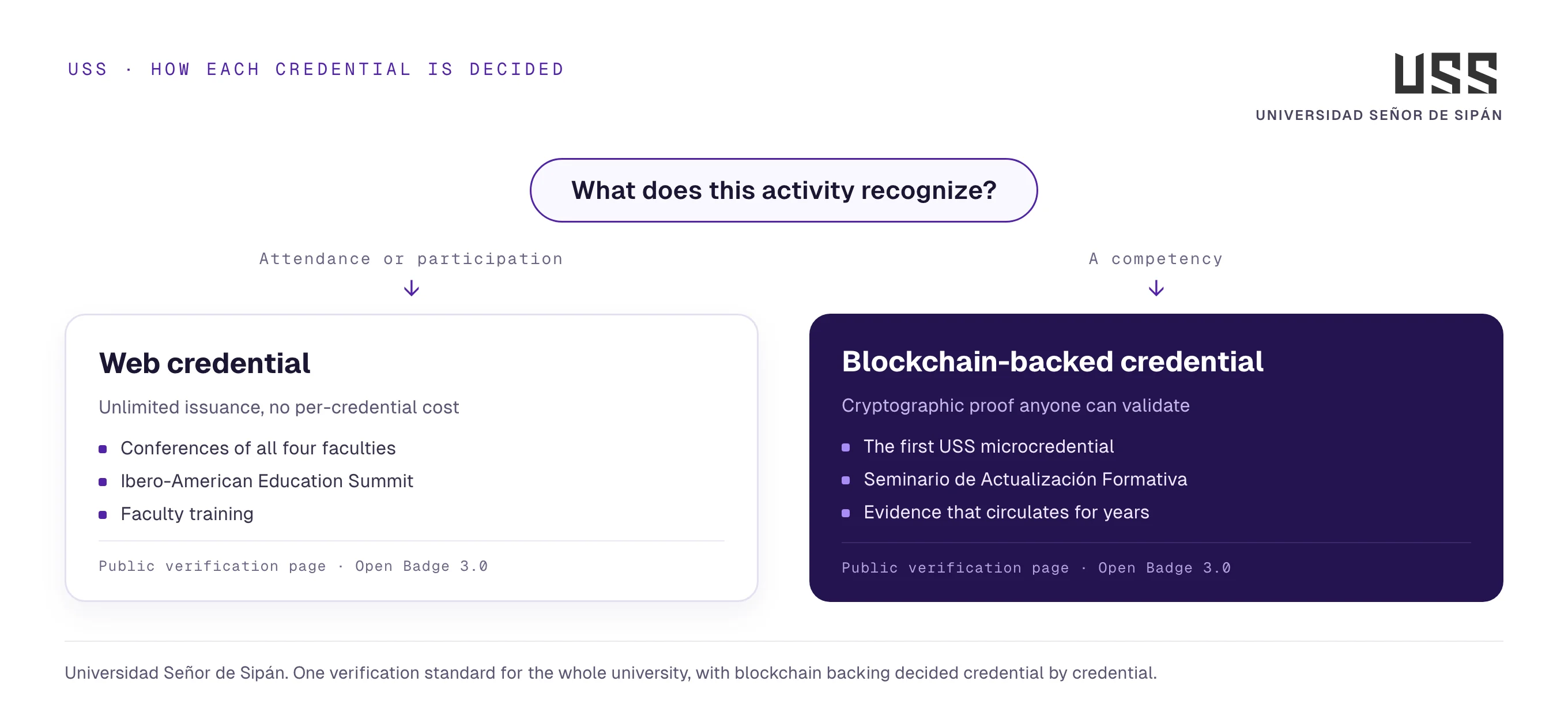
| Type of activity | Model used | Criterion |
|---|---|---|
| Faculty conferences, seminars, faculty training | Web credential, unlimited issuance | High, recurring volume, where what you need is speed and public verification |
| Higher-stakes experiences, such as the first USS microcredential | Blockchain-backed credential | It recognizes a competency, not attendance, and it will circulate for years |
The practical difference is that everyday issuance stops being a budget problem. POK's web credentials are issued with no cap on quantity and no per-credential cost, so certifying a conference of six hundred attendees costs the same as certifying one of sixty. On that footing, blockchain backing stops being a platform decision and becomes an academic one: this experience earns it, that one does not.
Both options share what matters to the person receiving the credential: a public verification page and the open Open Badge 3.0 standard. Blockchain backing adds a cryptographic proof anyone can validate without depending on the issuer, and what that level costs is laid out in the Blockchain Verify guide.
That flexibility had an effect beyond the operational. It let DEaD support different units of the Academic Vice-Rectorate under one shared model of digital certification, without forcing all of them onto the same level of technology. A shared standard that does not flatten each unit's identity.
How adoption happens without a mandate
Getting started internally is usually the hard part of any change, and the part least often told in a success story. At USS adoption was gradual and rested on coordination between DEaD and the units responsible for each activity.
"Rather than forcing a tool on people, the idea was to show what it was good for through concrete cases."
Silvia Sialer Carhuattocto, Director of Distance Education, Universidad Señor de Sipán
The strategy was deliberately unheroic: instead of announcing a new tool for the whole university, demonstrate its usefulness with concrete cases. One training program in one unit, one conference in another. Every successful issuance did the convincing on its own.
There is a reason that beats a mandate. A faculty told to use a platform evaluates the cost of learning it. A faculty that watches the neighboring faculty's conference handled in an afternoon evaluates something else: what it is paying by not using it. Same argument, with the weight on the other side.
Three conditions kept the strategy from staying a set of isolated anecdotes:
- Gradual. No big bang. Scope grew as units joined.
- Coordinated. DEaD as the single point of articulation with each unit, in a university where faculties, professional schools and department heads run on their own timelines and priorities.
- Evidence-driven. Concrete cases that showed the value in practice, ahead of presentations about the value in the abstract.
If your institution is still working out where to start, the step-by-step guide to implementing microcredentials covers the beginning in detail, and the Universidad Santo Tomás Seccional Tunja model shows the opposite route: define academic recognition first, issue afterwards.
What Universidad Señor de Sipán certifies today
The current scope runs across much of the university's academic life:
- Conferences of all four USS faculties: Health Sciences, Business Sciences, Law and Humanities, and Engineering, Architecture and Urban Planning.
- The Ibero-American Education Summit (Cumbre Iberoamericana de Educación, CIE), organized by the Rectorate and the Academic Vice-Rectorate, whose 2026 edition brought rectors and specialists from eight countries to Chiclayo over three days. The full program is on the official Summit site.
- Faculty training, run by the Training Office of the Academic Development Directorate.
It is not a light calendar. In Law, the university is the host and co-organizer of the IX National Congress of Constitutional Procedural Law, together with the Asociación Peruana de Derecho Constitucional, held in Chiclayo from 29 to 31 October 2026. An event of that size used to mean a mailing list and several afternoons of manual work.
The starting point is publicly documented: in its press release of 2 September 2025, USS announced the POK implementation and described a first phase with credentials without blockchain, already in use for participants in conferences from two of its faculties and for faculty in training activities. In that same release the university projected issuing microcredentials for the courses of its Seminario de Actualización Formativa. A year later, that projection came true.
The first microcredential: when a credential stops certifying attendance
During 2026 USS implemented its first microcredential, for the Seminario de Actualización Formativa in Criminalistics, Forensic Sciences and Legal Medicine at the Professional School of Law. It was issued as a verifiable digital credential with blockchain technology.
The change is not one of format. A conference certificate says someone was there. A microcredential says what that person is able to do, which is why it has to name the competency, its scope and who stands behind it. That is the difference between a document for the personnel file and evidence that works in a job application, which is exactly how employers verify credentials today.
For the university it also settled an internal question: whether the platform they were using for events could support academic offerings of greater scope. The answer was yes, and that unlocked the rest of the plan.
The order matters, and the usual advice runs the other way. USS did not start with the microcredential. It started with the everyday volume, the conferences and the training programs, where the pain was immediate and the risk low. By the time it came to certifying a competency, the circuit was already proven, the units already knew how to use it, and nobody had to argue about the tool. The only thing left to discuss was the academic side, which is the discussion that belongs there.
From a certificate of participation to evidence that circulates
The main impact was turning certification into digital evidence with real use value. The credential stopped being a file you save and forget, and became something that actually circulates.
The person who receives it gets it quickly, keeps it without depending on anyone, and shares it far more easily. For students and faculty it is a more accessible and more reliable way to evidence their training, inside and outside the classroom. The university is strengthening the guidance so that students, faculty and participants know how to add their credential to LinkedIn and get professional value out of it, which is the step that makes recognition work for the person carrying it.
"We turned certification into digital evidence with greater use value: for USS, it is a way of showing our commitment to innovation and to recognizing competencies."
Erick Salazar Montoya, Academic Vice-Rector, Universidad Señor de Sipán
On the institutional side the effect is consistency. Credentials from different faculties keep the identity of each unit and of the conference or course behind them, yet all of them verify under the same standard, each with its own public page and unique code. A university with four faculties and a permanent events calendar now has, for the first time, a single answer to how what it issues can be checked.
How to certify a conference at scale, step by step
The order USS followed is the one that holds up best when you have to convince units that do not report to you.
- Start with the process that hurts most and risks least. Certificates of attendance for events are the obvious candidate: high volume, simple criteria, visible impact within a week.
- Ask inward before looking at platforms. The academic units' list of requirements is what later lets you compare options without arguing about features nobody will use.
- Separate cost from criteria. With unlimited bulk issuance as the baseline, deciding what gets blockchain backing stops being a budget negotiation and becomes an academic decision.
- Add units through evidence. One successful, visible issuance convinces more than a memo. Pick a unit with a big event close on the calendar first.
- Only then move up a step. The microcredential, the learning path and the badge rest on a circuit that already works. Doing it the other way around forces you to solve the technology and the academic recognition at the same time.
What comes next
The university's roadmap points toward extending the model to continuing education courses, diplomas and badges tied to the progressive development of competencies. In other words, supporting the full trajectory and not only isolated milestones.
Within the digital ecosystem USS has been building with various platforms and tools, POK holds a precise place: the issuance, management and verification of credentials. The asset that makes the rest possible is less technological and harder to copy: a directorate that works across the Academic Vice-Rectorate, the faculties, the professional schools and the Training Office, and that can therefore bring digital recognition to students, faculty, graduates, professionals and external audiences under one shared criterion.
"We would recommend POK because it turns learning achievements into verifiable digital credentials, easy to manage and adaptable to the different kinds of academic activity a higher education institution runs."
Silvia Sialer Carhuattocto, Director of Distance Education, Universidad Señor de Sipán
Frequently asked questions
How do you issue digital certificates for a conference?
You issue them by uploading the participant list once and generating every credential in a single process, with the design and institutional identity of that activity, instead of assembling and sending each file separately. Every participant receives their credential with its own public verification page, so the institution does not have to answer queries to confirm it. Universidad Señor de Sipán issues the credentials for the conferences of its four faculties, its Ibero-American Education Summit and its faculty training this way, with POK Proof of Knowledge.
Can credentials be issued in bulk and personalized at the same time?
Yes, and it was the first requirement on Universidad Señor de Sipán's list. Personalization does not happen credential by credential but activity by activity: each conference, course or training program has its own design and institutional identity, and within that activity issuance is bulk. That is how a single verification standard for the whole university coexists with the distinct character of each faculty or professional school.
Does every digital credential need blockchain?
No, and treating the decision as binary is what keeps many institutions from moving at all. It is better decided credential by credential: for high-volume, recurring activities such as conferences and training, a verifiable web credential is enough, and in POK those are issued with no cap and no per-credential cost. Blockchain backing is justified when the credential recognizes a competency and will circulate for years, as happened with Universidad Señor de Sipán's first microcredential.
What is the difference between a certificate of participation and a microcredential?
A certificate of attendance, also called a certificate of participation, attests that someone was present at an activity. A microcredential attests a competency: it names what the person is able to do, its scope and who stands behind it, which is why it reads as evidence in a job application. Both can be issued as verifiable digital credentials, but only the second says something about the learning. USS walked that path in that order: events first, then the microcredential for the Seminario de Actualización Formativa in Criminalistics, Forensic Sciences and Legal Medicine.
How do you get academic units to adopt digital credentials?
By showing results before tools. Universidad Señor de Sipán did not impose the platform: the Distance Education Directorate supported concrete cases, one training program and one conference at a time, and each successful issuance became the argument for bringing in the next unit. Three conditions hold that strategy together: gradual growth with no mass launch, a single point of articulation with each unit, and practical evidence instead of presentations.
Can digital credentials be integrated with the university's LMS?
Yes, and it is one of the four requirements Universidad Señor de Sipán defined before choosing a platform. Integrating with the virtual campus avoids maintaining a second participant roster in parallel spreadsheets, because the record of who completed the activity already lives in the LMS. POK integrates with Moodle, Blackboard, Canvas and other platforms over LTI 1.3 and API.
What credentials does Universidad Señor de Sipán issue with POK?
Today it issues attendance credentials for the conferences of its four faculties, for the Ibero-American Education Summit (Cumbre Iberoamericana de Educación, CIE) organized by the Rectorate and the Academic Vice-Rectorate, and for the faculty training run by the Training Office of the Academic Development Directorate. During 2026 it added its first microcredential, with blockchain technology, for the Seminario de Actualización Formativa in Criminalistics, Forensic Sciences and Legal Medicine at the Professional School of Law. The roadmap includes continuing education, diplomas and badges.
Related reading
- How to implement microcredentials at a university, step by step
- Blockchain verification: what it costs and when it is worth it
- Stackable microcredentials that count for academic credit: the Universidad Santo Tomás Seccional Tunja model
- How to issue verifiable certificates from Moodle
- Verifiable records for workshops and conferences at Universidad de Guadalajara
- How employers verify digital credentials
To see how POK supports institutions across Latin America and beyond, take a look at the plans and pricing or book a demo.
Last updated: 21 September 2026.
Start recognizing achievements with POK!
Join over 1,100 institutions already issuing verifiable digital credentials with POK. Free plan, no commitment.