Can You Trust an AI-Written Résumé? Why Verifiable Credentials Are Hiring's New Proof of Truth
Can you trust an AI-written résumé? AI can fake a CV, a LinkedIn profile, even interview answers. A verifiable credential is proof that can't be faked.By POK Team
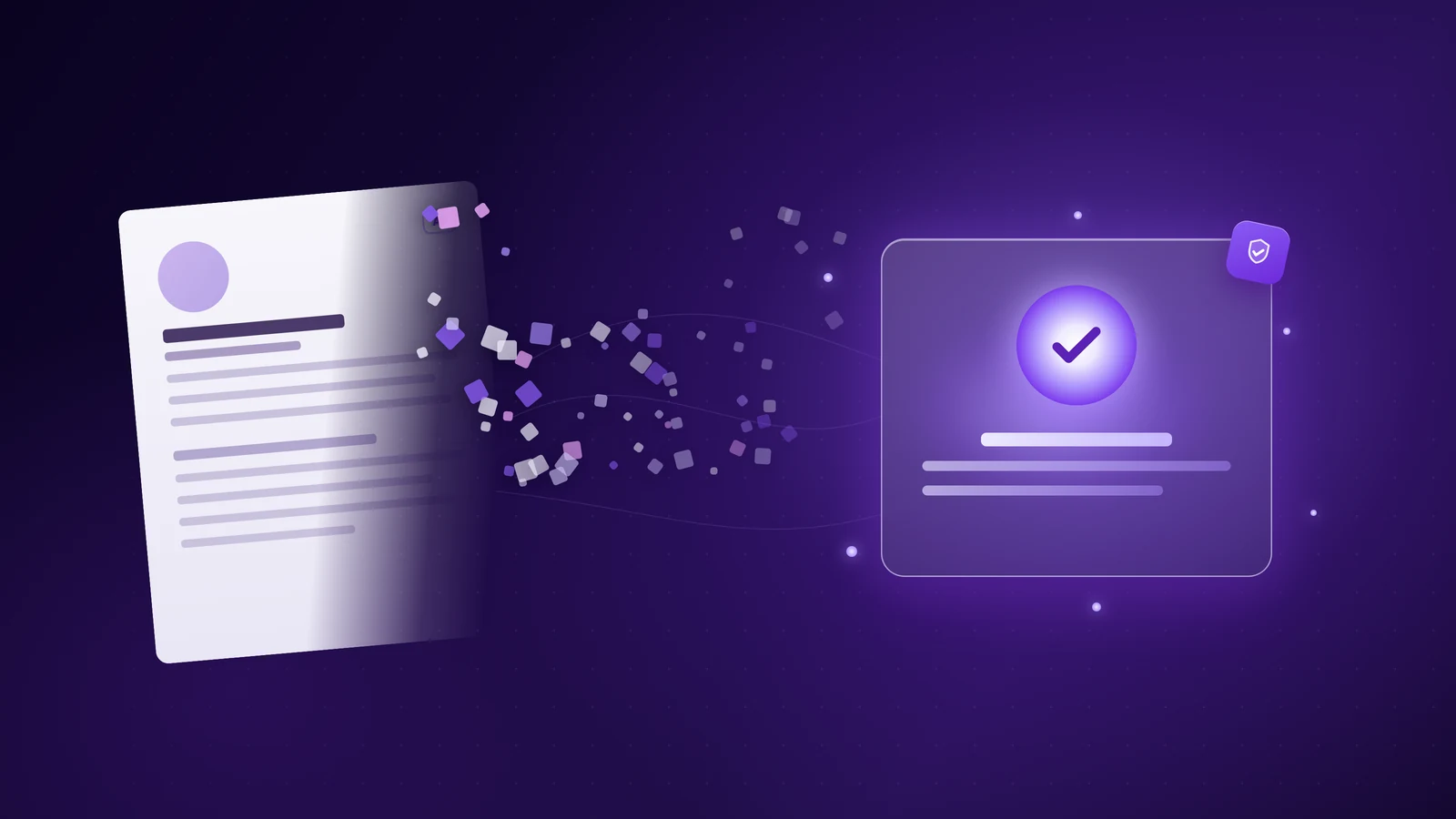
Can you trust a résumé written with AI? Not on its own. In 2026, generative tools can produce a polished CV, a convincing LinkedIn profile, even coached answers in a live interview, in seconds. The only signal that still holds up under scrutiny is a verifiable credential: a claim cryptographically signed by the institution that actually issued it, one that can't be inflated, copied or faked.
Direct answer: No, not without independent proof behind it. Generative AI can produce a flawless résumé, a believable LinkedIn history and coached answers read live off a second screen, so a candidate's self-reported claims stopped being evidence a while ago. What AI cannot fabricate is a credential cryptographically signed by the institution that actually issued it: a verifiable credential names a real issuer, binds to a real recipient, and can be checked independently of both. That's the shift POK - Proof of Knowledge has been building toward: credentials as trust infrastructure, not paperwork. For employers, the practical response is to stop trusting the résumé and start checking the credential behind it.
Key takeaways
- AI generates polished claims, not proof: a flawless résumé, LinkedIn profile or interview answer no longer signals real ability, because generative tools can produce all three convincingly in minutes.
- Traditional verification can't keep pace: calling a registrar or running a manual background check is slow and costly enough that most claims on most résumés go unchecked at any real hiring volume.
- A verifiable credential is signed, not self-reported: it carries the issuing institution's cryptographic signature and can be checked on a public page, or on-chain, without contacting anyone.
- Verifiability is a spectrum: Open Badges 3.0 is the baseline for every POK credential, Blockchain Verify adds an independent cryptographic hash, and NFT credentials add full on-chain ownership.
- POK issues verifiable credentials free, is ISO 27001 and SOC 2 certified and a 1EdTech-certified Open Badges 3.0 issuer, trusted by 1,100+ institutions across 19 countries, making verified proof the default instead of the exception.
Why AI Made the Résumé Impossible to Trust
Ask a recruiter what changed since 2024, and most give the same answer: everything got easier to fake, including the parts that used to take real effort.
A résumé used to cost something: tailoring a cover letter, phrasing years of work into convincing bullet points, matching a job posting's language. Time was a rough proxy for effort, and that proxy is gone. A candidate now pastes a job listing into a generative tool and gets back a résumé retuned to that exact posting, keywords included, in under a minute. The same trick runs fifty times for fifty postings, at close to zero marginal cost.
The LinkedIn layer moved just as fast. The specific, personal-sounding phrasing recruiters once read as a soft signal of competence can now be generated on demand, because generative models are good at exactly that: sounding specific without being true. Fabricated profiles with invented histories and AI-generated headshots are common enough that platforms now run detection systems against them.
The interview was supposed to be the backstop, the stage that required thinking in real time. It isn't anymore. Browser-based AI copilots sit through a video call, listen to the question, and feed the candidate an answer to read off a second screen. In 2022, the FBI's Internet Crime Complaint Center warned of candidates using deepfake video and voice, combined with stolen personal information, to interview for remote IT and software roles, citing mismatched lip movement and audio as a telltale sign. None of this takes special skill, just a laptop and a second screen.
Put an AI-tuned résumé, an AI-polished profile and AI-coached answers in the same funnel, and the result is an arms race: recruiters now run their own AI tools just to filter the flood of AI-written applications, and neither side actually verifies anything.
The Signals Employers Relied On No Longer Prove Anything
SHRM has long flagged the cost of a bad hire as one of the most expensive, and most avoidable, mistakes in HR, which is exactly why the signals employers screen on matter: a résumé describing the work, a certificate naming the credential, an interview testing how someone thinks under pressure. None of those proxies were perfect, but they used to be hard enough to fake that most candidates didn't bother, so employers extended a reasonable benefit of the doubt.
That trade-off breaks the moment faking a proxy costs nothing. A résumé is a claim, not evidence. Anyone can write one that sounds accomplished regardless of what they actually did.
A PDF certificate is worse. Editing a name, a date or a grade in any image editor has always been trivial, and the file carries no built-in way to confirm the institution named on it actually issued it, or still exists. That is how most fake certificates and forged diplomas are made: a genuine-looking template, lightly edited.
An interview answer, once the strongest signal because it demanded thinking on the spot, loses that value the moment an AI tool can generate the same answer for the candidate.
The traditional fallback is direct verification: call the registrar, email a previous employer's HR department, run a check through a background screening vendor. This is what education verification and employment verification still look like for most employers: manual, one candidate at a time, and slow. All of that still works, in principle, but it's expensive enough that most employers reserve it for finalists, if they do it at all. A registrar takes days to respond, assuming anyone responds; a small or foreign institution may have no one who answers that line; a screening vendor charges per candidate and adds a week to the process. None of it scales to a funnel with hundreds of applicants per role, so most claims on most résumés simply go unchecked.
That's the real gap AI widened. It didn't invent résumé exaggeration. It removed the cost that used to keep exaggeration in check, while verification stayed exactly as slow and manual as it's always been.
What Makes a Verifiable Credential Impossible to Fake
A verifiable credential isn't a nicer-looking certificate. It's a different kind of object, built so trust doesn't rest on anyone's word, including the platform that issued it.
| Résumé or PDF certificate | Verifiable credential | |
|---|---|---|
| Where it comes from | Self-reported by the candidate | Cryptographically signed by a verified issuer |
| Tampering | Trivial to edit, hard to catch | Mathematically detectable |
| How you verify it | Call or email the issuer, wait days | Instant and independent, from a public page or on-chain |
| What it is | A static file (PDF, image, text) | A standards-based record (Open Badges 3.0, W3C VC) |
| Who holds it | Whoever sends it | Owned by the recipient |
What actually gets checked
Four properties do the real work, and none of them exist in a résumé, a PDF, or a LinkedIn profile.
- The issuer's identity is checked before it can issue anything. On POK, an organization proves domain ownership through a DNS record, its official LinkedIn presence, and an internal review that includes KYC, before issuing a single credential. The issuer's name isn't self-declared.
- The credential carries a cryptographic signature, not just a claim. Under Open Badges 3.0 and the W3C Verifiable Credentials data model, the credential's data is signed at issuance. Change any field and the signature breaks: tampering becomes mathematically detectable, not just against the rules.
- Anyone can verify it without contacting the issuer. A public verification page, or the credential's own machine-readable data, tells an employer everything a phone call to the registrar used to, in seconds.
- The recipient owns it. A verifiable digital credential belongs to the person who earned it, not the platform hosting it, so the credential a candidate presents is the exact one issued at completion, not something edited afterward.
A language model can write a paragraph that looks like a certificate. It can't forge a signature from an institution whose keys it doesn't hold, or manufacture an issuer identity that already passed a KYC check months before the résumé was written. For the full technical picture, see Open Badge 3.0: The Complete Guide to Digital Credentials.
The baseline: Open Badges 3.0 and W3C Verifiable Credentials
Every credential POK issues, including everything on the free plan, is signed, standards-based and independently checkable on a public page, already more proof than a PDF and a LinkedIn line ever offered.
One level up: Blockchain Verify
Blockchain Verify adds an independent cryptographic layer on top. POK hashes each credential and batches many into a Merkle tree, anchoring only the root on public blockchain under the open Blockcerts standard. Each credential keeps a Merkle proof tying it back to that root, so one on-chain transaction certifies thousands at once, and the recipient can download the credential's Blockcerts file and validate it in any compatible tool, with POK's own servers out of the loop. The proof lives on-chain, permanently.
The strongest signal: NFT credentials
NFT credentials sit at the top of the spectrum. The credential itself is minted as a token on public blockchain (Polygon or LACNet) and owned by the recipient in their own wallet, not rented from a vendor's server. Its metadata (issuer, credential name, issue date) lives on-chain, and the certificate image and template sit on IPFS rather than a private database. An employer can look the token up on a public block explorer with no POK account and no cooperation from anyone. It's a credential that can outlive the company that issued it.
None of these three levels ask an employer to trust the candidate's description of what happened. They ask the employer to check a signed, traceable record of what an accountable third party says happened, and let anyone confirm that record independently.
From Self-Reported Claims to Verifiable Evidence
Once a credential is signed instead of self-reported, the way it gets checked changes, and it fits how hiring actually runs today.
The first shift is speed. A recruiter no longer takes a claim on faith or starts a multi-day verification process. They open the credential's public page, or scan its QR code, and get an answer in seconds: who issued it, who it belongs to, and whether anything has changed since. How employers verify digital credentials in practice looks more like checking a boarding pass than running an investigation.
The second shift is scale. Because credentials under Open Badges 3.0 and W3C Verifiable Credentials carry structured, machine-readable metadata, an applicant tracking system can pull the issuer, the skill, the date and the verification status straight from the data, and flag anything that doesn't check out, automatically, across every application in the funnel.
The third shift is cost. Bulk verification of blockchain-backed credentials doesn't require contacting a single issuing institution, which is exactly the bottleneck that made manual verification impractical at scale. An employer hiring for fifty roles a month can check every credential on every résumé that includes one, not just the credentials attached to finalists.
None of this replaces judgment. An employer still has to decide who fits the role, run the interview, and weigh experience a credential doesn't capture. What changes is the input feeding that judgment: actual evidence of what an accountable institution says a person completed, instead of AI-generated claims about what that person knows. That is what skills verification looks like when the evidence is signed at the source instead of self-reported.
Trust Infrastructure for an AI-Driven Job Market
Step back from résumés specifically, and the pattern is familiar from every other field generative AI reached first: once content becomes infinite and free to produce, the market stops rewarding the content and starts rewarding whatever can prove the content is real.
It happened to writing, when anyone could generate a fluent article in seconds and publishers started asking who actually stands behind it. It happened to images, when the real question became provenance rather than quality. Hiring is going through the same shift later than most, because a résumé was always a piece of writing pretending to be evidence, and now the pretending part is free.
Getting better at detecting AI-written text isn't a durable answer, because detection is a losing race against generation: every improvement gets absorbed into the next model within months. What holds up is building the layer underneath the claims: a way for a real institution to vouch for a real fact about a real person, checkable independently of the institution, the candidate, or the platform that issued it.
That's the same argument behind the shift from commodity credentials to trust infrastructure: a basic badge stopped being valuable once it became trivial to produce, and the real value moved to a layer that's verifiable, owned by the person who earned it, and traceable over time. AI-written résumés are the hiring side of the same problem. The résumé got easy to fake first. The credential behind it is the part that still has to hold up.
How POK Makes Verified Proof the Default
None of this works if verified credentials stay rare or expensive. A trust layer only a handful of elite institutions can afford doesn't fix the hiring market; it just creates a two-tier one, where verification becomes a privilege instead of the default.
That's why POK issues standards-based digital credentials free, with no limit on volume. Every credential, from the free plan up through Blockchain Verify and NFT ownership, is issued under Open Badges 3.0 and W3C Verifiable Credentials, carries a public verification page, and comes from an issuer whose identity was checked before it issued anything. Institutions that want an independent cryptographic proof can add Blockchain Verify. Institutions that want learners to fully own the credential, on-chain, for life, can issue NFT credentials.
POK is ISO 27001 and SOC 2 certified and a 1EdTech-certified Open Badges 3.0 issuer, certified by the same body that maintains the standard itself. More than 1,100 institutions across 19 countries already issue through POK, with over 1.5 million credentials in circulation, each one checkable in seconds by any employer who takes the time to look.
Explore POK pricing or schedule a demo to see how verifiable proof replaces the self-reported résumé, end to end.
Frequently Asked Questions
Can employers tell if a résumé was written by AI?
Not reliably. Detection tools that claim to spot AI-written text keep losing ground as generative models improve, and AI-assisted writing isn't against any rule, so suspicion alone isn't actionable. The more useful question isn't whether the writing was AI-generated, but whether the specific claims in it (the degrees, certifications and skills listed) can be independently verified.
Can AI fake or forge a digital credential?
No, not a properly verifiable one. AI can generate an image that looks like a certificate, but it can't forge the cryptographic signature of an issuer whose identity was checked before it issued anything, and it can't fabricate a record that a public verification page or an on-chain proof will confirm as genuine.
What is a verifiable credential and why can't it be faked?
A verifiable credential is a digital record, typically built on Open Badges 3.0 and the W3C Verifiable Credentials standard, cryptographically signed by a verified issuer and bound to a specific recipient. Checking it doesn't depend on trusting the document itself: any employer can confirm its authenticity independently, through a public page or, for blockchain-backed credentials, an on-chain proof that exists whether or not the issuer can be reached.
How can employers verify a candidate's skills in the age of AI?
By asking for evidence that's independently verifiable instead of self-reported. A digital credential issued under open standards can be checked in seconds from its public page or QR code, read automatically by an applicant tracking system, and, when blockchain-backed, confirmed in bulk without contacting the issuing institution at all.
Are verifiable credentials replacing the résumé?
Not entirely, but they're taking over the part that needs to be true. A résumé still tells the story of a career and shows judgment and context a credential doesn't capture. What verifiable credentials replace is the résumé's role as evidence: the specific, checkable claims about degrees, certifications and skills that used to rest on the reader's trust.
Should employers reject AI-written resumes?
Rejecting a résumé just because it was written with AI is neither practical nor fair: detection is unreliable, and using AI to draft an application is now normal. The productive move is to stop treating the résumé as proof and start asking for evidence that can be checked. A candidate who backs their claims with verifiable credentials has given you something an AI-written document never can, which is proof you can confirm at the source.
Related Reading
- How Employers Verify Digital Credentials
- The Real Value of Digital Credentials: Commodity vs Trust Infrastructure
- Blockchain Credential Verification Cost: How POK's Blockchain Verify Works
- NFT Digital Credentials: Verification, Ownership and Trust
For more on résumé fraud, AI in hiring and verifiable credentials, visit our blog.
Last updated: July 28, 2026.
Start recognizing achievements with POK!
Join over 1,100 institutions already issuing verifiable digital credentials with POK. Free plan, no commitment.